Anonymised data and AI: the legal position in Switzerland
Anyone who wants to analyse patient or customer data with an AI model needs to know whether the data still counts as personal data. That determines what the revFADP, professional secrecy or tax secrecy require. The article explains the legal position in Switzerland. Six questions help you assess your own project.
Guide · Published 11 Nov 2026 · Updated 12 Nov 2026 · Joel Barmettler
May I pass pseudonymised data to an AI model in the US?
Often yes, under conditions. If a company only replaces the names with codes and keeps the key, the data remains personal data for the company itself: the company needs a contract with the provider and, for the US, usually standard contractual clauses. If the recipient cannot identify anyone with reasonable effort, the data does not count as personal data for that recipient, according to the Dispatch on the revFADP. The courts have not settled this.
An example that runs through this series: a family practice in the Knonaueramt wants to analyse its patient data with an AI model in the US, such as ChatGPT or Claude. The practice and its patients are invented; the population figures from the Federal Statistical Office (BFS) are real. Beforehand, the practice replaces the names with codes. The patient from the first part, Hildegard Kaufmann, 87, from Maschwanden, then appears in the table as “P-0001”, with date of birth, municipality of residence and the diagnosis heart failure. The practice keeps the list that matches codes to names to itself. This technique is called pseudonymisation. The first part of this series showed how little pseudonymisation protects on its own: in Switzerland, 72 per cent of residents can already be uniquely identified by date of birth, sex and municipality of residence. In Maschwanden, with 669 residents, Hildegard Kaufmann is the only woman born in 1939.
What does the law require before such a database is passed to a cloud model, an external development team or an AI agent? The question arises in the same way for a company’s customer data. For the practice, there is more: under the Data Protection Act, health data counts as sensitive. Doctors are also bound to confidentiality under Art. 321 of the Swiss Criminal Code. The answer has several layers. The Data Protection Act defines what personal data is and whom the act protects. The act also governs who decides on passing data on. For some data, secrecy obligations apply that go further than the Data Protection Act. For public authorities, cantonal law comes on top. This article goes through the layers in order and ends with a decision path you can use to work through your own case.
What the law counts as personal data
The revised Federal Act on Data Protection, revFADP for short, defines personal data as “any information relating to an identified or identifiable natural person”.[1] A person is identified when their name appears alongside the information. A person is identifiable when it is possible to find out who is meant. Anonymisation is about exactly this identifiability.
Since 1 September 2023, the law applies only to natural persons. The old Data Protection Act also protected companies. The Dispatch on the revision states expressly that the new law is “no longer applicable” to legal entities.[2] A table with the revenue of business customers therefore does not fall under the revFADP. The column with the name of the contact person does.
Anonymised data does not fall under the law. The FDPIC describes anonymisation in the legal sense as follows: personal data is altered “irreversibly” in such a way that it “allows no conclusions to be drawn about a specific person without disproportionate effort”.[3] The law itself also requires anonymisation, for example as soon as data is no longer needed for its purpose (Art. 6(4)).[1]
Souverana is not a law firm. This article assesses the legal position and does not replace legal advice. The quotations have been checked against the original texts, as of November 2026; quotations from German-language sources are our translation.
Identifiable to whom: it depends on the recipient
Whether a person can be identified also depends on who holds the dataset and what else that holder knows. The graphic shows this with the pseudonymised patient list of the invented family practice. Row P-0001 is Hildegard Kaufmann. Choose a point of view and the precision of the attributes the recipient receives. The coarser the attributes, the more real women fit the row. At the same time, the analysis becomes less precise, for example per municipality.
The Federal Supreme Court stated this in 2010 in the Logistep case. The company Logistep had collected the IP addresses of file-sharing users and passed them on to rights holders. Identifiability is to be assessed “from the point of view of the respective holder of the information”, the court wrote. And: “If the effort is so great that, according to general life experience, one need not expect an interested party to undertake it, there is no identifiability.” Besides the effort, the interest someone has in the identification also counts. In the specific case, the court found the users identifiable: Logistep itself could not identify the users, but the rights holders could once the data had been passed on. The Federal Supreme Court has not decided the reverse case, in which only the sender holds the key.[4]
For that case there is another source: the Federal Council’s Dispatch on the revFADP. The Dispatch states that the law does not apply to anonymised data if re-identification by third parties is impossible or “would only be possible with great effort that no interested party would undertake. This also applies to pseudonymised data.” For research, planning or statistics, the Dispatch calls the procedure in which the sender passes on pseudonymised data and keeps the key “de facto anonymisation”.[2] The Dispatch explains the law, but it does not bind the courts.
In the EU, the Court of Justice decided a similar case in September 2025. The Single Resolution Board (SRB), an EU authority, had passed pseudonymised comments to the consultancy Deloitte. The court held that pseudonymised data is not personal data in every case and for every person. The condition is that the recipient cannot reverse the pseudonymisation and cannot find the people through other attributes either. For the SRB as sender, however, the data remained personal data. The SRB’s duty to inform the data subjects about Deloitte as recipient therefore applied regardless.[5]
The supervisory authorities apply a stricter standard than the Dispatch. In its 2024 guide on technical measures, the FDPIC writes that with pseudonymised data “the risk of re-identification still exists” and that such data “therefore still counts as personal data”. The FDPIC does not address the recipient’s perspective in that guide.[3] The European Data Protection Board (EDPB) states the same in its draft guidelines on pseudonymisation of January 2025, even where data and key are held by different bodies.[6] The EDPB’s draft on anonymisation of July 2026, by contrast, follows the Court of Justice and assesses anonymity from the perspective of the respective recipient.[7]
The timeline shows how the legal position has developed.
Federal Supreme Court in the Logistep case
Identifiability is assessed from the perspective of whoever holds the data. When data is passed on, it is enough that the recipient can identify the people.
Dispatch on the revFADP
Pseudonymised data does not fall under the law if re-identification would only be possible with an effort that no interested party undertakes.
Official secrecy covers auxiliary persons
Art. 320 of the Swiss Criminal Code expressly also applies to auxiliary persons of public authorities.
revFADP in force
The Data Protection Act now protects only natural persons; company data is no longer covered.
FDPIC guide
The FDPIC continues to treat pseudonymised data as personal data.
Swiss-U.S. Data Privacy Framework
Certified US companies count as recipients with adequate protection.
Court of Justice of the EU in the SRB case
Pseudonymised data is not personal data for every recipient. The sender keeps its duty to inform.
Resolution of the cantonal data protection commissioners
For public authorities, secret data in international cloud services is impermissible in most cases, unless the authority encrypts the data itself.
Final versions of the EDPB guidelines
The drafts on pseudonymisation of January 2025 and on anonymisation of July 2026 have not yet been adopted.
In practice, this means: the approach that looks at the recipient is defensible in Switzerland as long as the company can substantiate it. No court has settled this approach for this situation. Anyone who relies on it must be able to show that the recipient cannot identify anyone with reasonable effort. The first part of this series showed how quickly date of birth and place of residence disprove the assumption that the recipient cannot identify anyone.
Who decides on passing data on
The revFADP distinguishes two roles. The controller is whoever decides on the purpose and means of a processing, usually the company whose customers are in the database. The processor is whoever processes personal data on behalf of the controller: the software house, the AI integrator, the cloud provider.
Art. 9 of the revFADP sets narrow limits for the processor. The processor may process the data only in the way the controller itself would be permitted to. The processor may engage a further third party only with the prior approval of the controller.[1]
This leads to a rule that project teams easily overlook. A development team that receives a copy of the customer database may not decide on its own to pseudonymise the data and give the data to an AI model. Pseudonymising is itself processing of personal data. Whether the result is sufficiently anonymous for the recipient is best judged by whoever knows the rest of the data and the purpose. The controller can delegate the work. The decision and the responsibility stay with the controller.
Where secrecy obligations are stricter than the Data Protection Act
For part of the data, other laws go further than the revFADP. Official secrecy (Art. 320 of the Swiss Criminal Code) and professional secrecy (Art. 321 of the Swiss Criminal Code) apply alongside the revFADP.[8] So do banking secrecy (Art. 47 of the Banking Act) and tax secrecy (Art. 110 of the Federal Act on Direct Federal Taxation, DBG, and Art. 39 of the Tax Harmonisation Act, StHG).[9–11] Art. 9 of the revFADP expressly prohibits handing data to a processor where a statutory or contractual duty of confidentiality stands in the way.[1]
What this means for law firms, medical practices and fiduciaries is set out in the article on professional secrecy: what is protected is whatever was entrusted to the professional or whatever the professional perceived in the course of their profession. Anyone who wants to pass such data to a service provider needs consent or additional contract clauses. For the family practice from the introduction, professional secrecy applies in addition to the revFADP: the doctor learned of Hildegard Kaufmann’s diagnosis during a consultation. For official secrecy, the legislator expressly anchored the auxiliary persons of public authorities in the law in 2023. A service provider working as an auxiliary person of a public authority is therefore itself subject to official secrecy. However, not every provider can be engaged as an auxiliary person, as the cantonal data protection commissioners expressly point out.[12]
The difference from the revFADP shows most clearly with company data. Tax secrecy obliges the persons entrusted with enforcing the tax laws to remain silent “about facts that come to their knowledge in the exercise of their office”.[10] The wording is not limited to natural persons. Tax secrecy therefore also covers information about companies, such as the profit, capital and shareholdings of a company limited by shares (AG), even though the Data Protection Act has not protected companies since 2023. Exceptions apply only where federal law or cantonal law provides for disclosure.[11] A tax office that wants to analyse tax assessments with AI must therefore also protect the company data.
Neither the law nor the Dispatch expressly answers whether passing on pseudonymised data discloses a secret. Anyone who wants to analyse such data with AI should have this question reviewed by a legal professional before the first export. This also applies to the family practice before the pseudonymised patient list goes to an AI model.
Public authorities: cantonal law and the position of the data protection commissioners
For municipalities, cantons and their enterprises, cantonal data protection law applies; for federal bodies, the revFADP applies. The cantonal data protection commissioners are organised in the conference privatim. On 18 November 2025, privatim adopted a resolution on the cloud. In the resolution, privatim considers it “in most cases (such as M365 in particular) impermissible” for public bodies to outsource sensitive or secret personal data to cloud services of large international providers. According to the resolution, such outsourcing is possible only if the authority encrypts the data itself and the provider has no access to the key.[12] The canton of Glarus has not joined the resolution.
The resolution does not address pseudonymised data. The cloud fact sheet that privatim published in October 2026 mentions pseudonymised data only for telemetry and log data that the provider generates about the use of its service. According to the fact sheet, further analysis of such telemetry and log data is permissible only “with data collected anonymously or anonymised beforehand or effectively pseudonymised”.[13]
For AI, the privatim resolution has a practical consequence: a language model has to read the text in plaintext in order to process it. The encryption that privatim requires therefore cannot be maintained while a language model processes the text. For secret data of public authorities, the main option in practice is a model that the authority operates itself or that a Swiss partner operates on its behalf. Whether official secrecy is preserved when the data is anonymous for the provider remains an open question.
What belongs in an anonymisation concept
Anyone who relies on data being anonymous for the recipient must be able to substantiate it. A written concept of a few pages is usually enough for this. The concept answers six questions.
Who receives the data, and for what purpose? The recipient and the purpose determine what additional knowledge someone could have. A development team abroad usually knows less about your customers than a partner in the same industry.
What residual risk is accepted? The Federal Supreme Court measures identifiability against an effort that, according to general life experience, no interested party would undertake. The concept sets out how the company interprets this standard and why.
What could a determined attacker find out? The UK data protection authority, the ICO, describes the “motivated intruder test” for this purpose. The ICO has in mind a competent person who wants to identify someone. This person has access to the internet, libraries and public registers and uses common investigative techniques. Among the sources such an attacker can use, the ICO expressly lists generative AI chatbots.[14]
How was anonymity measured? The metrics from the first part belong in the concept with their values: how many combinations of birth year, sex and place of residence occur fewer than five times and how these combinations were dealt with.
Where is the key kept? The key to the pseudonyms stays with the controller, separate from the data and with few people authorised to access it. The FDPIC advises against simple hash values, because a list of names makes it easy to check which hash value belongs to which person. The FDPIC recommends a hash with a secret key.[3]
Who approved, and when is the check repeated? The controller approves and records the date and the names. The check is repeated as soon as the data, the recipient or the technology changes. The Dispatch on the revFADP expressly requires that the “further development” of technologies also be taken into account.[2]
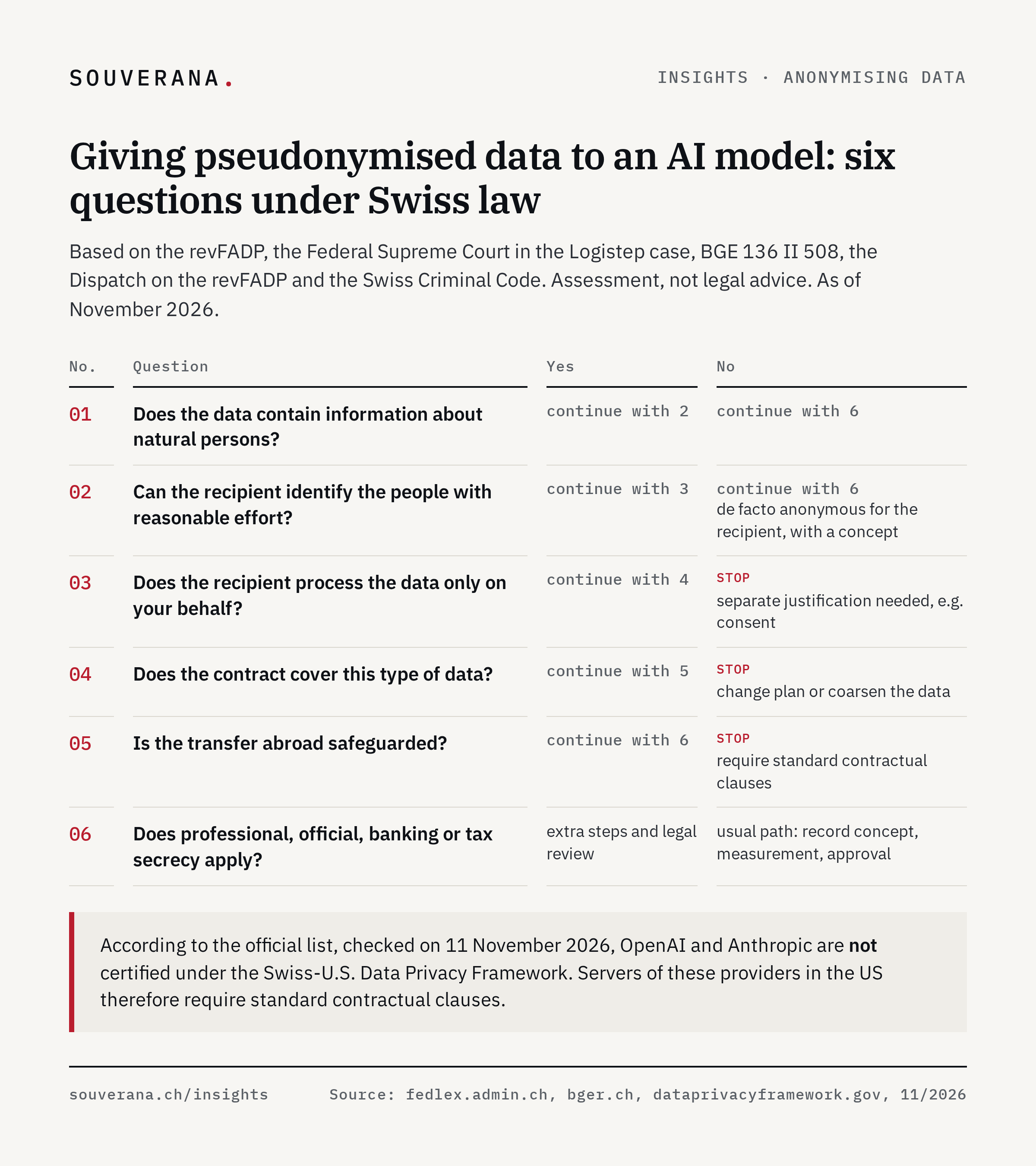
May the pseudonymised database go to a US model?
With these building blocks, the question from the beginning can be answered. There are two cases.
First case: the data remains personal data for the provider. This is the normal case as soon as date of birth, place of residence or free text appears in the data. A business tier with a data processing agreement is then required. For ChatGPT and Claude, these are the Team and Enterprise plans and the API. The Zurich law firm VISCHER reviewed the contracts of both providers in July 2026: the contracts do not cover sensitive personal data such as health data.[15, 16] Since 15 September 2024, transfers to the US count as adequately protected if the US company is certified under the Swiss-U.S. Data Privacy Framework.[17]
Key figure
0 of 2Source: Official Data Privacy Framework List of the US Department of Commerce, retrieved on 11 November 2026
Transfers to these two providers therefore need a different basis. In practice, the basis is standard contractual clauses recognised by the FDPIC (Art. 16(2) of the revFADP).[1, 18] The provider’s data processing agreement shows whether the clauses have been agreed. In addition, the privacy notice must mention the transfer.
Second case: the data is de facto anonymous for the provider. The key stays in-house. Date of birth and place of residence are coarsened to the point where no rare combinations of attributes remain. Free text is removed or cleaned. According to the Dispatch on the revFADP, the data then does not count as personal data for the provider. Within the company itself, the data remains personal data, with the obligations under the revFADP. These obligations include informing the data subjects about the recipients in the privacy notice. The anonymisation concept documents why the second case applies.
For the family practice from the introduction, this means: if the patient data remains personal data for the provider, the contracts of OpenAI and Anthropic do not cover the health data, according to the VISCHER review. For the second case, the practice has to coarsen the attributes. As long as date of birth and municipality are in the table, Hildegard Kaufmann’s row fits exactly one woman in Maschwanden. With birth year and district, 107 women fit; with age group and district, 526 women.
For data under professional or official secrecy, what the section on secrecy obligations sets out applies in addition, in both cases. The practice’s patient data is subject to professional secrecy. The decision path shows which steps your own case requires. Answer the questions in order.
How to start
- 01
Clarify the roles
Record who the controller is and which service providers work on the controller's behalf. Instruct the service providers in writing to pass data on to other parties or AI models only after approval.
- 02
Flag data under secrecy
Label the datasets that are subject to professional, official, banking or tax secrecy. For these datasets, the check from the section on secrecy obligations applies in addition.
- 03
Check the contracts
Check with the AI provider whether the data processing agreement covers the type of data and whether standard contractual clauses or a certification are in place.
- 04
Write the concept
For transfers that rely on the data being anonymous for the recipient, draw up an anonymisation concept that records the measurement, where the key is stored and the approval. The template is in the PDF for this article.
Sources
Frequently asked questions
- Is pseudonymised data personal data under the revFADP?
- For the company that holds the key, yes. For a recipient without the key, it depends on whether the recipient can identify the people with reasonable effort. If the recipient cannot, the pseudonymised data is not personal data for that recipient, according to the Dispatch on the revFADP. The courts have not settled this. The FDPIC applies a stricter standard. This is an assessment, not legal advice.
- May I give pseudonymised customer data to ChatGPT or Claude?
- On a business tier with a data processing agreement, usually yes, provided the data contains no sensitive personal data and no professional secrets. Patient data of a medical practice is health data and is also subject to professional secrecy. For patient data, a business tier alone is therefore not enough. In November 2026, OpenAI and Anthropic were not certified under the Swiss-U.S. Data Privacy Framework. Transfers to OpenAI and Anthropic therefore require standard contractual clauses. This is an assessment, not legal advice.
- Does the revFADP apply to data about companies?
- No. Since 1 September 2023, the revFADP protects only natural persons. Information about a company's contact persons, however, remains personal data. Company data can also fall under tax secrecy, banking secrecy or contractual confidentiality obligations.
- What belongs in an anonymisation concept?
- The concept records who receives the data and for what purpose. It states the accepted residual risk and what a determined attacker could additionally know. It describes how anonymity was measured, where the key is kept, who approved the transfer and when the check will be repeated. The concept is meant to show why, by the standard of the Federal Supreme Court, the recipient cannot identify any person with reasonable effort.
- May public authorities put pseudonymised data in an international cloud?
- Cantonal data protection law is decisive. In most cases, the cantonal data protection commissioners consider it impermissible to outsource sensitive or secret personal data to cloud services of large international providers, unless the authority encrypts the data itself. This is set out in their resolution of 18 November 2025. The resolution does not address pseudonymised data.
Share this article
Ready-formatted graphics and a suggested post for your LinkedIn feed: download, copy, post.
Suggested post
Do you want to analyse patient or customer data with ChatGPT or Claude, and have you already replaced the names with codes?

In Switzerland, whether that is enough depends first on one question: can the recipient recognise the people in the data with reasonable effort? In the Logistep case of 2010, the Federal Supreme Court held that what matters is the perspective of whoever holds the data. The Dispatch on the revFADP expressly applies this to pseudonymised data. No court has decided this case yet.

For your own company, the data remains personal data, because you hold the key. For OpenAI and Anthropic, one more point applies: neither is certified under the Swiss-U.S. Data Privacy Framework. We checked this on the official list on 11 November 2026. Our conclusion: anyone who analyses pseudonymised data with AI and relies on the data being anonymous for the recipient needs written evidence of this.

The article covers the case law, the position of the FDPIC and of the cantonal data protection commissioners, the role of tax and banking secrecy and an interactive decision path with six questions. In the PDF: a template for the anonymisation concept. Assessment, not legal advice. Link in the comments.

#DataProtection #revFADP #Anonymisation #AI #Switzerland