Is ChatGPT GDPR-compliant? What OpenAI's contracts cover
A Zurich law firm reviewed the contracts of OpenAI, the provider of ChatGPT: none of them holds up for lawyers, doctors and other holders of professional secrecy. What that means for companies, and the routes around it that the review does not name.
Analysis · Published 21 Jul 2026 · Updated 1 Oct 2026 · Joel Barmettler
Is ChatGPT GDPR-compliant?
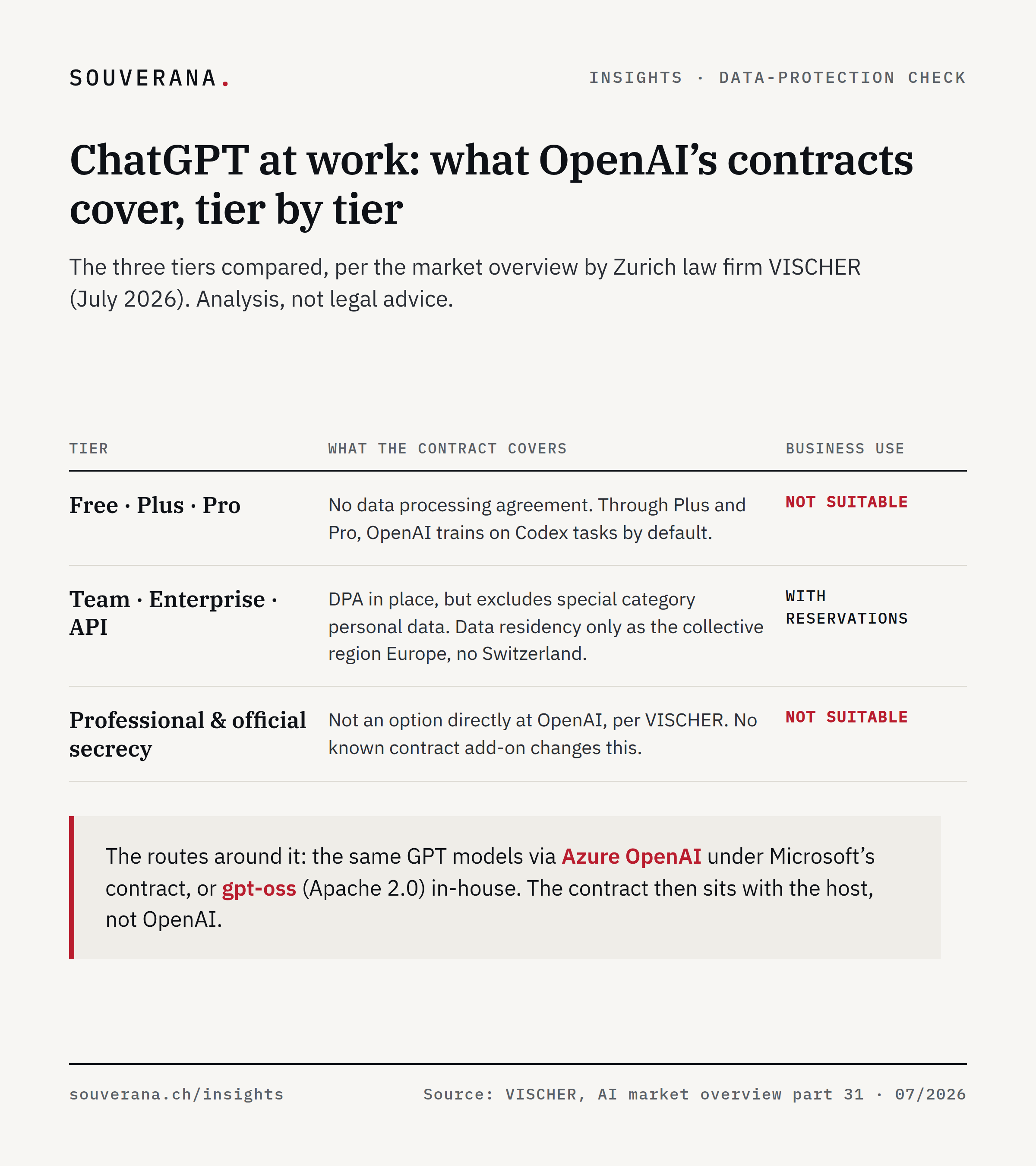
Whether ChatGPT complies with data protection law in business use depends on the tier. For the personal tiers Free, Plus and Pro, there is no data processing agreement, the contract that binds OpenAI as a service provider. The business tiers (Team, Enterprise, API) have one, but it excludes sensitive data such as health data. For lawyers and doctors it falls short, according to the Zurich law firm VISCHER (July 2026).
In brief
- Check first whether employees use ChatGPT with a personal account (Free, Plus, Pro) for work. For these accounts, no data protection contract exists to justify that.
- Switching to a business tier (Team, Enterprise, API) is sufficient for ordinary business data. For special category personal data, for example health, religious or trade-union data, you additionally need a deliberate risk decision.
- For anyone handling client-mandate, patient or official records, VISCHER finds the direct OpenAI contract insufficient (as of July 2026). Two routes remain. The first is a contract with a hyperscaler, a large cloud provider such as Microsoft, through Azure OpenAI, meaning the same GPT models in Microsoft’s cloud. The second is an open model that you or a host operate.
- OpenAI offers no Swiss data residency, meaning no commitment to keep data in Switzerland. There is only the collective region Europe. Anyone required to keep data in Switzerland therefore cannot choose OpenAI.
- If you use Codex, OpenAI’s coding agent, check the training setting separately. Codex runs under the same contracts as ChatGPT but has its own switch that releases entire working environments for training (as of July 2026).
The Zurich law firm VISCHER (authors Lucian Hunger and Jonas Baeriswyl) regularly updates a public market overview of AI providers; the July 2026 edition gives OpenAI its own section. Souverana is not a law firm. We reproduce VISCHER’s legal assessment and add the architecture questions a legal review naturally does not answer: through which contract, and on which infrastructure, can a company still deploy OpenAI’s GPT models?
This article opens our series “Provider Data-Protection Check”, in which we review the major AI providers against the same grid: contracts, data residency, professional secrecy, routes around the gaps.
What VISCHER criticises in OpenAI’s contracts
As with any provider, a basic rule applies first. Only the business tiers count for business use. VISCHER states explicitly that the consumer-facing offerings are not built and not suitable for business use, at OpenAI as at any other provider.
On the business tiers, where a DPA exists at all, VISCHER names three concrete reservations.
First, the contract applies only to ordinary personal data. It does not cover special category personal data, such as health data. VISCHER’s assessment on this is blunt: the clause is an attempt by OpenAI to shed responsibility for a correspondingly higher data security standard. Most customers do not notice, and the firm considers it questionable whether the clause even holds up under data protection law.
Second, a clause governs how OpenAI informs customers about new sub-processors, that is, service providers OpenAI engages to process customer data. OpenAI is free to choose the notification channel: a blog post, an in-app notice, another “appropriate” form, or email, but only for those who have subscribed. A customer cannot rely on email alone. Anyone who wants to be reliably informed would have to monitor every channel continuously, blogs included. VISCHER names the risk directly: new sub-processors can be added without the customer’s knowledge, so the customer cannot actually exercise their own duty to review.
Third, on web search: according to VISCHER, the public contract texts contain no exception, which is why the firm assumes the same rules apply as in chat. A competitor claimed to VISCHER that OpenAI uses the same Bing search as Microsoft for web search. If that were true, OpenAI could not keep its own DPA commitment. It permits data flow only through declared sub-processors. Microsoft, however, does not offer Bing search under a data processing arrangement. VISCHER cannot verify this but considers it reasonable for a supervisory authority to ask OpenAI about it.
When VISCHER itself asked OpenAI how ChatGPT could be used in a way that respects professional secrecy, it reports receiving only unusable answers from an AI chatbot. Its impression: OpenAI shows no interest in a solution that would satisfy customers.
Codex: the same business terms, its own switch
VISCHER’s overview does not separately cover Codex, OpenAI’s coding agent for terminal and development environment. What follows is our own research into OpenAI’s public data protection disclosures, as of July 2026, not VISCHER’s assessment.
Contractually, the same applies to Codex as to ChatGPT. Anyone using Codex through ChatGPT Business, Enterprise or the API is subject to the same business terms and the same DPA criticised in the previous section, including the same gap for special category personal data. There is no separate Codex DPA or separate Codex terms of use.
Two details are Codex-specific and easy to miss. First, OpenAI stores API inputs and outputs for up to 30 days by default for abuse detection, even with training disabled; zero data retention, meaning no storage, is available only for eligible endpoints, on request through sales, and not automatically for every Enterprise account. Second, Codex has its own separate setting in the interface for whether entire working environments are released for training, a considerably larger release than individual requests. It is independent of the general organisation-level switch and belongs on the checklist for every Codex rollout.OpenAI Help Center
Professional secrecy: why OpenAI falls short
For law firms, medical practices, trustees and banks, the question of professional secrecy is often more pressing than general GDPR or revFADP compliance. On OpenAI, VISCHER’s answer is short.
Unlike Microsoft or Google, OpenAI, as of July 2026, has no known contractual add-on and no workaround that changes this. Anyone processing client-mandate or patient data therefore needs a different route than the direct OpenAI contract; more on that below.
EU data residency: closer than the US, but not Switzerland
One feature deserves its own attention, because at first glance it promises more than it delivers: EU data residency, that is, the commitment to keep data in a chosen region. OpenAI processes data for the API and for ChatGPT Enterprise, Edu and Healthcare in a chosen region on request, with zero data retention on eligible API endpoints.OpenAI Help Center
Key figure
9 countriesSource: OpenAI Help Center, Data residency and inference residency, January 2026
Two limitations remain. The choice of region applies only to newly created projects and not retroactively, and for the API it must be made for each project individually. Moreover, “Europe” is a collective region and says nothing about a Swiss location. Anyone who must demonstrate a Swiss location is more likely to find it with a provider that actually names a Swiss location, or by self-operating an open model.
Where ChatGPT stands on the sovereignty scale
How sovereign ChatGPT is for your company is decided by six questions, each answerable independently of the others. Here is where OpenAI’s offering stands today on each one:
The picture shows why “ChatGPT, yes or no” is the wrong question. The highlighted point marks, on each axis, where OpenAI’s standard hosted offering (the business tiers) sits: on the first level for five axes, on the second for data. Only all six axes together show how sovereign a given setup actually is. Two escape routes move individual axes to a higher level: self-hosted gpt-oss and Azure OpenAI Service, both described further below. (We explain the full framework behind the six axes in our foundational article, What is sovereign AI?.)
One example is the operation axis. With ChatGPT, OpenAI operates the models in its own cloud. Through Azure OpenAI Service, the same GPT models run under Microsoft’s contract terms, as is usual with hyperscalers. That is a different legal starting point from OpenAI’s own terms of service; we place it in this series’ article on Microsoft Copilot.
On the model axis, OpenAI is not uniformly closed. With gpt-oss-120b and gpt-oss-20b, the company released two models under the open Apache 2.0 licence in August 2025. They can be downloaded, self-operated and retrained with your own data.OpenAI As a hosted business tier, though, OpenAI does not offer them, more on that in the next section.
The escape route: gpt-oss
For tasks the smaller gpt-oss models can handle, self-hosting is a genuine sovereignty gain. Your contract partner is then a host such as Infomaniak, OVHcloud or PHOENIQS. The contract covers exactly what your company negotiates with that host, independent of OpenAI’s own business terms.
Anyone needing the full GPT-5 class finds the second route at the hyperscaler: Azure OpenAI Service offers the same models under Microsoft’s contract terms, with its own conditions for professional secrecy and abuse monitoring (misuse detection). For a company with data of differing protection levels, it is often pragmatic to choose the suitable route for each task.
Where to start
Before your next ChatGPT contract or the next renewal, clarify four points:
- Is a personal tier (Free, Plus, Pro) running in business use at your company, even though no DPA exists for it?
- Do you process special category personal data or even professional-secrecy data through ChatGPT, for which the business contract, according to VISCHER, is not sufficient?
- Does the location of your data matter, and is the collective region Europe enough, or must you demonstrate a more precise location?
- Would a hyperscaler contract through Azure OpenAI or a self-hosted gpt-oss be the better fit for the application in question than OpenAI’s own business terms?
Against the same grid, the series also reviews Anthropic, Google, Microsoft, and Proton, a provider that does it differently.
Frequently asked questions
- Is ChatGPT GDPR-compliant?
- It depends on the tier. According to the Zurich law firm VISCHER, the personal tiers (Free, Plus, Pro) are unsuitable for business use. The business tiers (Team, Enterprise, API) include a data processing agreement binding OpenAI as a service provider. It suffices for ordinary personal data, but special category data such as health data needs a deliberate risk decision.
- Can I use ChatGPT for sensitive business data?
- For ordinary business data on a business tier, yes in principle, with contractual cover. For special category personal data or professional-secrecy work, the Zurich law firm VISCHER (as of July 2026) explicitly advises against it. In their assessment, the OpenAI contract is not built for it. Special category data includes, for example, health, religious or trade-union data.
- What is the difference between ChatGPT and the OpenAI API on data protection?
- Contractually, the same business-tier rulebook applies to both. The API, the programming interface for your own applications, additionally offers optional EU data residency for newly created projects, with processing in the region and, on eligible endpoints, zero data retention, meaning no storage of the data. Neither offers a Swiss option.
- Can ChatGPT be used by professionals bound by confidentiality, such as lawyers or doctors?
- Not in the assessment of the Zurich law firm VISCHER. Their conclusion (as of July 2026) is that OpenAI is not an option for holders of professional or official secrecy, partly because the contract does not cleanly resolve abuse monitoring (the detection of misuse). The alternatives are a model hosted by a hyperscaler such as Microsoft or a self-operated open model.
- Does OpenAI offer Swiss data residency?
- No. For ChatGPT Enterprise/Edu/Healthcare and the API, OpenAI names several countries for data residency (the storage location of the data), including the UK, the US, Japan, Canada, Singapore and others, plus the collective region Europe. Processing (inference) in the region has only been available in the US or in Europe since January 2026. Switzerland is not listed as a separate option in either case.
- Does OpenAI train Codex on our code?
- Codex is OpenAI's coding agent. Through ChatGPT Business, Enterprise or the API, OpenAI does not train on your code by default; the same data protection commitments apply as for ChatGPT. Through the personal tiers Plus or Pro, however, OpenAI trains on Codex tasks by default unless someone actively opts out. A separate switch also releases entire working environments for training, independent of the organisation-level switch.
Share this article
Ready-formatted graphics and a suggested post for your LinkedIn feed: download, copy, post.
Suggested post
Does ChatGPT run in business use at your company? Then the tier is worth checking.

The tier decides whether a data protection contract exists at all. Free, Plus and Pro have none. The personal tiers are not built for business use, and OpenAI trains on the tasks of Codex, its coding agent, by default through Plus and Pro.

Team, Enterprise and the API come with a data processing agreement, the contract that binds OpenAI as a service provider. It does not cover special category personal data such as health data. For professional and official secrecy, OpenAI is not an option today, according to the Zurich law firm VISCHER, and there is no Swiss data residency, only the collective region Europe.

Our conclusion: the route to the models is what matters, meaning through whom and under which contract you obtain them. The same GPT models run through Azure OpenAI, Microsoft's cloud, under Microsoft's contract terms. For suitable tasks, gpt-oss is available, an open OpenAI model under Apache 2.0, for self-hosting at a Swiss host. Then the contract is with your host.

Analysis, not legal advice. The article compares the four routes to the same models, the Codex details, and seven questions for the next contract. Link in the comments.

#AI #DataProtection #OpenAI #Switzerland