What sovereign AI actually means for Swiss companies
If you sell discretion, you have a problem the moment a client asks where your data goes when you use AI. Sovereign AI answers that question, and the degree of control can be set like a dial.
Guide · Published 16 Jul 2026 · Updated 1 Oct 2026 · Joel Barmettler
What sovereign AI actually means
Sovereign AI means that your company decides for itself who gets to see its most confidential data when it uses artificial intelligence. Sovereign AI is a degree of control over four questions: which AI model does the work, where it runs, who sees the data, and whether you can switch providers. How much control you need depends on how confidential the data is.
In brief
- Sovereignty comes in degrees. There are six axes: jurisdiction, model, software, operation, data and integration. You set each axis separately.
- Two mix-ups cost you room to manoeuvre. A Swiss data centre alone does not make a solution sovereign, because the model, the software and the data access count as well. Open weights means you may run the finished model yourself. Open source additionally discloses the training code and the training data.
- Budget for more work. Model, host, interface and support come from different providers, and someone has to join them together and maintain them for years.
- If you sell discretion, for example as a law firm, trust office or medical practice, you should be able to prove it in your AI too. If client data flows through a chat service to a US corporation, the technology contradicts the promise.
A pattern repeats across our mandates. A law firm, a trustee, a medical practice lives on discretion. It is the real product. Then AI arrives, and suddenly exactly that confidential data flows through a chat service to an American corporation. As long as nobody asks, it goes unnoticed. The moment a client does ask, the promise of discretion stands against the technology behind it.
Sovereign AI closes this gap between promise and technology. An AI decision holds for years and cannot be reversed on the side.
This article opens our five-part series on sovereign AI. It sets out the terms. The four further parts work through the decision layers one by one.
Sovereignty is a mixing desk, not a light switch
The most common mistake is treating sovereignty as a yes-or-no question. That ends in one of two dead ends. The first: “everything must run on our own servers,” expensive and rarely necessary. The other: “we sit in a Swiss data centre, so we are sovereign,” a widespread fallacy.
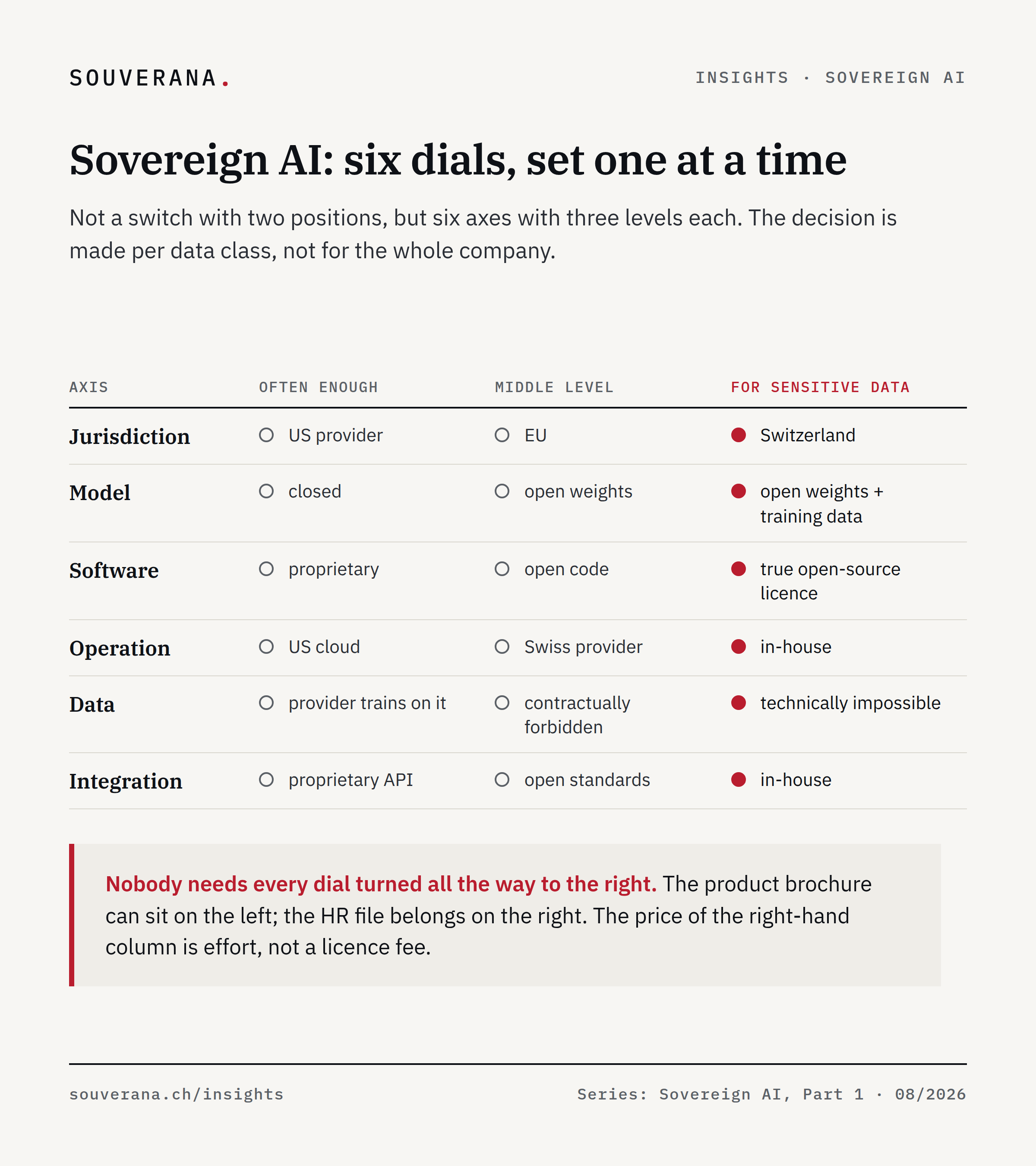
Sovereignty in fact has several axes, and you set each one on its own. A model with open weights running on an American cloud is not sovereign. A Swiss provider delivering an impenetrable black box is not either. Only taken together do they give the full picture:
Nobody needs every dial turned all the way to the right. Marketing brochure copy is fine on the left; HR files need several dials moved to the right. The work lies in deciding this separately for every category of data.
Two terms are worth keeping apart, because providers like to blur them. Open weights means you may download the finished model and run it yourself. Open source goes further and also discloses the training code and the training data. Meta, for instance, calls its Llama models “open source,” even though the training data stays locked away and the licence restricts use; the Open Source Initiative explicitly disagrees. The Swiss model Apertus, developed by ETH Zurich, EPFL and the CSCS supercomputing centre, meets the stricter definition: weights, data and code are all open.
Why this matters for Swiss SMEs
The driver is rarely big geopolitics. There are four sober reasons.
Cost. Sovereignty has a reputation for being expensive. For models, the opposite is true: open models cost a fraction, per token (the unit of text that providers bill by), of the large American ones, and that advantage holds wherever you run the model. Whether your own server pays off is then a question of utilisation. Book an API and you pay only for what you use; your own hardware only pays off under consistently high load. And a Swiss data centre is not automatically cheaper than AWS, but is often competitive on compute and storage.
Key figure
around a fifthSource: Artificial Analysis and price lists from Z.ai and Anthropic, as of July 2026
We worked through why the cheapest model is nonetheless rarely the least expensive one in our article on LLM cost. That capable AI can run entirely on European infrastructure is shown by Proton with Lumo.
Lock-in. How easily could your company get out of Microsoft 365 today? With AI the same question arises again, and the lock-in sits deeper. Open weights and open software hand the freedom back: nobody can take away what you build today or change it overnight. And because the same open model runs at many hosts, you switch operator whenever it suits you.
Consistency. If you sell trust, you have to deliver it in your technology too. If a client learns that their data sits with an American corporation via an AI service, they will draw their own conclusions about the discretion you have promised so often. With sovereign AI, the question never arises in the first place.
Equal footing. One provider sends three hundred pages of terms and conditions and a support queue. The other, say a Swiss data centre such as SteppingStone, sits an hour away, runs the same open model at a similar price to the hyperscaler, and signs a contract you helped negotiate. With the hyperscaler, one of the large cloud providers such as AWS or Azure, you are a number in a ticketing system; with the Swiss provider, someone who knows your business sits across the table from you.
It does happen that a US provider actually locks someone out, though for most SMEs it is not an everyday risk. When the American government sanctioned the Chief Prosecutor of the International Criminal Court in 2025, his Microsoft account was suspended shortly afterwards. Not long after, the head of legal and external affairs at Microsoft France testified under oath before a commission of inquiry of the French Senate that he could not prevent access under the US CLOUD Act, even for data held on European servers. The case shows where control actually sits when it matters.
The honest price of sovereignty
Sovereignty has a price. It just sits somewhere other than most people assume.
Microsoft delivers model, platform, hosting and advice on one invoice, with a single contact you can hold accountable when something goes wrong. Whoever goes sovereign gives up that convenience. You might end up running an open model such as Apertus or Gemma at a Swiss host, through an interface such as Open WebUI, on a server from Infomaniak, looked after by a partner such as VSHN. Four building blocks, four contracts, where Microsoft provides a single one.
The price, then, is the work of joining these parts into a whole and maintaining that over years. Sovereign AI therefore calls for a role the Microsoft model does not even have: someone independent, who masters the building blocks and negotiates with you and with the Swiss providers as an equal. Without that role, you are left with an unfinished DIY project.
The four layers
Sovereign AI is built on four layers, each with its own question and its own article in this series.
- Strategy. Where does sovereignty begin for you, and which data needs how much of it? This is where you set the dials, before anything is procured.
- Infrastructure. Which model does the work, and where does it run? Open weights and Swiss operation decide whether the intelligence belongs to you.
- Platform. What does your team work with daily, and could you ever get out of it again? Open tools keep your data and your freedom to switch in your own hands.
- Integration. How does AI connect to your specialist applications? Open standards ensure your most confidential documents never leave the company.
The following articles take up the layers in order, from strategy through to integration.
What this means for your company
Sovereign AI is a foundation that belongs to you: free of lasting lock-in, in keeping with what you promise your clients. The first step is a sober stocktaking, not yet a technology question: what data do you hold, how sensitive is it, and where does the dial need to sit for each category? That basic question breaks down into concrete, affordable decisions.
What these dials look like in practice is what the further parts of the series show: strategy, infrastructure, platform and integration, each its own decision layer.
Frequently asked questions
- What does sovereign AI mean?
- Sovereign AI means you decide, at every layer of an AI solution, which model does the work, where it runs, who sees the data and whether you can switch providers. Sovereign AI is not a single product. The term describes a degree of control that you choose yourself, depending on how confidential your data is.
- Is sovereign AI more expensive than ChatGPT or Microsoft Copilot?
- Not necessarily. Open models often cost a fraction, per token (the unit of text that providers bill by), of the large US models. The Swiss host Infomaniak is often competitive on compute with the US clouds AWS and Azure. Whether self-hosting pays off depends on utilisation. The main effort is that no single provider delivers all the building blocks.
- Which AI comes from Switzerland?
- The best-known Swiss model is Apertus, developed by ETH Zurich, EPFL and the CSCS supercomputing centre. Apertus is fully open: weights, training data and code are all disclosed. Alongside it, Swiss hosts such as Infomaniak run open models on their own infrastructure.
- What is the difference between open weights and open source?
- Open weights means you may download the finished model and run it yourself. Open source goes further and also discloses the training code and details of the training data, under a free licence. Many models marketed as "open source" are, strictly speaking, only open weight. The Swiss Apertus meets the stricter definition.
- Does an SME even need sovereign AI?
- Yes, as soon as client, patient, case or HR data is involved. Then sovereignty decides whether you can defend that use to clients and regulators. For publicly accessible tasks, a standard service is often enough. It makes sense to set the degree of control according to the type of data. Only the most sensitive data needs the maximum.
Share this article
Ready-formatted graphics and a suggested post for your LinkedIn feed: download, copy, post.
Suggested post
Do you sell your clients discretion? Then it is worth asking whether your technology keeps that promise.

In law firms, trust offices and medical practices, confidentiality is the real product. With AI, exactly that data flows through a chat service to a US corporation. How real this is became clear in 2025, in the case of the Chief Prosecutor of the International Criminal Court: after US sanctions, his Microsoft account was suspended, and the head of legal and external affairs at Microsoft France later testified under oath before a commission of inquiry of the French Senate that he could not prevent access under the US CLOUD Act (US authorities can demand data from American providers, even from European servers).

Sovereignty comes in degrees. There are six axes with three levels each: jurisdiction, model, software, operation, data and integration. Our conclusion from advisory practice: nobody needs to choose the highest level everywhere. The decision is made according to the type of data, and the highest degree of control mainly costs effort, because nobody delivers all the building blocks from a single source.

The article explains each of the six axes, gives you a table for working through your own data by confidentiality, and sets out seven questions for your next provider choice. Link in the comments.

#AI #DataSovereignty #Switzerland #SME