Public Swiss AI: answers to the Marti interpellation
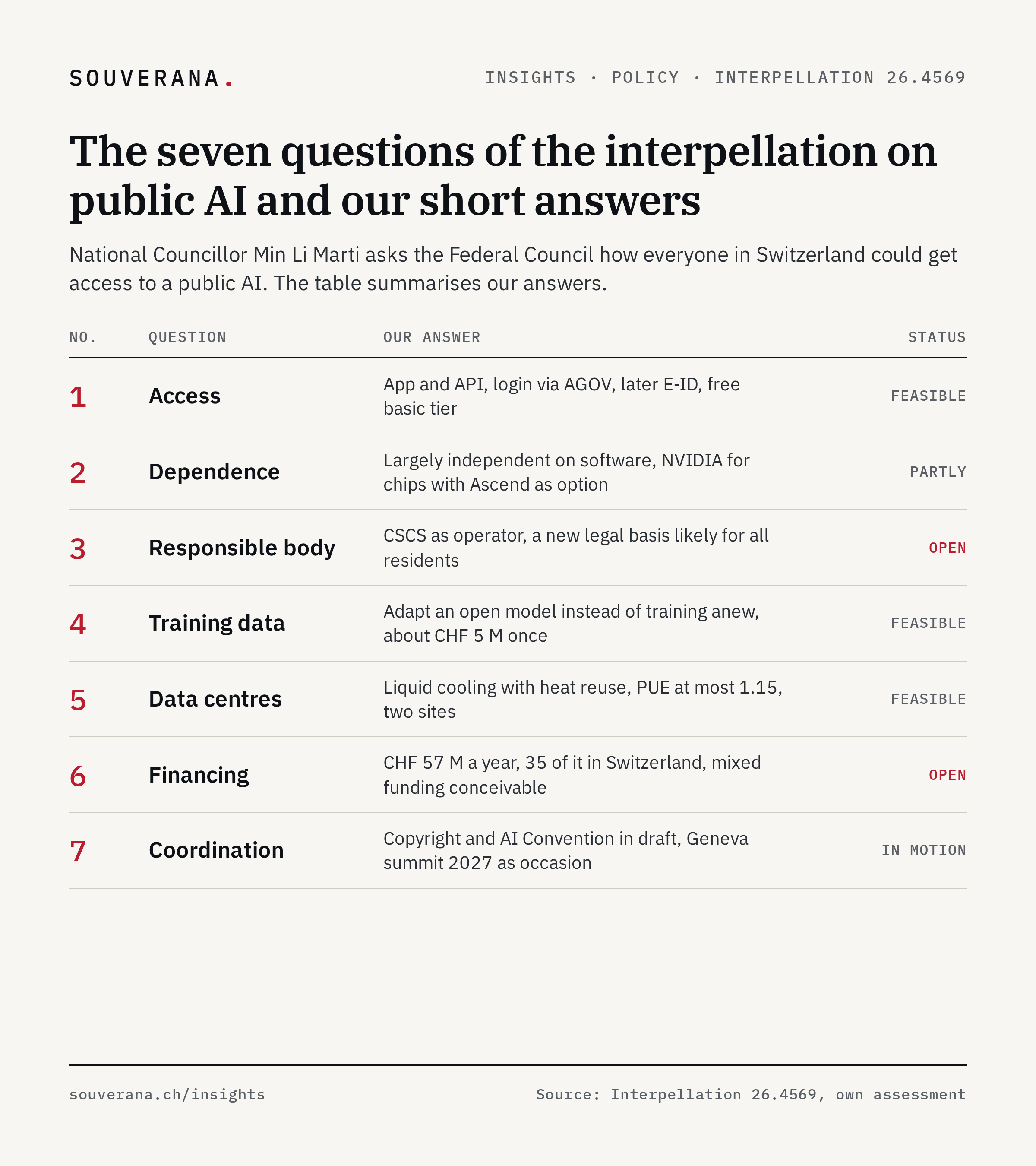
National Councillor Min Li Marti asks the Federal Council how everyone in Switzerland could get access to a public AI. We answer her seven questions in turn: access, dependence, responsible body, training data, data centres, funding and coordination. The costs are worked out in a separate article.
Analysis · Published 20 Oct 2026 · Updated 22 Oct 2026 · Joel Barmettler
What this is about
How could everyone in Switzerland use a public AI, who would operate it, and who pays for it? National Councillor Min Li Marti has put seven questions on this to the Federal Council. Our answers in one sentence: technically it is feasible, the cost is in line with other federal infrastructure, and what remains open is mainly the operator, the legal basis and the funding.
In brief
- Access: A public body runs the app and the API, login works through AGOV and later the E-ID, and a basic tier is free.
- Dependence: On software, Switzerland becomes largely independent. On chips, NVIDIA is the supplier today under US export rules, but DeepSeek’s software also runs on Huawei Ascend as a second source.
- Responsible body: CSCS would be the shortest route to technical operation. A service for the whole population will probably need a new legal basis.
- Training data: We do not calculate the cost of training a model from scratch (pretraining). Adapting an open model to Swiss requirements costs about CHF 5 million one-off.
- Data centres: Liquid cooling with heat recovery, a closed cooling loop and grid-friendly operation are feasible. The service would use less than 1 per cent of the electricity of today’s Swiss data centres.
- Funding: In our model calculation the service costs CHF 57 million a year for 7 million users, of which CHF 35 million stays in the country. A mixed funding model of federal funds, internal charging and cost price is conceivable.
- Coordination: Copyright and the AI Convention are in motion. The Geneva AI Summit 2027 would be an occasion for partnerships with other states.
Min Li Marti submitted Interpellation 26.4569 “Artificial intelligence as infrastructure” on 2 October 2026.[1] An interpellation is a parliamentary question to which the Federal Council replies in writing. Marti argues that AI is basic infrastructure but is largely in the hands of American and Chinese companies. The Confederation funds Apertus through the ETH Domain, she says, but leaves the access layer to a market that runs on US models. The Federal Council has not yet replied.
This article answers the seven questions from a technical point of view, each in its own section and at the same depth. The figures on capacity and cost come from our own model calculation, which uses the operating figures DeepSeek published on 20 October 2026.[2] How the model calculation is built is explained in the article What does a national AI infrastructure cost?. Here we give only the results.
AI basics in brief
A language model consists of an architecture, the blueprint by which it computes, and weights, a very large file of numbers. The weights are produced in training: the model reads huge amounts of text and adjusts its weights so that it can continue text sensibly. This takes a great deal of compute time, once. In fine-tuning, a fully trained model is trained further with additional examples, such as questions and the desired answers. This costs only a fraction of the training and changes the model’s behaviour without building it from scratch.
The computing happens in a data centre on GPUs, chips originally built for graphics. Every answer costs compute time, billed in tokens, small word fragments: “Harry Potter and the Philosopher’s Stone” comes to roughly 100,000 of them.
A closed model such as OpenAI’s GPT-6.1 Sol can only be reached through the provider’s service. With an open model, the developer publishes the weights and anyone can run it on their own hardware. DeepSeek V4.1 Flash is released under the MIT licence, which permits running and modifying it. The Swiss model Apertus from ETH Zurich, EPFL and the Swiss National Supercomputing Centre (CSCS) is open as well (article on Apertus).[3] We calculate with DeepSeek V4.1 Flash because it is among the most efficient models: it is strong enough for most applications, including agents, and with the published operating figures it can be run so cheaply that a service for the whole population becomes affordable.
In the cost calculation, GPT-6.1 Sol serves as the yardstick for a proprietary frontier model, that is, a model with maximum reasoning ability. It is stronger than DeepSeek V4.1 Flash and considerably more expensive. A fair comparison is only with models in the same performance class as DeepSeek V4.1 Flash, such as Claude Haiku 5.5.
Question 1: how does everyone get access?
“How could the population, business, research, education and administration get low-threshold access to a capable, open and secure AI system?”
Our answer: A public body runs an app and an API. Login works through AGOV and later the E-ID. A basic tier is free for everyone, administration, schools and research get their own tiers, and companies get API access at cost price.
The demand is there: according to a Comparis survey of March 2026, 76 per cent of adults regularly use AI chatbots, up from 50 per cent in 2024.[4] Most of these users rely on US services today. A public offering would therefore not have to win users first. It would have to give them an alternative that they are more likely to trust with sensitive questions.
For access we propose four tiers. The basic tier for all residents is free and capped in volume. Administration, schools and universities get higher quotas and a connection to their systems. Research gets API access with large quotas. Companies use the API at cost price, that is, without a margin for sales and profit. This tiering keeps the offering low-threshold, and whoever generates a lot of load, above all agents in business products, pays accordingly.
Sign-in can be solved: AGOV, the Confederation’s login, works today. The E-ID was planned for 1 December 2026 and has been postponed again. A launch is now expected in 2027.[5, 6] Until then a pilot could run on AGOV, and with the E-ID the whole population could follow.
Technically, for 7 million users this means about 1,300 GPUs, which is 12 per cent of the chips in Alps, the CSCS supercomputer. The service would use about 0.03 per cent of Swiss electricity. The derivation is in the article on the model calculation.
Question 2: does dependence fall, and does operation hold up in a crisis?
“Would this reduce dependence on foreign providers and secure operation in geopolitical crises?”
Our answer: On software and data, dependence falls markedly. Open weights keep running without any connection to the outside. On chips, NVIDIA is the supplier today, but DeepSeek’s software also runs on Huawei Ascend: that is a second source in case the USA cuts Switzerland off from NVIDIA. Large procurement tranches with spare parts and a portable software stack also make sense.
On software, Switzerland would be markedly more independent. Weights under the MIT licence and open software for running the model work on hardware in Switzerland, with no connection to the outside. If DeepSeek stopped publishing tomorrow, the last published model would keep running. Drivers, firmware and spare parts for the GPUs would still come from abroad, though. That a model comes from China does not mean, when you run it yourself, that data flows there: the model is a file that runs on Swiss hardware. We deal with the objection of censorship and bias in the model under question 4.
On hardware, Switzerland depends today on US manufacturers such as NVIDIA, and their chips are subject to US export rules. DeepSeek’s operating software (DeepInfer), however, also supports Huawei’s AI chips (Ascend). That is a gain for independence: if the USA blocked the delivery of NVIDIA GPUs to Switzerland, there would be a second source. One should not begin with Ascend, because in May 2025 the US Department of Commerce warned that using the 910B, 910C and 910D types could violate US export controls.[7] As an option for an emergency it is still important, precisely to stay able to act geopolitically. How well DeepSeek V4.1 Flash runs on Ascend is open. Switzerland has experienced US export restrictions on chips before,[8] and the US rules keep changing.[9] In early 2025 the USA divided the countries of the world into tiers that governed the export of AI chips (the “AI Diffusion Rule”) and put Switzerland in the restricted second tier. The timeline shows why the supply of GPUs cannot be taken for granted:
Switzerland in the second tier
Under the "AI Diffusion Rule", the USA places Switzerland in the restricted second tier.
Rule rescinded
The USA withdraws the AI Diffusion Rule. The Department of Commerce at the same time warns against using Huawei Ascend chips.
Draft of new rules
The Department of Commerce drafts rules under which almost every export of AI accelerators worldwide would need a US licence.
The base case needs about 1,300 GPUs, replaced every four years. In global terms that is little. By comparison, the rescinded rule would have allowed about 16,500 chips a year, by CH++‘s estimate.[10] As practical safeguards we see:
- Buy the hardware in one or two large tranches with a full set of spare parts and run it for four to five years. A running cluster probably needs no further export licences. That would have to be clarified legally.
- Keep the software stack portable. vLLM and SGLang run on more than one chip family, and AMD is a second US supplier. We do not know whether DeepInfer runs on AMD.
- Keep Ascend open as a second source. DeepInfer already supports the chips. A pilot could measure early how well the model runs on them, so that the option is not tested for the first time in an emergency.
Question 3: who could be responsible for it?
“Could existing public-service institutions carry this, or is a new organisation needed, and on what legal basis?”
Our answer: This is not legal advice. CSCS (the Swiss National Supercomputing Centre, operator of Alps) as technical operator would be the shortest route, because it already runs the technology. For serving the whole population, the statutory mandate of the ETH Domain does not readily cover this. A new or amended legal basis is probably needed.
The question has two parts: who runs the technology, and who is accountable to the public for the service? There is also a legal side that decides the choice of responsible body. Four options are on the table.
CSCS and the ETH Domain. CSCS runs Alps and has made Apertus 1.5 available to researchers since July 2026. Among the tasks the ETH Act lists are education, research and “scientific and technical services”, and the ETH institutions take “the needs of the country” into account (Art. 2).[11] Article 10 applies to other services: the ETH may provide them insofar as this is compatible with their tasks in teaching and research, and for services that the private sector can provide equally well, competition must not be distorted. The Federal Council wants the ETH Domain to operate research infrastructure and make it accessible to the whole research community.[12] A service for the population is not mentioned there. Because private Swiss hosts already offer Apertus today,[13] the competition question would also have to be clarified. Whether a service for the population would fall under Article 10 is open.
SWITCH is a private, non-profit foundation. The Confederation and the eight university cantons of the time founded it in 1987, today it is owned by the universities, and its purpose is the digitalisation of teaching and research.[14] An offering only for education and research, about 1 million users, is conceivable. For a service for everyone, the foundation’s purpose does not fit.
Swisscom is majority-owned by the Confederation and runs data centres. This raises competition questions with regard to private Swiss providers and ties a public service to a listed company. We have not examined this legally.
A new public-law institution, with CSCS as technical operator and its own access organisation, separates the mandate cleanly but takes the longest.
For the legal basis there is a model in the federal administration: the Federal Act on the Use of Electronic Means for the Fulfilment of Official Tasks (EMBAG) creates the legal basis for the digital transformation of the federal administration and for cooperation with cantons and third parties.[15] Whether a public AI service for the population could rest on this basis or would need a law of its own is for lawyers to answer. A permanent service for everyone, funded from federal money and processing data, will probably need an explicit basis.
Examples abroad show that it can be done on a smaller scale: in the Netherlands, SURF, the Netherlands Forensic Institute (NFI) and TNO developed GPT-NL with EUR 13.5 million from the Ministry of Economic Affairs, a model intended not for private individuals but for organisations.[16] That is a different goal from an AI for everyone.
One possible division: CSCS runs the GPUs and the engine, that is, the software that executes the model on the GPUs. A new or existing public body is responsible for the app, API, sign-in and support. Whoever commissions and accepts the adaptation of the model should not be the operator (more under question 4).
Question 4: how does Swiss training data come about, and what does it cost?
“How can high-quality Swiss training data be produced and funded in the long term?”
Our answer: Switzerland does not have to train a model from scratch. It can adapt a strong open model such as DeepSeek V4.1 Flash with Swiss data through fine-tuning. This costs about CHF 5 million one-off per model generation and CHF 2 million a year for new versions. The Swiss data for this should come from the open datasets of the Apertus team and from cooperation with publishers, media houses and SRF.
Three routes to a Swiss model
Whoever wants a model for Switzerland has three routes. They differ in what you build yourself: architecture, weights and training.
- Everything yourself: own architecture, own training. This is how Apertus came about. ETH Zurich, EPFL and CSCS trained a model with its own blueprint from scratch and published data, pipeline and intermediate checkpoints along the way, which hardly any other open model does (article on Apertus). This is a great achievement and, according to the NZZ, cost about CHF 7 million for the pretraining alone.[17] In capability, however, Apertus lags behind the commercial competition.[18]
- Known architecture, new training. You take over DeepSeek’s blueprint, discard the weights and train from the start. Training is the expensive and difficult part: it needs huge amounts of data and a great deal of experience. It is unlikely that a Swiss team would come anywhere near DeepSeek’s performance this way.
- Existing model, fine-tuning. DeepSeek’s architecture and weights stay, and a Swiss team only trains further: with examples that show how the model should behave in Switzerland. This gives you a strong model at a fraction of the cost of training.
We calculate with route 3 because it is the most economical. Apertus remains valuable alongside it: as proof that Switzerland can build such a model itself, and as a source of data and know-how.
One can object that DeepSeek trained on data it should not have used. That is possible, because what DeepSeek trained on has not been published. For the choice of route, though, this is not the decisive question: of five open models compared, only Apertus and OLMo 3 disclose their training data (comparison in the article on Apertus). The question arises for most of the models on offer, and fine-tuning with your own, properly licensed data changes nothing about the base model. The objection of censorship and bias that goes back to Chinese requirements has to be taken seriously. It can be addressed: the MIT licence allows the model to be modified, and part of the censorship of the hosted DeepSeek services probably sits in the layer of API and app, which falls away when you run it yourself.
Where the Swiss data comes from
Fine-tuning needs good data, and here the Apertus team has done a lot of groundwork. It respected the blocking directives of websites (robots.txt), including retroactively, and removed content from domains that block AI crawlers from crawls of 2013 to 2024.[19] In fine-tuning it admitted only datasets with a clear licence.[20] Many datasets are openly available on Hugging Face: Swiss texts such as parliamentary business (Curia Vista) and court decisions,[21] Romansh with original texts, translations and synthetic data,[22] and a mix of 3.7 million examples for fine-tuning (with mixed licences, to be checked before use).[23] A public AI should build on these and coordinate with the Apertus team.
What is missing is a continuing stream of high-quality, current Swiss texts. For this we propose cooperation: with publishers and media houses that provide archives and articles for a licence fee or public funding, and with SRF, which is funded through the media levy. Explicit consent creates legal certainty that an opt-out solution does not offer. What publishers and media houses would ask for this, we have neither calculated nor negotiated. Our cost calculation assumes that the data is newly created. Existing datasets and licences could reduce or shift the effort.
The precedent: Perplexity and R1 1776
In 2025 Perplexity adapted DeepSeek R1 through fine-tuning, that is, targeted further training with additional examples, and released it as R1 1776. According to reports, specialists identified about 300 topics affected by Chinese censorship and compiled 40,000 multilingual prompts with factual answers from them. R1 was trained on these prompt-answer pairs. Perplexity reports that performance in mathematics and reasoning stayed almost unchanged and that the model is no longer censored. Perplexity has not disclosed how the test was set up or what the project cost.[24–26]
Three work packages for a Swiss team
Each package consists of prompt-answer pairs: a question and the desired answer, as training data for the fine-tuning.
- Censorship and bias. We adopt Perplexity’s approach: topic list, dataset, fine-tuning. We assume 40,000 pairs. US models are also examined for bias. A common test suite should therefore run on Apertus, DeepSeek and the adapted model, before and after the adaptation, with published results.
- Swiss values. What Swiss values mean for a model is a political question: who determines what is meant? The options are Parliament by law, the Federal Council by ordinance, an expert body after a consultation procedure (Vernehmlassung), or the responsible organisation. The choice of the body that decides this is itself a political decision. A publicly adopted specification and a published test suite are needed, otherwise one bias is simply replaced by another. When the state determines the behaviour of a public model, a risk of its own also arises for freedom of information and opinion. That is why the specification must be publicly debated. We assume 20,000 pairs.
- Romansh. The Apertus team has published Romansh datasets.[3, 22] We do not know how well Apertus handles the language. For DeepSeek, specialists would additionally have to write and check fine-tuning data in Rumantsch Grischun and the five idioms. We assume 20,000 pairs. Whether fine-tuning alone suffices is open: if the foundation model has hardly seen the language in pretraining, fine-tuning hits limits. That would have to be measured in the pilot.
What the adaptation costs
In the base case the initial adaptation costs CHF 5.0 million (range: low 2.7, high 10.1). Four fifths of that goes to staff and data, only CHF 0.3 million to compute time. Keeping up with new DeepSeek versions adds at about CHF 2.0 million a year. Initial adaptation and upkeep together, spread over four years, come to CHF 3.3 million a year, which is 6 per cent of the total annual cost in the base case. The derivation is in the article on the model calculation.
What the adaptation does not deliver
Fine-tuning changes behaviour on the topics it covers. Whether bias remains afterwards is shown only by the test suite. The safeguards are these: the test suite is published, with results before and after the adaptation, it runs again with every new version, and Apertus stays alongside as a second model. Whether the adaptation degrades the model’s capabilities is likewise shown only by measurement. For R1 1776, Perplexity reports almost unchanged benchmarks, but we know of no independent check.
Question 5: what would data centres have to meet?
“What would data centres for public AI have to meet on waste heat use, cooling, water and load flexibility?”
Our answer: Liquid cooling with heat recovery, a closed cooling loop with a cap on water use, a PUE of at most 1.15, grid-friendly batch jobs and two sites at least 50 kilometres apart.
The servers and GPUs of the base case need 2.6 megawatts of power. That fits into a single hall of an existing Swiss data centre. According to the Confederation, Swiss data centres together used 2.1 terawatt hours in 2024, 3.6 per cent of national consumption, and none of these data centres is built for training large models.[27] The service would use 17.2 gigawatt hours of electricity a year, which is 0.8 per cent of what Swiss data centres already use today.
Why these requirements? New data centres in Switzerland are under pressure on electricity, water and waste heat. Whoever sets the requirements in the tender from the start makes the service a gain for municipalities and grid operators rather than a burden. The Confederation could write these requirements into the tender:
- Direct liquid cooling, because the racks for decode (NVL72) require it anyway. Return water at 40 to 60 °C can feed a district heating network directly or via a heat pump. About 15 of the 17 gigawatt hours of electricity a year can be recovered as usable heat. At 12 megawatt hours per home per year (an assumption), this heat is enough for about 1,250 homes.
- Closed cooling loop with dry coolers. Evaporative cooling only as a reserve on hot days, with a cap on annual water use fixed in the contract.
- PUE of at most 1.15 as an annual average, measured and published. The PUE puts total electricity consumption in relation to the electricity of the chips themselves, the rest goes to cooling and operation.
- Load flexibility in two tiers. Interactive requests cannot be deferred, batch jobs (large jobs where nobody waits for the answer, such as overnight analyses) can. At DeepSeek, a controller, the autoscaler, already switches the prefill and decode GPUs on or off within minutes depending on load.[28] A rule that batch jobs follow the balancing power signals of Swissgrid would make 30 to 50 per cent of the night-time load grid-friendly.
- Two sites at least 50 kilometres apart, so that the failure of one site does not stop the service. DeepSeek’s set-up treats the failure of individual GPUs or racks as the normal case anyway and reroutes requests. The cost of the second site is not included in the tables.
Question 6: what funding would development and operation need?
“What funding would development and operation need?”
Our answer: Running it for 7 million users costs CHF 57 million a year in the base case, plus CHF 85 million one-off for the hardware, which is depreciated over four years in the annual costs. A mixed funding model is the obvious choice: federal funds for the basic tier, internal charging for administration, schools and research, cost price for companies.
What it costs
Running it costs CHF 6.29 per resident a year, about CHF 0.68 per user per month. Staff is the largest item at CHF 26 million, then hardware depreciation at CHF 22 million, model adaptation at CHF 3.3 million, the data centre at CHF 3.1 million and electricity at CHF 2.6 million. Whoever wants to change the assumptions will find a calculator for it in the article on the model calculation.
For context: for the E-ID, which also concerns the whole population, the Confederation budgets CHF 182 million for development and build-up and, from 2029, about CHF 25 million a year for operation.[29] Federal IT spending stood at CHF 883 million in 2024,[30] so the CHF 57 million would be about 6.5 per cent of that. The Dutch GPT-NL cost EUR 13.5 million to build but is designed on a smaller scale.[16]
What the same volume would cost abroad
The same amount of text (measured in tokens) that 7 million people consume would cost the following from other providers at list price:
| Comparison | CHF million per year |
|---|---|
| Own operation (DeepSeek V4.1 Flash) | 57 |
| Same performance class: DeepSeek’s API or Claude Haiku 5.5 | 104 |
| Frontier model: GPT-6.1 Sol | 1,750 |
| Subscriptions: ChatGPT Plus (CHF 20 a month) for the 6.2 million light and power users, agents via the API | 2,140 |
Compared with models of the same performance class, running it yourself is about 45 per cent cheaper. GPT-6.1 Sol is a stronger model. The figure shows the order of magnitude and is not a forecast of spending, because at these prices Switzerland would not consume the same volume. Subscriptions do not change the order of magnitude either: if the light and power users each pay for a Plus subscription, it comes to about CHF 2.1 billion a year. List prices are also an upper bound, and our cost figures are not market prices. Details and limitations are in the article on the model calculation.
What stays in the country
Of the CHF 57 million, CHF 35 million stays in the country, as wages, electricity, data centre space and model adaptation. CHF 22 million goes abroad as hardware depreciation. With own operation, the money that would otherwise go to foreign providers stays in the Swiss value chain. Whether users save the difference or spend it elsewhere is their own affair.
The effect grows with use. The more companies use AI, the larger their technology bill becomes, above all for tokens. With a foreign provider this is a levy paid to a US group, with operation in Switzerland it becomes wages, contracts and profits in the country, which can be taxed here. Cheap domestic AI also helps the economy become “AI first” faster, and because it runs entirely in Switzerland, sectors such as banking can adopt it quickly.
Who could fund it?
The interpellation asks about funding, not only about cost. There is no ready answer, but the building blocks of a funding model can be named:
- One-off hardware (CHF 85 million): most likely a federal commitment credit, because the hardware is used over several years. A pilot (estimated at about CHF 3 million) would need only a small amount and could run on existing infrastructure.
- Basic tier for everyone: federal funds, as with other basic infrastructure. The per-capita cost of CHF 6.29 a year is manageable, and the operating costs of the E-ID are of a comparable order of magnitude.
- Administration, schools, universities and research: internal charging or joint funding with the cantons, insofar as they use quotas. What share would fall on whom has not been calculated.
- Companies: API access at cost price. This covers the cost of use by companies but creates no surplus. Whether the compute capacity left idle at night could be sold for a fee for non-urgent jobs has not been examined.
What remains open is whether such an operation may also be a business. The cost price is a political decision: whoever charges more competes with private Swiss hosts, whoever charges less subsidises.
Question 7: how does this fit with the rest of policy?
“How does this fit with the copyright revision, the Council of Europe AI Convention, the Confederation’s AI strategy and the Geneva AI Summit 2027?”[1]
Our answer: The three domestic initiatives are still in draft or in motion, and none of them today regulates how a public model may be trained. The Geneva AI Summit 2027 would be an occasion to take up the procurement and testing of models together with other states.
Copyright. The ongoing revision concerns the ancillary copyright for media, not the training of AI. The Council of States referred it back to the Federal Council on 17 June 2026 without a dissenting vote, after the National Council had approved it in March by 157 to 29. The Federal Council is to examine what consequences AI has for platforms and search engines. Federal Councillor Jans spoke of a delay of about two years for the revision, and the Swiss Federal Institute of Intellectual Property (IPI) has already begun implementing a motion intended to protect copyrighted content from abusive AI use.[31] For a public model this means: the legal position on training with copyrighted content is not settled. In adapting the model (question 4) we train with data created specifically for the purpose. The risk there is small. We cannot judge what is in the pretraining of the base model.
Council of Europe AI Convention. On 12 February 2025 the Federal Council instructed the FDJP to prepare a consultation draft regulating transparency, data protection, non-discrimination and oversight. DETEC is to propose further measures, without legislative change, by the end of 2026. This is meant to enable Switzerland to ratify the Convention.[32] According to the Federal Office of Justice, a consultation has not yet been opened. The Convention also applies to state bodies, so a public AI service would itself be affected by it. The published test suite and the transparency about model behaviour (question 4) fit with what the Convention requires.
The Confederation’s AI strategy. Beyond the decisions on the Convention, we have found no strategy that provides for or rules out a public AI. How a public AI fits into the strategy is for the Federal Council to say.
Geneva AI Summit 2027. DETEC is preparing the summit, supported by the FDFA and in coordination with India, host of the 2026 summit. According to the Confederation, the funding is secured, from the existing budget and with contributions from third parties.[33] The summit could trigger partnerships, in particular with other mid-sized states that, like Switzerland, may be affected by US export restrictions on GPUs (question 2). Together they could procure hardware and test models. Procuring about 1,300 GPUs is a large undertaking for a single state. In a group it would be easier to negotiate. The adaptation of the model and the accompanying test suite could also be shared by several states.
What a start could look like
The table shows in which four steps operation could grow from a pilot to the 7 million users of the base case, and what each step needs in hardware and money. It is a proposal, calculated with the assumptions of the model calculation and intended as an illustration. Dates and the pilot amount are estimates. The annual costs include the model adaptation.
| Phase | When | What | Users | Hardware | Cost |
|---|---|---|---|---|---|
| 0. Pilot | First half of 2027 | DeepInfer with V4.1 Flash on a reserved part of Alps, alongside the existing Apertus service. Build the parts DeepSeek has not published: cache management and load balancing. Develop the specification and test suite for the model adaptation | 10,000 test users from the federal administration and ETH | Existing GH200 nodes.[34, 35] | Mostly staff, estimated at about CHF 3 million |
| 1. Public service | 2027 to 2028 | Administration, schools, universities. Initial adaptation of the model. Tender for liquid-cooled hall space with heat recovery | about 1 million | 2 NVL72 racks, 8 prefill servers | CHF 14 million hardware plus about CHF 5 million initial adaptation one-off, CHF 16.8 million a year |
| 2. Opening to the population | 2028 to 2029 | E-ID login, free basic tier and batch jobs at night | about 5 million | 7 racks, 36 servers, second site | CHF 52 million one-off, CHF 38 million a year |
| 3. National infrastructure | from 2029 | API access for Swiss companies at cost price, partnerships from the Geneva AI Summit 2027 | 7 million | 11 racks, 63 servers | CHF 85 million one-off, CHF 57 million a year |
The hardware in phase 3 would be a generation newer than the B300 we calculate with. Throughput per GPU usually rises with each generation. The number of GPUs would therefore probably be below the values in the table.
What we could not check
- We reproduce the interpellation’s questions in shortened form. You will find the full wording in the source below.[1]
- Our answers on the legal questions (question 3, question 7) are an assessment and not legal advice. Whether a public AI service would fall under the ETH Act or the EMBAG, or would need a law of its own, we have not clarified.
- The costs are a model calculation. What assumptions the calculation rests on and where it is uncertain is explained in the article on the model calculation.
- How much Swiss companies and administration together could contribute to the funding, we have not calculated.
- The comparison figures for the E-ID, federal IT and GPT-NL come from media reports. We have not checked them against the original documents.
What you can take away
Technically, a public AI for Switzerland is feasible: about 1,300 GPUs, CHF 57 million a year for 7 million users, with open models and software that runs in the country. The bigger gain lies in the data, in availability and in the work that stays here, than in the price alone.
Three things remain open that no calculation answers. Who is responsible for the service, and on what legal basis? Who pays for it, and what does it cost companies? And who determines what a public model may say? These are political decisions. The figures are a yardstick for that debate, not a quotation.
Sources
Frequently asked questions
- How could everyone in Switzerland get access to a public AI?
- A public body runs an app and an interface (API). Login works through AGOV and later the E-ID. A basic tier is free for everyone, administration, schools and research get their own tiers, and companies get API access at cost price.
- Would a public AI make Switzerland independent of foreign providers?
- For software, largely: open model weights run on Swiss hardware with no connection to the outside. For chips, NVIDIA is the supplier today under US export rules, but DeepSeek's software also runs on Huawei Ascend as a second source. Large procurement tranches with spare parts and portable software help as well.
- Who could be responsible for a public AI in Switzerland?
- As technical operator, CSCS would be the shortest route. The ETH Act directs the ETH Domain towards teaching and research, so a service for the whole population would probably need its own or an amended legal basis. This is an assessment, not legal advice.
- What does it cost to adapt an open model to Switzerland?
- About CHF 5 million one-off per model generation plus CHF 2 million a year to keep it up to date. Staff and data make up most of it, compute time is the smallest item.
- What requirements should a data centre for public AI meet?
- Liquid cooling with heat recovery, a closed cooling loop with a cap on water use, a PUE of at most 1.15 as an annual average, deferrable batch jobs that follow the power grid, and two sites at least 50 kilometres apart.
- What does a public AI cost, and who could fund it?
- In our model calculation, running it for 7 million users costs about CHF 57 million a year (CHF 6.29 per resident), plus CHF 85 million one-off for hardware. A mixed funding model is conceivable: federal funds for the basic tier, internal charging for administration and education, cost price for companies.
Share this article
Ready-formatted graphics and a suggested post for your LinkedIn feed: download, copy, post.
Suggested post
How could everyone in Switzerland use a public AI, who would operate it, and who pays for it? National Councillor Min Li Marti has put seven questions on this to the Federal Council (Interpellation 26.4569, submitted on 2 October 2026, the Federal Council has not yet replied).

We have answered all seven. Access could be solved through AGOV and later the E-ID, on software Switzerland becomes largely independent, on chips a second source (Huawei Ascend) helps. As operator, CSCS would be the shortest route, but a service for the whole population will probably need a new legal basis. Running it for 7 million users costs about CHF 57 million a year in our model calculation, of which CHF 35 million stays in the country.

In the article: the requirements for data centres, a roadmap from pilot to national infrastructure, and what is still open on coordination, copyright and the AI Convention. The calculation behind it is in a separate article. Link in the comments.

#AI #Switzerland #Infrastructure #DataSovereignty #Policy