What a national AI infrastructure costs: a model calculation
How many GPUs, how much electricity and how much money does an AI need that 7 million people in Switzerland use? We work it out with DeepSeek's published operating figures: CHF 57 million a year in the base case, with assumptions, sensitivity and a calculator in which you can change every input.
Analysis · Published 22 Oct 2026 · Updated 22 Oct 2026 · Joel Barmettler
What this is about: what a national AI would cost
An AI that 7 million people in Switzerland use costs CHF 57 million a year in our model calculation. CHF 35 million of that stay in the country. The same quantity of text (measured in tokens) would cost CHF 1.75 billion at list price with a frontier model such as GPT-6.1 Sol, all of it abroad.
In brief
- Demand: 7 million users consume 11.9 trillion input tokens and 293 billion output tokens per day. Agents are only 11 per cent of the users but generate two thirds of the input.
- Hardware: This needs around 1,300 GPUs (spare capacity included) drawing 2.6 megawatts, sized at 2.75 times the average load so that the office-hours peak is also served. The hardware costs CHF 85 million as a one-off.
- Costs: Operation costs CHF 57 million a year, CHF 6.29 per resident. Staff is the largest item at CHF 26 million. CHF 35 million stay in the country, CHF 22 million go abroad as hardware depreciation.
- Comparison: The same quantity of text costs around CHF 104 million with a model of the same performance class, so in-house operation is around 45 per cent cheaper. At GPT-6.1 Sol list price it would be CHF 1.75 billion. At 1 million users, in-house operation is not cheaper than the API.
- Companies: For normal office work, tokens are a small item: CHF 263 per power user per year at the GPT-6.1 Sol list price, around CHF 5 at cost price. For agents in products it is CHF 559 against CHF 32. Cheap, trustworthy AI from within the country also speeds up adoption, including in sectors such as banking, and the growing AI costs stay in the country as value creation instead of flowing out as a levy to a US corporation.
- How reliable the figures are: With one assumption changed at a time, the costs lie between CHF 42 and 83 million; in the worst case with several assumptions at once they reach CHF 97 million. The strongest effects come from throughput per GPU, the consumption of the agents and the office-hours peak.
This article is the calculation behind our answer to interpellation 26.4569 (Public AI for Switzerland). The political answers are given there; here we show how the figures arise: from DeepSeek’s published operating figures, from assumptions, and from a calculator in which you can change every assumption yourself.[1]
We write for readers who have used ChatGPT before. We assume nothing beyond that. The article starts with the basics and becomes more technical step by step. Large tables and charts can be expanded.
Basics: what happens with every AI answer
This section explains in a few paragraphs what you need for the rest.
A model runs on GPUs
When you ask ChatGPT a question, a language model in a data centre calculates the answer. The model is a very large file of numbers, the weights. The calculation runs on GPUs, chips originally built for graphics that now carry out most AI computation.
Tokens: what is billed
A language model reads and writes in tokens, small word fragments. In German that is slightly more than four characters per token: the Federal Constitution, with around 126,000 characters, comes to roughly 30,000 tokens when measured (somewhat more or less depending on the model).
Input tokens are everything the model reads: your question, the conversation so far, uploaded documents. Output tokens are the answer. Providers bill the two separately, per million tokens. In this article this article does not work with monthly subscriptions such as Microsoft Copilot, but with what the usage costs by tokens consumed. The input is usually much longer than the output. It is especially long for agents, that is, programs that carry out several steps with the model on their own, such as writing code or processing applications. An agent reads the entire history so far again at every step.
Operation is the cost block
Training a model costs a great deal once. Calculating each individual answer, the inference, by contrast costs computing time on a GPU with every use. With millions of users, inference is the ongoing cost. Every answer is produced in two steps: first the model reads the entire input (prefill), then it writes the answer token by token (decode). Operators usually run the two steps on separate servers, because they load the hardware differently. What a token costs therefore depends on how well an operator utilises its GPUs.
Not every model is equally strong
Language models fall into different performance classes. Models such as OpenAI’s GPT-6.1 Sol sit in the top class. One class below sit models such as DeepSeek V4.1 Flash and Claude Haiku 5.5, which are far cheaper. In the Intelligence Index of Artificial Analysis, a performance comparison of models, GPT-6.1 Sol scores 42 to 52 points depending on reasoning effort (how long the model thinks before answering), Claude Haiku 5.5 scores 34 to 43 and DeepSeek V4.1 Flash 39.[2, 3] For many everyday tasks such as summarising, translating or answering questions about documents, the second class is often sufficient. On difficult tasks, the lead of the top class remains real.
Open and closed models
A closed model such as GPT-6.1 Sol is reachable only through the provider’s service. With an open model, the developer publishes the weights, and anyone can run it on their own hardware. DeepSeek V4.1 Flash is under the MIT licence, which permits running and modifying it. The Swiss model Apertus from ETH Zurich, EPFL and the Swiss National Supercomputing Centre (CSCS) is also open (article on Apertus).[4] Only an open model can be run by a country or a company on its own hardware.
Reuse makes operation cheap
When a model reads a text, it calculates intermediate results and stores them in a fast buffer, the cache. If the same beginning of a text is sent again later, the model can reuse these intermediate results, and the cost falls sharply. On average, DeepSeek reads 96 per cent of the input from the cache.[1] That is why DeepSeek V4.1 Flash can be offered at USD 0.30 per million input tokens and still earn money: around USD 38 of revenue against hardware costs of roughly USD 2 to 2.50, each per GPU and hour.[5]
DeepSeek’s operating figures are the benchmark because the model is among the most efficient and its figures are published. Anyone who wants to check them will find them in the article on DeepSeek’s operation.
What we calculate
We want to know what it would cost to run an AI for the whole of Switzerland in-house. The calculation has three steps, and the article builds it up gradually.
- Demand: How many people use AI, and how many tokens do they consume per day?
- Hardware: How many GPUs does it take to produce these tokens the way DeepSeek does, and how much electricity and space do these GPUs need?
- Costs: What does it cost per year, how much of that cost stays in the country, and what would the same token volume cost at a foreign provider?
We look at a single case: 7 million users, which is around three quarters of the residents, from occasional chat use to AI agents running in business. Smaller cases with 1 and 5 million users can be explored in the calculator in step 3. Every figure comes from a named source, from an assumption or from the calculation, and the article marks which.
Step 1: How many tokens Switzerland consumes
Who uses how much
Usage is already high today. According to Netzwoche (21 April 2026), 41 per cent of the employed use generative AI at work, and among 16- to 24-year-olds, 79 per cent use it at all.[6] According to a Comparis survey of March 2026, 76 per cent of adults regularly use chatbots, up from 50 per cent in 2024 (Netzwoche, 2 April 2026).[7] A study by the University of Zurich puts the share of people using AI daily at 17 per cent for 2025 (ZWP Online).[8]
Not everyone consumes the same amount. So that the calculation follows consumption, we divide the users into three profiles. The table shows how many tokens a user of each profile reads and writes on an average day:
| Profile | Typical use | Input tokens per day | Output tokens per day |
|---|---|---|---|
| Light | 15 questions with some history and search results | 90,000 | 10,500 |
| Power | 60 document and e-mail tasks with long context | 1,500,000 | 72,000 |
| Agent | Coding agents, automated case handling | 10,000,000 | 100,000 |
Power users and agents have the model read many things several times. That is why 85 per cent (power users) and 96 per cent (agents) of the input come from the cache. The calculation assumes a national AI offer that is also open to companies. In the base case there are 7 million users: 3.8 million light users, 2.4 million power users and 0.8 million in the agent profile (programs that run in products and business processes).
The resulting consumption
The profiles give the following daily consumption for the whole country:
Key figure
11.9 trillionSource: Own model calculation, 20 October 2026, 7 million users
Agents are only 11 per cent of users but generate two thirds of all input tokens. Chatting is cheap. Costs rise where many agents are at work.
Step 2: What hardware this needs
DeepSeek states figures per GPU. When reading the input (prefill), a GPU handles 60,000 tokens per second, and 1.5 million with cache hits. When writing the answer (decode), it handles 14,000 tokens per second.[1] The daily consumption of tokens determines how many GPUs are needed.
We calculate with fixed hardware blocks, so that capacity can be planned in equal units. One block consists of a rack with 72 GPUs for decode (NVIDIA GB300 NVL72, of which 64 GPUs work and 8 are spare) and of 8 servers with 64 GPUs in total for prefill (NVIDIA HGX B300). With 64 active GPUs each for prefill and decode, the block matches DeepSeek’s ratio of about 1:1. The 8 spare GPUs of each rack are included in all GPU figures in this article: 11 racks of 72 plus 63 servers of 8 GPUs make 1,296. One block has 136 GPUs, costs around CHF 8.6 million and needs around 275 kilowatts.[9–12]
We do not plan for the average but for the peak, because in Switzerland everyone works in one time zone at the same time. The busiest hour carries 9 per cent of daily traffic, which is 2.2 times the average. At that peak the GPUs should be at most 80 per cent utilised, as at DeepSeek. The hardware must therefore cover 2.75 times the average traffic.
For 7 million users this gives 11 decode racks and 63 prefill servers, 1,296 GPUs in total, or around ten hardware blocks. Together these GPUs need 2.6 megawatts of power and 8.9 petabytes of storage for the cache. This capacity is the basis for the costs in step 3.
Key figure
1,296Source: Own model calculation, 20 October 2026. Alps: CSCS
Which model we assume
The interpellation mentions Apertus as the model that the Confederation funds through the ETH Domain. We calculate with DeepSeek V4.1 Flash because it is among the most efficient models: it is strong enough for most applications, agents included, and can be run so cheaply that an offer for the whole population becomes affordable. According to DeepSeek, it beats the earlier flagship V4 Pro.[13]
DeepSeek V4.1 Flash would be the standard model, Apertus would run alongside, and every model would pass a Swiss test suite before release. How a Swiss team could adapt the standard model is described in the article Public AI for Switzerland.
Step 3: What operation costs
What operation costs per year
In the base case, operation for 7 million users costs CHF 57 million a year, around CHF 6.29 per resident. The hardware costs CHF 85 million as a one-off and is depreciated over four years within the annual costs.
The table shows what the CHF 57 million consist of.
| Item | CHF million per year | Basis |
|---|---|---|
| Hardware (depreciation and interest) | 22.2 | CHF 85 million over 4 years, 2 % interest |
| Electricity | 2.6 | 17.2 gigawatt hours at 15 centimes per kilowatt hour |
| Data centre (space and cooling, excluding electricity) | 3.1 | CHF 1.2 million per megawatt of IT load per year |
| Staff | 26.0 | around 130 full-time posts at CHF 200,000 |
| Model adaptation | 3.3 | initial adaptation depreciated plus updates |
| Total | 57.2 | around CHF 0.68 per user per month |
For context: one million tokens cost on average 1.3 centimes to run in-house, input and output together. Staff is the largest item because the parts that DeepSeek has not published (cache management and load balancing) would have to be built and operated by a Swiss team itself.
Where the “model adaptation” item comes from
An open model can be retrained with Swiss data (fine-tuning). This requires prompt-answer pairs: a question with the desired answer, used as training data. What this is for and how the procedure works is described in the article Public AI for Switzerland (question 4). The figures are estimates, built up from effort and price assumptions. In the base case, the initial adaptation costs CHF 5.0 million (range: low 2.7, high 10.1). Around four fifths of the cost is staff and data (3.5 of 4.2 million francs before the reserve), only 0.3 million is computing time. The data alone cost around CHF 2.3 million: 0.8 for censorship and biases, 0.5 for Swiss values and 1.0 for Romansh.
On top comes the updating: the adaptation has to be repeated for new DeepSeek versions. Each new version needs a new run with the existing data, and the calculation assumes two versions a year at roughly CHF 1.0 million each, so CHF 2.0 million a year. The initial adaptation applies per model generation, here for the V4 series. We spread it over 4 years (2 % interest), which gives CHF 1.31 million a year. Together that is CHF 3.3 million a year (low 1.2, high 7.2), 6 per cent of the annual costs in the base case.
What the same volume would cost abroad
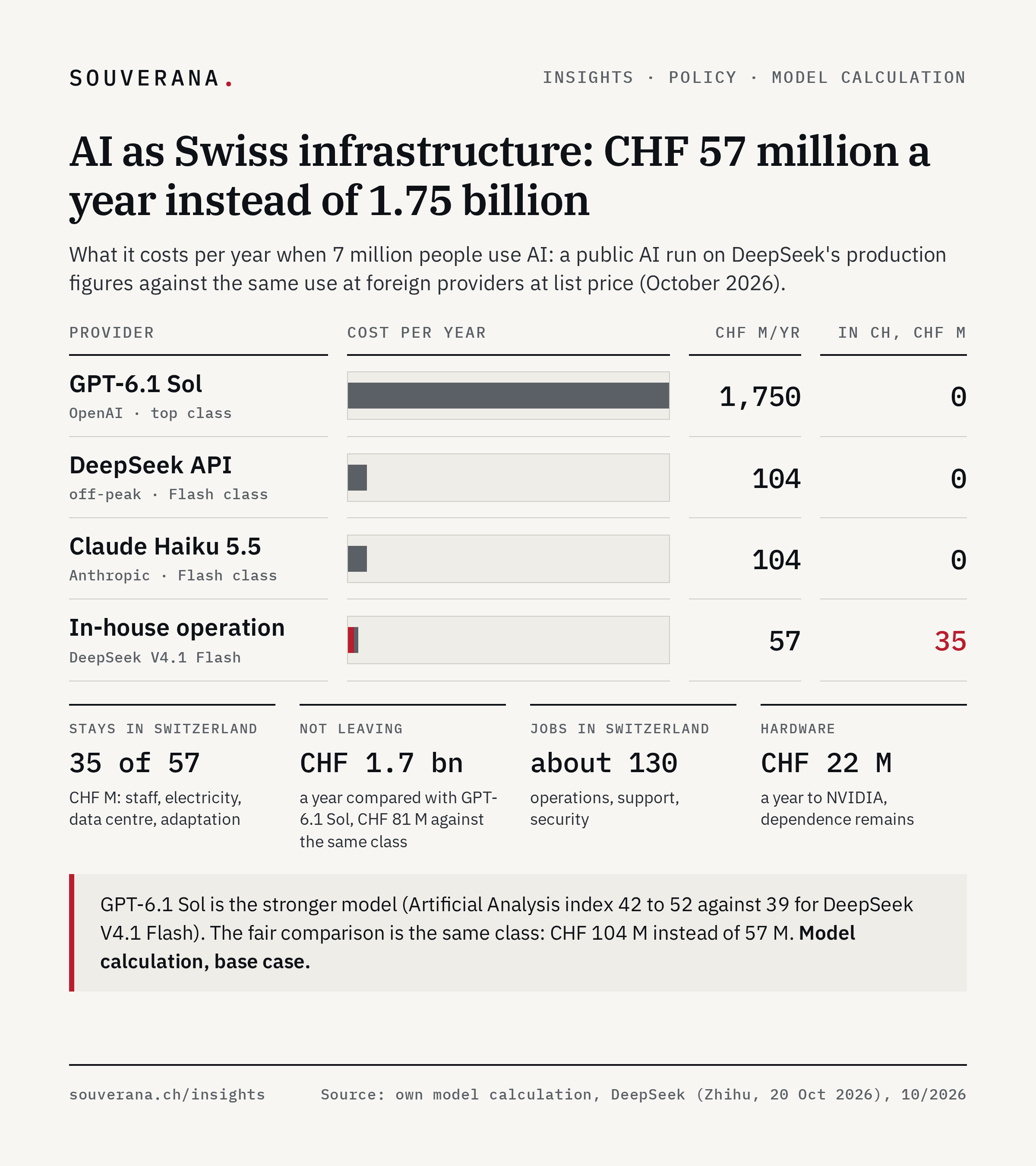
As a cross-check, we calculated the same tokens at the list prices of foreign providers.[5, 16–20] The comparison is fair only between models of the same performance class. The third column shows how much of each amount flows abroad.
| The same volume of tokens at | CHF million per year | of which abroad |
|---|---|---|
| In-house operation (DeepSeek V4.1 Flash) | 57 | 22 (hardware) |
| DeepSeek’s API, off-peak | 104 | 104 |
| Claude Haiku 5.5, list price | 104 | 104 |
| GPT-6.1 Sol, list price | 1,750 | 1,750 |
DeepSeek’s API costs twice the off-peak price at peak times, so around CHF 207 million.[5] Anyone who uses DeepSeek’s API pays roughly twice the in-house cost for the same volume even off-peak, abroad and without control over the data.
“The same volume” is the token consumption from step 1: 11.9 trillion input tokens and 293 billion output tokens per day, around 4.5 quadrillion tokens a year. Per million tokens, that is on average 1.3 centimes in-house, 2.3 centimes (off-peak) to 4.6 centimes (peak) with DeepSeek’s API, and 39 centimes with GPT-6.1 Sol.
Two comparisons that should not be mixed:
- Same performance class: Compared with Claude Haiku 5.5 or DeepSeek’s API (CHF 104 million each), in-house operation is around 45 per cent cheaper. Around CHF 81 million a year less flows abroad (CHF 104 million against the CHF 22 million for the hardware). This is the fair comparison.
- Frontier model: GPT-6.1 Sol is stronger (see Basics) and costs more than 30 times as much as in-house operation. Compared with the list price, around CHF 1.7 billion less flows abroad. The figure shows the order of magnitude, not a forecast of spending.
And if users have a subscription?
Most people do not pay per token but a subscription: ChatGPT Plus costs CHF 20 a month in Switzerland, ChatGPT Pro CHF 83 (OpenAI price page, October 2026).[21] That is CHF 240 and CHF 996 a year. The table sets them against the token costs of the three profiles from Step 1, calculated at the GPT-6.1 Sol list price and for 365 days:
| Profile | API, GPT-6.1 Sol | Subscription | Ratio |
|---|---|---|---|
| Light | CHF 46 | Plus: CHF 240 | Subscription about 5 times as expensive |
| Power | CHF 384 | Plus: CHF 240 | Subscription about 40 per cent cheaper |
| Agent | CHF 816 | Pro: CHF 996 | Subscription about 20 per cent more expensive |
For the base case with 7 million users this gives:
| Scenario | CHF million per year | Multiple of in-house operation |
|---|---|---|
| In-house operation (DeepSeek V4.1 Flash) | 57 | 1 |
| All 7 million on a Plus subscription | 1,680 | about 29 |
| 6.2 million (light and power) on Plus, 800,000 agents via the API | 2,140 | about 37 |
| As above, agents on a Pro subscription | 2,290 | about 40 |
| The same volume via the GPT-6.1 Sol API | 1,750 | about 31 |
A subscription therefore does not change the order of magnitude. Per user and month, Plus costs CHF 20 and in-house operation CHF 0.68. Who pays is a separate point: with a subscription the user bears the cost, and light users pay for headroom they do not need. The subscriptions also have limits that OpenAI does not state as a token volume. Whether Plus can carry a power profile of 1.5 million input tokens a day is unknown to us, and in practice agents are programmes inside products that run through the API. Not all 7 million users have a subscription either, many use the free version.
What stays in the country
Of the CHF 57 million, CHF 35 million stay in the country: staff for around 130 full-time posts, electricity, data centre space and the adaptation of the model. CHF 22 million go abroad as depreciation of the hardware. So 61 per cent of the costs stay in the country. For an operation with 1 million users, the share is 79 per cent: staff weighs more in a small operation, and the hardware makes up a smaller part of the costs. Whether the money that does not flow out would be saved or spent otherwise is for the users to decide. The calculation shows only that it does not flow to a foreign provider.
What the comparison does not show
- At the list prices of GPT-6.1 Sol, Switzerland would not consume the same volume: many agent applications would not pay off. The comparison holds volumes equal and is not a forecast of spending.
- Large customers negotiate discounts. The list price is the upper limit.
- Cost is not price. A service for companies would need surcharges for sales, support and risk, which are not included in the CHF 57 million.
- We have not compared model strength and answer quality. The token volume is also not directly comparable: tokenizers differ, and reasoning tokens are billed as output with GPT. The same token volume is therefore not the same work.
- The subscription calculation assumes that a Plus subscription covers the volume of the power profile and a Pro subscription that of the agent profile. OpenAI states no token limits for them. The subscription prices are OpenAI’s prices, our own costs are not.
- The prices of GPT-6.1 Sol and Claude Haiku 5.5 come from secondary sources and have not been checked against the providers’ price pages (as of October 2026).[16, 19]
What this means for Swiss companies in international competition
The following assessment rests on figures from the calculation. It assumes that a national operation offers its service at cost price. No such offer exists, and with surcharges the price would be higher.
For normal office work, tokens are a small item. An employee in the power profile costs around CHF 263 a year at the GPT-6.1 Sol list price (250 working days), and around CHF 5 at the cost price of the national operation (the costs without surcharges). An agent (10 million tokens per day, 96 per cent cache hits) costs around CHF 559 a year at list price and around CHF 32 at cost price. For comparison: in the calculation, one full-time post costs CHF 200,000. Five things are decisive:
- Price, where tokens are a product cost. For an agent, the list price is 17 times the cost price. This takes effect only at large volumes: 1,000 agents cost CHF 0.56 million a year at list price and CHF 0.03 million at cost price. Anyone who builds agents or mass processing into a product gains a cost advantage that a competitor without access to the cost price does not have.
- Speed of adoption. Cheap AI lowers the barrier to designing processes and products around AI from the start (“AI first”). Because the operation runs entirely in Switzerland and is trustworthy, sectors with high requirements such as banking could also adopt AI quickly, without first having to settle the question of the foreign provider.
- Data. With an operation in Switzerland, data that would run into limits at a foreign provider can go into the model (not legal advice), such as professional secrets, health data and trade secrets. This widens what a company may do with AI, and is likely to matter more to banks, law firms, hospitals and industry than the token price. However, the advantage applies to every operation in Switzerland, including private Swiss hosts. A public service does not create it alone.
- Value creation in the country. As AI use grows, so do companies’ technology costs, mainly for tokens. With a foreign provider they are a levy to a US corporation. With an operation in Switzerland they become wages, contracts and profits in the country, which can be taxed here. This applies to every operation in Switzerland. A public service at cost price generates no profit itself, but it does generate wages and contracts.
- Reliability. For software, a Swiss operation is independent of a model provider’s price lists and terms of delivery. For hardware, the dependence on NVIDIA and US export rules remains.[22, 23]
Compared with foreign competitors who buy at list price from a top-class provider, Swiss companies with access to the cost price would have a cost advantage. Compared with those who use a model of the same tier through a cheap API (Claude Haiku 5.5 or DeepSeek’s API, both around CHF 104 million for the same volume), the cost advantage is considerably smaller: the national operation is then still around 45 per cent cheaper. The larger advantage would then lie in data and reliability.
How reliable the figures are
The calculation rests on assumptions, for example on hardware prices, the electricity price and throughput. To see how strongly the result depends on them, we changed each assumption individually. The costs then lie between around CHF 42 and 83 million a year. If several unfavourable assumptions come together, they reach up to CHF 97 million, which is CHF 5 to 11 per resident. The electricity price shifts the result by just under CHF 1 million, the hardware price by about CHF 6 million, the model adaptation by minus 2 to plus 4 million. Three assumptions have a stronger effect:
- Operator throughput: This is the quantity of tokens that a GPU processes. If a Swiss team reaches only half of DeepSeek’s throughput per GPU, the costs rise by CHF 26 million.
- Consumption of the heavy users: If agents need 30 instead of 10 million tokens per day, the costs rise by CHF 17 million.
- Office-hours peak: This is the traffic during office hours, which the installation must be sized for. Without it, the costs fall by CHF 15 million.
The office-hours peak costs around CHF 15 million a year (57 compared with 42 at an even load), because on average only about a third of the installed capacity is utilised. DeepSeek closes the gap in utilisation with worldwide traffic and with halved prices outside peak hours.[1, 5] A Swiss service could fill the night with time-insensitive jobs: mass processing of documents for the administration, research jobs, evaluation runs and capacity for Swiss companies at cost price. We have not examined whether the night capacity is suitable for fine-tuning Apertus.
Calculate it yourself
In the calculator, you distribute the 9.1 million residents across four groups (do not use AI, light users, power users, agents), which always add up to the whole population. Below that, the assumptions appear as real values, for example the throughput per GPU in tokens per second, the GPU price in US dollars or the model adaptation in millions of francs. You can replace every value with your own and return to the default assumptions with one click. A second slider sets over how many years the hardware is spread. The result consists of three figures: the cost of buying the hardware, the running costs of operation per year, and the cost per active user and month. The comparison with abroad calculates the same token volume per year at the list prices of GPT-6.1 Sol and at the off-peak price of DeepSeek’s API. The three presets correspond to the stages of the roadmap in the article Public AI for Switzerland: 1 million users (administration, schools, universities), 5 million (everyone who already uses AI) and 7 million (base case). At 1 million users, in-house operation is not cheaper than DeepSeek’s API, because at this size more than half of the costs go to staff. We have not calculated where the threshold lies between 1 and 5 million users.
What we could not check
-
DeepSeek’s article does not name the hardware on which the throughput figures arose.[1] If they come from older chips, the B300 performs better than assumed here. If they come from a team that knows its model better than anyone else, a new Swiss operator will at first do worse. Both possibilities are included in the table of tested assumptions.
-
We do not know how much Switzerland pays abroad for tokens today.
-
We have not independently checked the index values of Artificial Analysis with which we compare the strength of the models.[3]
-
For Claude Haiku 5.5, the calculation uses the price up to 100,000 tokens per request. Above that, a higher price applies, so the figure is too low.[19, 20]
-
We assumed that OpenAI reaches the same cache hit rates with these profiles as DeepSeek.
-
DeepInfer has been public since 20 October. We do not know how mature it is outside DeepSeek’s own infrastructure.
-
The user profiles and the size of the three cases (1, 5 and 7 million users) are assumptions, supported by survey data. Actual token consumption per person, especially for agents, can deviate by a factor of three or more.
-
The costs of model adaptation are an estimate from effort and price assumptions. Neither Perplexity nor anyone else has published costs for such a project. How strongly the adaptation changes the model’s performance is open.
-
In the calculation, the peak factor (the ratio of peak load to average load) applies to all traffic, including agents that are not tied to office hours. For the 800,000 agent users in the base case, there is no source for this assumption. The costs of a second site and of a pilot operation are also not derived.
-
Facility costs, staff numbers and the peak factor are estimates. Tender prices and traffic measured in a pilot should replace them.
-
The statements on the interpellation, on the model data of V4.1 Flash, on the export rules, on Alps and on electricity prices come from the sources named below.[23, 24, 26–29] We have not checked them individually against the original documents.
What you take away
For policy, the calculation provides a benchmark: a public AI with 7 million users costs in the order of CHF 57 million a year (range CHF 42 to 97 million). That is around 45 per cent less than the same usage would cost with an equally strong model through a foreign API. What follows from this for ownership, funding and dependence is described in the article Public AI for Switzerland.
For companies and hosts, this yields a guide value: at 5 to 7 million users, a token costs 28 to 66 per cent of DeepSeek’s API list price when run in-house.[5] A Swiss host that charges clearly more than this should be able to justify the premium: with lower utilisation, a higher peak factor or higher staff costs. For a single company, this guide value does not apply unchanged, because small operators utilise their GPUs less. The figures are a benchmark for follow-up questions, not a quote.
Sources
Share this article
Ready-formatted graphics and a suggested post for your LinkedIn feed: download, copy, post.
Suggested post
What does it cost if 7 million people in Switzerland use a public AI? We worked it out with the operating figures that DeepSeek published on 20 October 2026 for V4.1 Flash.

In the base case, operation needs around 1,300 GPUs and costs CHF 57 million a year (model calculation), of which CHF 35 million stay in the country. The same token volume costs around CHF 104 million with a model of the same performance class, and CHF 1.75 billion with GPT-6.1 Sol at list price. Our conclusion: in-house operation is around 45 per cent cheaper than equally strong models, and the bigger gain lies in data, availability and work in the country.

In the article: the demand per user profile, the hardware sizing, the sensitivity of the assumptions (CHF 42 to 97 million) and a calculator in which you change every assumption yourself. Link in the comments.

#AI #Switzerland #Infrastructure #DeepSeek #DataSovereignty