Apertus: the Swiss language model and how it was built
With Llama 4, Qwen3 and Gemma 3, what they were trained on remains unclear. With the Swiss model Apertus it is published, along with what giving up data of unclear licence costs in performance. Plus ten questions to put to any model provider.
Analysis · Published 14 Oct 2026 · Updated 21 Oct 2026 · Joel Barmettler
What is Apertus?
With the Swiss language model Apertus (ETH Zurich, EPFL, CSCS), you can check what it was trained on. Of five open models compared, only OLMo 3 allows the same. The price: Apertus trails OLMo 3 on mathematics and code, and leaving out data of unclear licence cost 5.8 per cent in performance in the trial.
The key points in brief
- Read leaderboards with caution. The team deliberately left out data with an unclear or non-commercial licence and measured what that costs: 5.8 per cent of performance on average (experiment with Apertus 8B in fine-tuning, Tech Report 1.0).
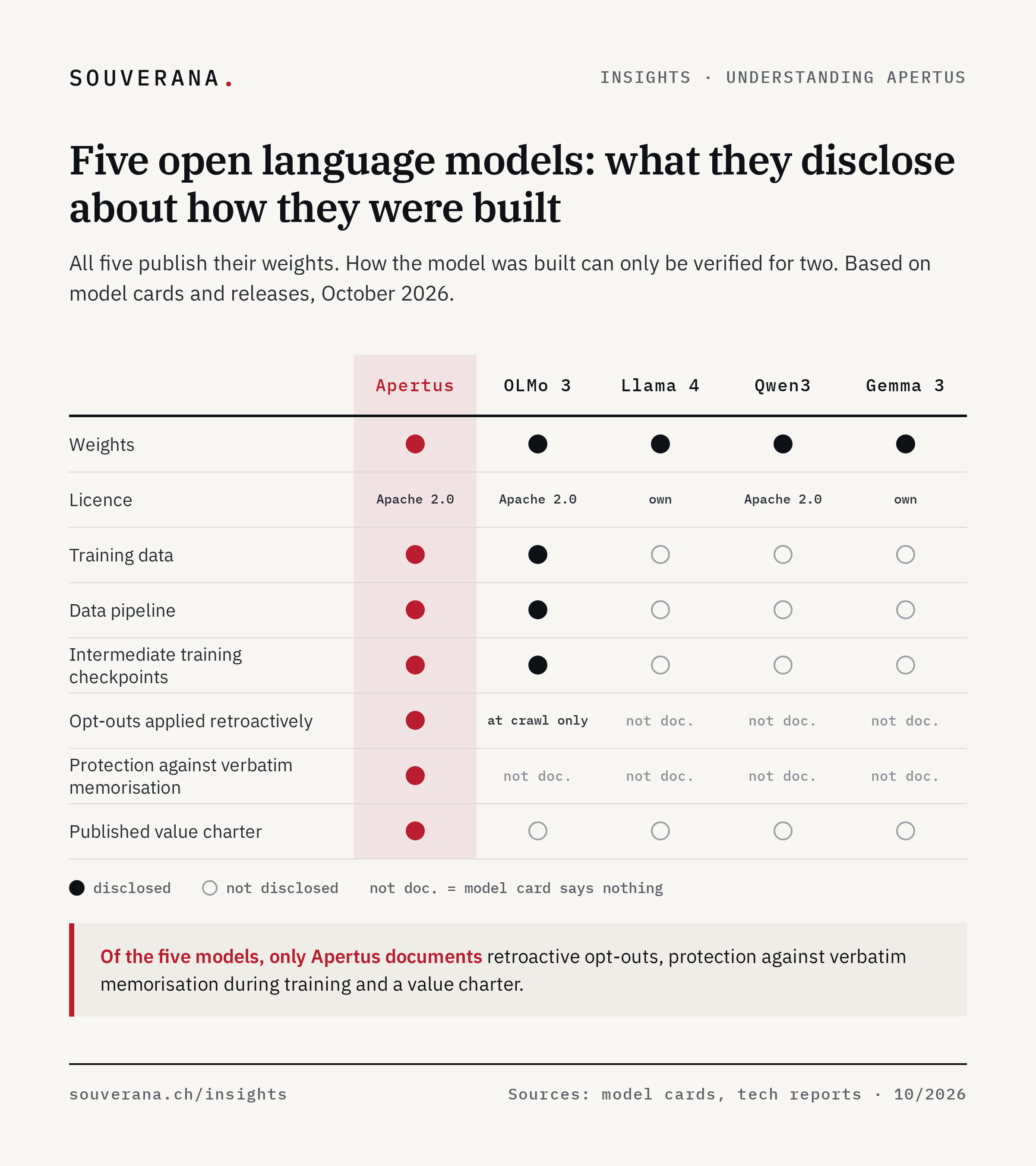
- If you need to prove what a model was trained on, that is possible with Apertus and OLMo 3: training data, pipeline and intermediate checkpoints are public. Llama 4, Qwen3 and Gemma 3 disclose only the weights (model cards, as of October 2026).
- Test specialist applications on your own cases. In a study by the team with models of 1.5 billion parameters, the opt-outs cost almost nothing in general knowledge, but measurable performance on biomedical tasks.
- If you run Apertus yourself, you need your own protection for personal data in the answers. Before training, only email addresses, IP addresses and IBAN numbers are replaced, and according to the model card the model has no filter for its outputs.
- Ask every model provider for the summary of training data that the EU AI Act requires. In March 2026, the summary for Apertus received the top grade in a review by researchers at Trinity College Dublin and the Mozilla Foundation. None was available from OpenAI, Google or xAI at the time.
Two days after the release in September 2025, the blog clickomania ran the headline “So wird das nichts mit dem Schweizer ChatGPT-Killer” (roughly: this will not work out as a Swiss ChatGPT killer).[1] The NZZ wrote in March 2026: “Nett, aber nicht praxistauglich” (nice, but not fit for practice).[2] In October 2026, SRF asked why Apertus lags behind the commercial competition.[3] All three measure a research project against finished products.
This article reads Apertus differently: as Switzerland’s ability to train large language models itself, and as a series of documented decisions about which data a model may lawfully learn from. It opens our three-part series “Understanding Apertus”.
The model family from 1.0 to 2.0
| Version | Released | Sizes | What is new |
|---|---|---|---|
| 1.0 | 2 September 2025 | 8B, 70B | 15 trillion tokens of training, context 65,536 tokens[4] |
| Mini (1.1) | May and June 2026 | 0.5B, 1.5B, 4B | distilled from the 8B, 16 models including quantisations for end devices[5] |
| 1.5 | 24 July 2026 | 8B, 70B | images as input, audio experimental, thinking mode, context 262,144 tokens |
| 2.0[6] | planned Q1 2027 | ”an order of magnitude larger” | according to the roadmap, among other things a fairer vocabulary for all languages |
“8B” stands for 8 billion parameters. Version 1.5 continues the training of version 1.0, with about 4 trillion additional tokens for the 8B and 2 trillion for the 70B.[6] Since then, Apertus has been multimodal: it reads images, but answers only in text. The team expressly describes the first quarter of 2027 for version 2.0 as a target that may slip.
Lab: what Switzerland has built with Apertus
The ability to do the training itself. The team distributed the training of the 70B model across up to 4,096 GPUs of the Alps supercomputer at CSCS.[4]
Key figure
80 %Source: CSCS, An Engineering Journey Training Large Language Models at Scale on Alps, arXiv:2604.12973, April 2026; Tech Report Apertus 1.0
CSCS describes the difficulties in a report of its own: memory bottlenecks and the stability of the connections between the machines.[7] The report on Apertus 1.0 lists 103 names, and the report on version 1.5 lists 138 from eight institutions.[4, 6]
Weights that others build on. Because the 8B model already existed, the Apertus Mini family was cheap to make. A team around Martin Jaggi (EPFL) and Dan Alistarh (IST Austria) derived models with 0.5, 1.5 and 4 billion parameters from it by distillation. The whole family needed less than 12 per cent of the computing effort that the 8B model had cost in pretraining.[5]
A narrow base. According to SRF, the first version was worked on by “lediglich zwei Leute Vollzeit, unterstützt von ein paar Dutzend Forschenden” (only two people full time, supported by a few dozen researchers).[3] Who pays for the project and what Switzerland buys politically with it is examined in the second part of the series.
What is public at Apertus and not at others
For language models, “open” stands for two different things. Open weights means: you may download and run the finished model. Open source additionally means that how the model came about can be traced. Why this difference matters for the sovereignty of a company is covered in our series on sovereign AI.
| Disclosed | Apertus | OLMo 3 | Llama 4 | Qwen3 | Gemma 3 |
|---|---|---|---|---|---|
| Weights | yes | yes | yes | yes | yes |
| Licence | Apache 2.0 | Apache 2.0 | custom | Apache 2.0 | custom |
| Training data | yes[4] | yes[8] | no | no | no[9] |
| Data pipeline | yes | yes | no | no | no |
| Intermediate training checkpoints | yes | yes | no | no | no |
| Retroactive opt-outs | yes | only at crawl time | not documented | not documented | not documented |
| Protection against verbatim memorisation | yes | not documented | not documented | not documented | not documented |
| Charter of values | yes[10] | no | no | no | no |
“Not documented” means: the model card and the publication say nothing about it. Whether the protection exists remains open.[11]
With Llama, Qwen and Gemma, you have to take the manufacturer’s word for which data went into training. Meta describes the data in the Llama 4 model card as “publicly available, licensed data and information from Meta’s products and services”.[11] For Apertus and OLMo, this can be traced through the published pipeline.[4, 8] How the retroactive opt-outs and the protection against verbatim memorisation work is described in the next section.
Lab: which data was allowed into training
Blocks respected retroactively too. In a file called robots.txt, a website specifies which crawlers may read its pages. Many websites now block the crawlers of AI firms, such as OpenAI’s GPTBot or Google-Extended. According to the report, training datasets usually respect such blocks only at the moment of the crawl. What was collected earlier stays in the dataset.[4]
In January 2025, the Apertus team queried the robots.txt of two million domains: the one million with the most English text and the one million with the most text in other languages. If a domain blocked an AI crawler, the team removed its content from all crawls from 2013 to 2024. GPTBot was blocked most often. In the English dataset FineWeb-Edu, 4.5 trillion of 4.9 trillion tokens remained as a result, and in the multilingual FineWeb-2, 45 of 47 trillion. The team puts the loss at about 8 per cent of the English and 4 per cent of the multilingual data.[12]
Whether a model with less web data knows less was examined by the three project leads Martin Jaggi, Antoine Bosselut and Imanol Schlag together with four other researchers. They call the performance difference between training with and without blocked data the “Data Compliance Gap”. For models with 1.5 billion parameters, it was close to zero in general knowledge. In specialist fields such as biomedical research, the texts of large publishers were missing, and the scores dropped. The study was published in 2025 at the COLM conference.[12]
Verbatim reproduction suppressed. Language models can memorise training texts and later output them verbatim, for example a whole newspaper article. Specialists call this memorisation. Apertus was therefore trained with the Goldfish loss. This method hides 2 per cent of the tokens during learning, at the same positions on every repetition of a text. Because the model lacks these pieces, it cannot reproduce long passages without gaps. According to the report, this also works for large models and for texts that occurred 128 times in training.[4]
Personal data and toxic content. Before training, a pattern search replaces email addresses, IP addresses and IBAN numbers with placeholders. The report itself calls this “best-effort”. The filter does not search for names or home addresses. In nine languages, including German, French and Italian, the team also removed the 5 per cent of documents that a classifier rated as most abusive or discriminatory. Code, mathematics and education datasets were exempt from this filter.[4]
Only clear licences in fine-tuning. In fine-tuning, a model learns to follow instructions. For this, the team admitted only datasets whose licence permits redistribution and commercial use, such as CC-BY or Apache 2.0. Data with a non-commercial licence (NC), with a share-alike licence (SA) or without a clear licence was dropped. The team measured what this costs in an experiment. It fine-tuned an intermediate checkpoint of the 8B model, taken after 10 trillion tokens, twice: with the widely used training mixture Tulu 3 and with its licence-filtered version.[4]
Key figure
−5.8 %Source: Tech Report Apertus 1.0, arXiv:2509.14233, Table 10
| Test | without licence filter | with licence filter | Change |
|---|---|---|---|
| Average over 13 tests | 0.443 | 0.417 | −5.8 % |
| Knowledge test with worked solution (MMLU-CoT) | 0.513 | 0.253 | −51 % |
| Knowledge about Switzerland (SwitzerlandQA) | 0.590 | 0.579 | −1.9 % |
| Truthfulness of answers (TruthfulQA MC2) | 0.486 | 0.518 | +6.6 % |
Across all multilingual tests, the average fell by 4.3 per cent. The team writes that it accepts this trade-off, “as necessary for responsible open-source model development”.[4]
Country: how a Swiss legal view found its way into the model
For the legal basis, the report points to an analysis of training on third-party content under Swiss law. It was written by David Rosenthal and Livio Veraldi of the Zurich law firm VISCHER. Both are listed in the report as advisers to the project.[4] The analysis appeared in 2025 in the journal Jusletter IT.[13]
The data rules follow an opt-out approach. Objections to the use of content are respected, even after the fact. Anyone who does not object is deemed to agree: if there is no robots.txt, the team uses the data. Moreover, only the domains with the most text were queried. A small website that blocks AI crawlers may therefore still have ended up in training. From an adviser’s point of view, the approach is nonetheless progress. A legal view that otherwise sits in expert opinions can be checked here against code and data.
In the EU, disclosure is already mandatory. The EU AI Act requires in Art. 53 that providers of general-purpose models publish a summary of their training data, following a template from the European Commission. Researchers at Trinity College Dublin and the Mozilla Foundation reviewed five published summaries for Tech Policy Press in March 2026. Apertus received the top grade on every criterion. From OpenAI, Google and xAI, no summary was available at the time.[14]
A publicly funded Swiss institution has thus shown that the EU’s transparency rule can be met. For the debate on how Switzerland intends to regulate training on third-party content, Apertus also supplies measured costs. Rights holders and model builders can both draw on them. This assessment is not legal advice.
Lab, country, operations: how the series reads Apertus
Every decision of the project can be read on three levels. Each part of the series goes through them in this order.
| Level | Question | Example from this part |
|---|---|---|
| Lab | What did the team build, research and measure? | retroactive opt-outs, Goldfish loss, licence filter with −5.8 % |
| Country | What does this mean for Switzerland, politically and legally? | a Swiss legal view on training, checkable against code |
| Operation | What does this mean for a company that uses AI? | screening questions for every model provider |
This first part describes what Apertus is and how it was built. The second asks who funds the project and what independence it brings Switzerland. The third examines which tasks the model suits in operation, where it runs and what it costs there.
What this means for your company
From an adviser’s point of view, the licence experiment changes how model comparisons should be read. Models that score better in tests are better in part because they learned from material that Apertus deliberately declines to use. How large this share is for a specific model can only be measured if its training data is public. For which tasks Apertus is nonetheless the right choice in operation is examined in the third part of the series.
If the model reproduces a name or a phone number despite the filters, your own application has to catch that. The team accepts deletion requests from data subjects at llm-privacy-requests@swiss-ai.org.[4]
The Apertus reports are a useful yardstick even if you use a different model. For a first conversation with a provider, four questions are enough:
- Is there a published summary of the training data under the EU AI Act, and where can it be found?
- Were website blocks respected, including retroactively for older crawls?
- What prevents the model from reproducing training texts verbatim?
- Which personal data was removed before training, and does anyone filter the outputs?
Apertus answers all four publicly. Get the provider’s answers in writing. Ten questions with the answers from Apertus as a comparison are included as a worksheet in the PDF.
Sources
Frequently asked questions
- What is Apertus?
- Apertus is an open language model from ETH Zurich, EPFL and the Swiss National Supercomputing Centre CSCS. Version 1.0 appeared on 2 September 2025 and version 1.5 on 24 July 2026, each in sizes of 8 and 70 billion parameters. The weights are under the Apache 2.0 licence, and the data pipelines, training code and intermediate training checkpoints are public.
- Is Apertus open source?
- Yes, in the strict sense. Besides the weights, the data pipeline, training code, intermediate training checkpoints and a charter of values are public. Llama 4, Qwen3 and Gemma 3 publish the weights, but neither training data nor pipeline. OLMo 3 from the Allen Institute for AI, for example, is about as open as Apertus (as of October 2026).
- What data was Apertus trained on?
- Apertus 1.0 learned from 15 trillion tokens, mainly from public web datasets such as FineWeb and FineWeb-2, as well as from code and mathematics. Content from websites that block AI crawlers was removed, including from older crawls. In fine-tuning, only data with a clear, commercially usable licence was permitted. The pipeline is public.
- What does leaving out sensitive training data cost in performance?
- The retroactive opt-outs cost about 8 per cent of the English and 4 per cent of the multilingual web data. In the fine-tuning experiment with Apertus 8B, leaving out data with a non-commercial or unclear licence lowered the average over 13 tests by 5.8 per cent. One test of truthfulness rose by 6.6 per cent in the process.
- Does Apertus meet the transparency obligation of the EU AI Act?
- According to a review by researchers at Trinity College Dublin and the Mozilla Foundation from March 2026, yes. They assessed five published summaries of training data under Art. 53 of the EU AI Act. Apertus received the top grade on every criterion. No summary was available from OpenAI, Google or xAI at the time.
- Is Apertus a Swiss ChatGPT?
- No. Apertus is a foundation model on which companies and public authorities build their own applications. According to the report on version 1.5, Apertus trails the open model OLMo 3 on mathematics and code, and leads all compared models at following instructions.
Share this article
Ready-formatted graphics and a suggested post for your LinkedIn feed: download, copy, post.
Suggested post
Do you know what the language model your company uses was trained on?

With the Swiss model Apertus from ETH, EPFL and CSCS, you can check. Of five open models compared, only OLMo 3 allows the same. With Llama 4, Qwen3 and Gemma 3, only the weights are open (model cards, October 2026).

The price is in the team's report. On mathematics and code, Apertus trails OLMo 3 (report on version 1.5). The report on version 1.0 also states what the team left out of training. It removed content from websites that block AI crawlers from all crawls since 2013. That cost about 8 per cent of the English web data. In an experiment with the 8B model, it left out data with a non-commercial or unclear licence in fine-tuning. Across 13 tests, performance fell by 5.8 per cent as a result, and by half in one knowledge test with a worked solution.

Our conclusion: part of the lead other models have comes from material that Apertus has declined to use. Anyone comparing models should know that. It can only be checked where data and pipeline are public.

In the article: the model family up to the planned version 2.0, the legal basis of the Zurich law firm VISCHER, the review under the EU AI Act by Trinity College Dublin, and a worksheet with ten questions for every model provider. Link in the comments.

#Apertus #AI #Copyright #Switzerland #DataSovereignty