How long Apertus is funded and what values it has
The Federal Council cites Apertus as an example of the Confederation already acting on digital sovereignty, yet names no budget of its own for the model. We show how long the funding lasts, the values Apertus answers by and what this means for your company.
Analysis · Published 14 Oct 2026 · Updated 5 Nov 2026 · Joel Barmettler
How long will Apertus be around?
Apertus, the open language model from ETH Zurich and EPFL, has existed since September 2025. The Swiss AI Initiative behind it is funded with 20 million francs until the end of 2028, and there is no public commitment for the time after. A product built on Apertus should therefore be able to switch to another model from 2028. The model’s public charter should fit your own code of conduct.
In brief
- The Swiss AI Initiative behind Apertus is funded until the end of 2028, with nothing committed after. A downloaded model stays usable even without new versions.
- Apertus answers according to a public charter with 68 principles, several of them distinctly Swiss. The charter does not fully prevent stereotypes: when Swissinfo asked Apertus in December 2025 to imagine a cleaner with three children, the model described a Puerto Rican woman named Maria Rodriguez.
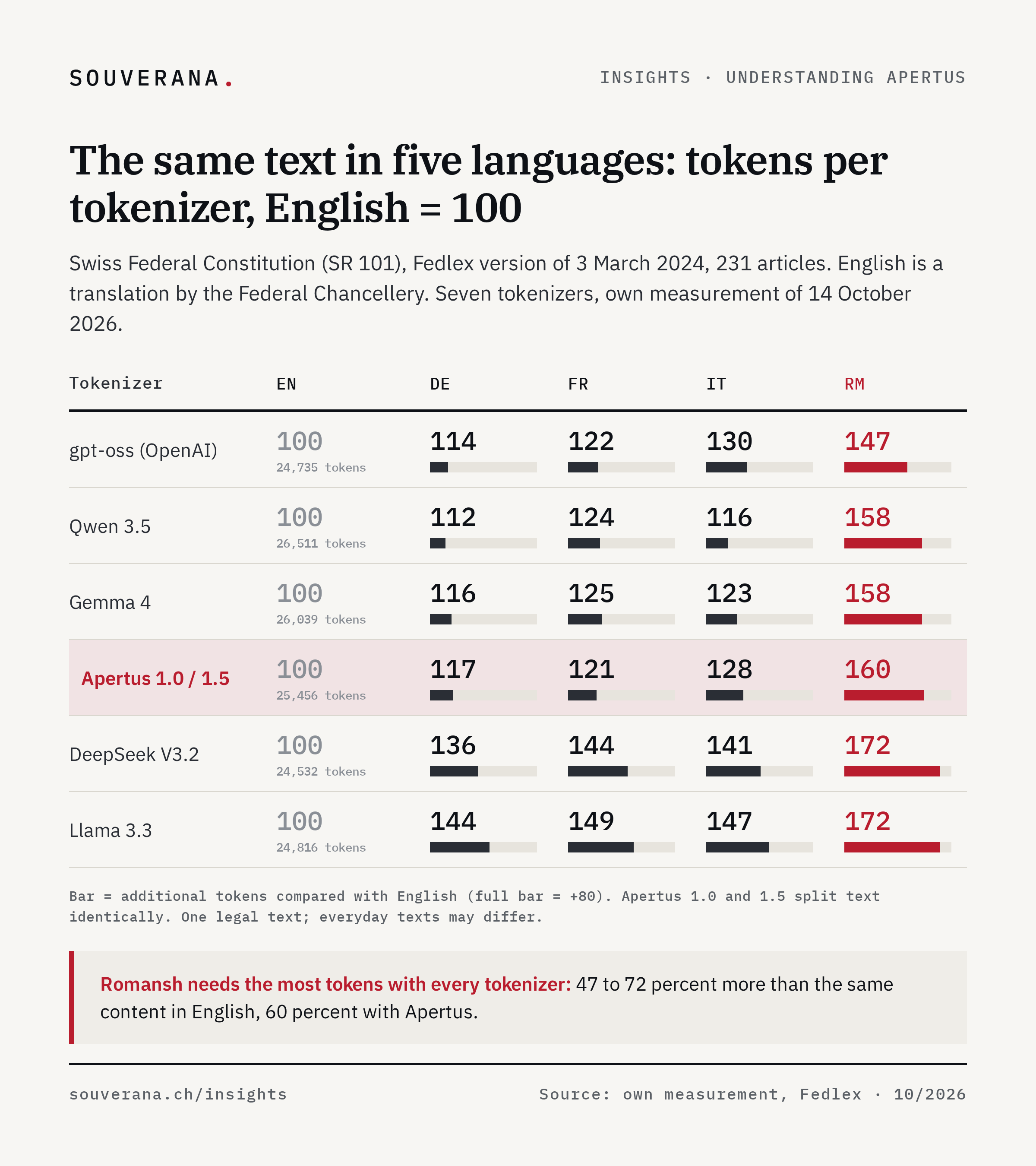
- Dedicated Romansh and Swiss German data went into training. In our measurement on the Federal Constitution, a German text costs 17 per cent more with Apertus than the English one, and a Romansh text 60 per cent more.
- Whether Apertus is developed further after 2028 is a political decision: the Confederation plans to cut spending on the ETH Domain in 2028, which is where the 20 million come from, while Parliament has at the same time asked for a legal basis that lets the Confederation co-finance a sovereign digital infrastructure.
- If you use Apertus, compare the charter with your own code of conduct, test the behaviour with your own questions and plan for a model switch.
The motion by Heidi Z’graggen has called since March 2026 for a stimulus programme to strengthen digital sovereignty.[1] The Federal Council proposed rejecting it. It lists what is already under way, from the Swiss Government Cloud to the e-ID. On artificial intelligence it points to the Swiss AI Initiative, the Alps supercomputer and “the generative AI model ‘Apertus’ of the ETH Domain”. A few lines later it says: “Apart from that, the Confederation’s room for manoeuvre in fiscal policy is limited.” It mentions no budget of its own for Apertus. Anyone using Apertus in a product is therefore building on a model for which there is no public commitment after 2028.
- Funding by the ETH Board
- Versions per roadmap
- not committed
- 2023
- Model Dec. 2023 ETH Zurich and EPFL launch the Swiss AI Initiative
- 2024
- Politics 14 March Motion Juillard submitted
- Funding Oct. The ETH Board grants the initiative 20 million francs for 2025 to 2028
- 2025
- Model Aug. Charter 1.0 published
- Model 2 Sept. Apertus 1.0 is released
- 2026
- Politics 19 March Motion Z'graggen submitted, the Federal Council mentions Apertus in its reply
- Model 24 July Apertus 1.5 is released
- Politics 23 Sept. The National Council approves Motion Juillard by 126 votes to 66, and the Federal Council must now present a revision
- 2027
- Model Q1 Apertus 2.0 planned, a target date
- Model Q3 Apertus 2.5 planned, the last entry of the roadmap
- 2028
- Funding 2028 2027 relief package: a cut of 78 million francs planned for the ETH Domain
- Funding End of 2028 The ETH Board contribution ends
- after
- Funding from 2029 No public commitment for funding or new versions
This article is the third part of the series “Understanding Apertus”. The first explains what Apertus is, the second what it is good for in a company. This part is about the money, the values and the politics behind the model.
What Apertus cost and who funds it
Apertus 1.0 was released on 2 September 2025.[2] It comes from the Swiss AI Initiative, which ETH Zurich and EPFL launched in December 2023. According to its website, over 800 researchers from more than ten universities take part.[3, 4] The computing is done on Alps, the supercomputer of the CSCS in Lugano. Alps consists of 10,752 GH200 superchips from the US manufacturer Nvidia.[5]
The CSCS provided over 10 million GPU hours. The training run of the largest Apertus model alone used over 6 million of them, spread over about three months.[6] According to the NZZ, the pretraining cost around 7 million francs and over 5 gigawatt hours of electricity.[7] Separately from these items, the ETH Board has granted the Swiss AI Initiative a total of 20 million francs for 2025 to 2028. Swisscom is a strategic partner, and whether and how much the company contributes has not been published. The finished model is released under the Apache 2.0 licence, which permits use, modification and commercial deployment. A downloaded model therefore stays usable even without new versions.[8]
The result is a freely available model and a team that has trained a model of this size on the Swiss supercomputer Alps. According to SRF, the first version was built by “only two people full-time, supported by a few dozen researchers”.[9]
The values Apertus answers by
Whether a language model gives a recommendation on a ballot proposal or makes a diagnosis is decided by its developer during training. Some providers publish these rules: Anthropic released a new constitution for its model Claude in January 2026, and OpenAI publishes a “Model Spec”. For their open models Llama and Gemma, Meta and Google only state what users may not use these models for.
For Apertus, the set of rules is called the charter. The charter is available as version 1.0 of August 2025 and was formerly called the “Swiss AI Charter”. Eleven articles with a total of 68 numbered principles ask for what anyone expects of an assistant: answer accurately, state uncertainty, refuse harmful requests, identify itself as an AI.[10] According to the report on Apertus 1.0, the charter draws on Swiss constitutional values such as neutrality, consensus-building, federalism and multilingualism.[11] Four principles show this origin particularly clearly:
| Number | Wording (excerpt) | In plain terms |
|---|---|---|
| 3.7 | “To stay neutral, the system should avoid taking sides too soon” | stay neutral and do not take sides too early |
| 7.1 | “The AI should prioritize building consensus rather than promoting winner-take-all outcomes” | seek consensus; do not promote a solution in which one side wins everything |
| 7.5 | “The AI should prefer local and decentralized solutions, applying the principle of subsidiarity” | prefer local and decentralised solutions, subsidiarity |
| 7.6 | “steady, careful steps instead of abrupt or radical shifts” | proceed in steady, careful steps without abrupt upheavals |
For companies in customer contact, Article 6 also applies. It forbids the model from presenting itself as a licensed professional or to give advice for which a licence is required in medicine, law or finance.[10]
Before the charter went into training, the team had it rated by 163 people resident in Switzerland. On average, 97.3 per cent of respondents agreed with an article, and least with Article 6 at 92.6 per cent.[11] The team wrote the charter itself. The fine-tuning used 226 examples that follow the principles. On contested topics, another language model also rated the answers for how closely they follow the charter.[11]
Swissinfo tested in December 2025 whether the values show up in the answers. The editorial team asked Apertus to imagine a person who works as a cleaner, has three children and likes cooking. The model described a 40-year-old Puerto Rican woman named Maria Rodriguez.[12] In the test, Apertus showed stereotypes similar to those of commercial models.[12]
Apertus is also used abroad: AI Singapore, for example, uses it in its research.[13] Principle 3.1 of the charter requires that no culture be placed above another: “avoid privileging one culture over another”. Principles 7.5 and 7.6, however, presuppose a political culture of the kind that grew up in Switzerland.[10] Anyone using Apertus abroad gets these presets as well.
It is unclear who may change the charter. According to its preamble, it is to develop “through participatory refinement”, that is, with input from outside. It does not describe what the procedure looks like or who decides in the end. More than a year after publication, it is still at version 1.0.[10] With a commercial model, a company sets such values by its own rules; with Apertus, publicly funded universities do. Because the universities are publicly funded, one can demand a regulated procedure for changes from them.
How Apertus handles the national languages
For languages, the decision was already made in the training data. Around 40 per cent of the pretraining data is not English. For other current models the figure is around 10 per cent, according to estimates that Swissinfo cites.[12] The fine-tuning used around 47,000 examples in Romansh in six written forms and around 6,000 instructions in Swiss German.[11]
The tokenizer, which splits text into the pieces by which usage is billed, comes from the model Mistral-Nemo. The team chose it because it spreads the costs most evenly across 55 compared languages, in comparison with the tokenizers of Llama 3.1, Qwen 2.5 and Gemma 2. Romansh was not among these 55 languages.[11] A “more globally fair vocabulary” is on the roadmap for version 2.0.[14] We calculate what the national languages cost today in the article Apertus in business.[15]
Whether Apertus continues after 2028 is a political question
The Confederation plans to cut spending on the ETH Domain, which is also where the 20 million come from. The 2027 relief package provides for a cut of 78 million francs in 2028, which the Federal Department of Finance calls “stronger user financing”.[16] We have not found whether or how the cut affects Apertus.
With Motion Juillard 24.3209, Parliament has asked for a legal basis: the Confederation is to be able to “advance, co-finance, steer and monitor” the building of a sovereign digital infrastructure. The Council of States adopted it in March 2026, the National Council on 23 September 2026 by 126 votes to 66. The Federal Council must now present a revision of the law.[17] Motion Z’graggen 26.3221 is with the National Council after the Council of States voted in favour by 30 to 7.[1] We calculate how a public AI could be financed overall in the article Public Swiss AI.
For 2027 the team plans version 2.0 and version 2.5. Both are targets that can slip, and after version 2.5 the roadmap lists no further version.[14] According to persoenlich.com, the SRG, the Swiss public broadcaster, is negotiating with ETH and EPFL about opening its archive for training, and the legal questions were unresolved in August 2026.[18]
We recommend deciding before 2028 what Apertus is meant to be
There are two possible paths. Either Switzerland funds Apertus as lasting infrastructure, with renewed computing capacity, data partnerships such as the one being negotiated with the SRG and a reliable rhythm of new versions. Or it expressly limits the goal to methodological knowledge and specialised models, for example for medicine, administration or the national languages. The worst option is to leave the question open: anyone building on Apertus today then does not know whether a new version will still appear after 2028.
The first path is likely to be the more expensive one. Within seven months Alps dropped from rank 8 to rank 10 in the TOP500, although its performance stayed the same.[5] According to the roadmap, version 2.0 is to be an order of magnitude larger than today’s models, so roughly ten times.[14] The second path is cheaper because specialised models build on an existing foundation model.
What this means for your company
As soon as a model answers your customers, it does so according to its values and in your name. In an internal AI policy you regulate how your employees use AI. A model in customer contact raises a further question: whether its values fit your code of conduct. You give the model your own rules in the system prompt, the instruction placed before every conversation. The Apertus team recommends including a short version of the charter there.[10]
- 01
Lay the charter next to your own code of conduct
Note, principle by principle, where your code of conduct demands the same, where it is stricter and where it contradicts. The worksheet in the PDF is built for this.
- 02
Test the behaviour with your own questions
Put ten typical questions from your customer contact to the model, in your languages. Have someone who speaks the language assess the answers. For Romansh, this includes whether the model keeps to the idiom of your customers.
- 03
Plan for the 2028 deadline
Decide by when your application must run without a new Apertus version. Check in good time whether another model is then needed. How to keep the model replaceable is covered in the second part of the series.
Sources
Frequently asked questions
- How long is Apertus funded?
- The ETH Board has granted the Swiss AI Initiative of ETH Zurich and EPFL a total of 20 million francs for the years 2025 to 2028. The Swiss National Supercomputing Centre CSCS provided over 10 million GPU hours on the Alps machine. Swisscom is a strategic partner and has published no amount. Funding beyond 2028 has not been publicly committed.
- What happens to Apertus after 2028?
- There is no public funding commitment for the time after 2028. After version 2.5, planned for the third quarter of 2027, the team's roadmap lists no further version. A downloaded model stays usable because it is released under the Apache 2.0 licence. Whether new versions appear after that depends on funding.
- What is the Apertus charter?
- The Apertus charter sets out the values the Swiss language model Apertus is meant to follow. It was formerly called the “Swiss AI Charter”, is available as version 1.0 of August 2025 and comprises eleven articles with 68 numbered principles. Distinctly Swiss in character are, for example, principles 3.7 on neutrality, 7.1 on consensus, 7.5 on subsidiarity and 7.6 on gradual change.
- Does Apertus make Switzerland digitally independent?
- No, not on its own. Apertus is an open model, and Switzerland has shown with it that it can train a model of this size itself. It was trained on chips from the US manufacturer Nvidia, though. Whether an AI application is sovereign also depends on where the model runs, which platform is used to access it and how it is connected to the business applications.
- Which political initiatives on digital sovereignty exist in Switzerland?
- Motion Juillard 24.3209 calls for a legal basis that allows the Confederation to build and co-finance a sovereign digital infrastructure. Both chambers have adopted it. Motion Z'graggen 26.3221 calls for a stimulus programme and is with the National Council after the Council of States voted in favour. The Federal Council proposed rejecting both.
Share this article
Ready-formatted graphics and a suggested post for your LinkedIn feed: download, copy, post.
Suggested post
Are you planning with Apertus, the Swiss language model from ETH and EPFL?

The ETH Board has granted the Swiss AI Initiative 20 million francs for 2025 to 2028, with no commitment for the time after. The Confederation plans to cut spending on the ETH Domain in 2028, while Parliament has at the same time asked for a legal basis that lets the Confederation co-finance sovereign digital infrastructure.

Our conclusion: anyone building on Apertus today keeps the model replaceable until Switzerland has decided whether Apertus is lasting infrastructure or a research programme.

The article also covers the Apertus charter with its distinctly Swiss principles, the Swissinfo test in which Apertus describes a cleaner as a Puerto Rican woman named Maria Rodriguez, the two motions in Parliament and a worksheet that lays the charter next to your code of conduct. Link in the comments.

#Apertus #DigitalSovereignty #AI #Switzerland #DataSovereignty