Apertus in business: where it works today and where it does not
According to Swissinfo, the canton of Ticino has decided to have administrative documents translated with Apertus. For agents, the Swiss model still trails other open models, in the judgement of the Ticino firm Artificialy. Which tasks fit, what a deployment costs and how to test it on your own data.
Guide · Published 14 Oct 2026 · Updated 21 Oct 2026 · Joel Barmettler
Where Apertus works in business today
Apertus 1.5 works today for translation in the national languages. For agents, code and mathematics, other open models lead, according to the team’s report and users. The open model from ETH Zurich, EPFL and CSCS runs at several Swiss hosts and on your own hardware.
The key points in brief
- Start with translation in the national languages. The Ticino firm Artificialy often prefers Apertus to other models for this, especially for sensitive documents (Swissinfo, September 2026).
- Do not plan agents on Apertus 1.5. For workflows in which the model completes several steps on its own, it is still behind other open models according to Artificialy.
- Calculate the budget in your own languages. The Italian text of the Federal Constitution needs 28 per cent more tokens with Apertus than the English one, so at the same price per token the cost is correspondingly higher (Souverana measurement, October 2026).
- A first test costs little. Infomaniak charges CHF 0.70 per million input tokens and CHF 2.50 per million output tokens for Apertus 1.5 70B (as of October 2026).
- Test the whole application. In tests by the Zurich agency Liip, a wrong answer was also caused by the search, which had selected an outdated source.
In March 2026, the Apertus team announced that the canton of Ticino is switching its translation tool for the administration from Mixtral, a model from the French provider Mistral AI, to Apertus. For this, the Ticino firm Artificialy built an adapted version of Apertus-8B, the smaller model with 8 billion parameters. This version runs on graphics cards in the data centre of the cantonal IT centre CSI. Among others, it translates between Italian, German, French, Spanish, Romanian and Ukrainian. In a first phase, around 100 employees are testing the tool.[1]
In a test by Artificialy, the adapted version reached 94 per cent. Before fine-tuning, the 8B model scored 90 per cent, and the larger 70B model without fine-tuning scored 92 per cent.[1]
This third part of the series “Understanding Apertus” examines which other tasks Apertus is suited for. It goes through the series’ three levels: what the team measured in the lab, who already uses the model in Switzerland, and what running it costs.
Lab: what the team reports for version 1.5
The report on Apertus 1.5 was published on 11 October 2026.[2] The team itself collected all the values in it. Independent comparisons so far exist only as users’ accounts of their experience.
Following instructions. Among the fully open models of its class, the 8B model leads in general knowledge and cultural knowledge. In following instructions, it outperforms all the models compared according to the report, including those that disclose only their weights (open weight).[2] An application needs this capability when the model is to keep to a fixed format, tone or length.
Mathematics and code. Here, according to the same report, OLMo 3 leads, a fully open model from the American institute Ai2.[2] You should test the thinking mode, which the first part of the series introduces, on your own tasks. For the 70B model, it raises the scores across all tests by 6.6 points on average. In a test with scientific expert questions (GPQA), however, the 70B performs worse with thinking mode.
Images. Since version 1.5, Apertus also processes images, so it is multimodal. According to the report, the 70B model adds little over the 8B here, although it is nine times larger.[2] Anyone who wants images analysed can therefore begin with the 8B. Apertus is weakest at text recognition in images (OCR), where it trails other open models. For scanned documents, it is better to put a separate OCR model in front of the language model.
Small models for end-user devices. The team has also published the models of the Apertus Mini family in compressed versions for NVIDIA graphics cards and for Apple devices. This technique is called quantisation. According to the Mini report, the compressed chat models reach 90 to 104 per cent of the accuracy of the uncompressed version, measured with a few examples in the prompt.[3] From a consultant’s perspective, these small models are suited for laptops without a network connection and for simple tasks such as summarising and sorting.
Country: who already uses Apertus
In Ticino, according to Swissinfo, the cantonal migration office benefits most from the new translation tool. Swissinfo reports that the office processes personal documents in many languages and needs precise translations with strong data protection.
Damiano Binaghi leads deep learning at Artificialy. “We often prefer Apertus to other models for our clients’ translation tasks, especially when they involve Switzerland’s four national languages or sensitive documents”, he told Swissinfo in September 2026. He bases the choice on quality: “We’re not doing charity. We don’t use Apertus because we have to, but because it’s a good model.”
Before the launch of version 1.5, 15 organisations reviewed the weights of the 8B and the 70B model, represented by around 50 specialists. They included the Federal Supreme Court, Swisscom, Switch, Infomaniak, Liip and Artificialy. Swisscom operates the 70B model on the Swiss AI Platform in a Swiss data centre.
Research also builds on Apertus. With EPFL’s medical pipeline MeditronFO, the 70B model rose from 47.2 to 53.8 points on average across four medical tests (report by the authors, arXiv:2605.16215).
In Singapore, AI Singapore uses Apertus for research because, it says, one must know which data a model was trained on. Leslie Teo of AI Singapore names the price of this openness to Swissinfo: “Being truly open-source means being unlikely to use some data, and this has consequences on performance and general capabilities.”
Operations: experience, prices and your own hardware
What users criticise
The agency Liip tested Apertus in ZüriCityGPT, an AI search that answers residents’ questions about the city of Zurich. According to Josef Kruckenberg, who leads the generative AI projects at Liip, version 1.5 gives more useful answers, follows instructions better and is more likely to decline to answer when information is missing. On the criterion that matters most to Liip, however, Apertus falls behind. That criterion is faithfulness: every statement in an answer must be supported by the sources found. “So far, we haven’t used Apertus in client projects. We felt it wasn’t ready yet”, Kruckenberg told Swissinfo in September 2026.[4]
The search was also involved in one error from these tests. Asked about the population of Zurich, the system answered wrongly, and the search had not selected the most recent source. For an application that generates answers from your own documents (RAG), you should therefore test the search and the model separately.
Artificialy also sees limits. In agentic capabilities, Apertus is, despite considerable progress, not yet at the level of other open models, says Binaghi. This means workflows that the model completes on its own in several steps. Federico Magnolfi leads language processing at Artificialy. According to Swissinfo, he estimates that version 1.0 was around two years behind the best American models at launch.[4]
Where Apertus runs and what it costs
On its list of September 2026, the Apertus team names seven Swiss providers. Swisscom, Infomaniak, PHOENIQS and Safe Swiss Cloud host the 70B model, stepping stone the 8B. OnPrem.ai installs compressed versions on the customer’s servers. For the Swiss cloud Exoscale, there is a guide for running both sizes yourself.[5] The hosts offer the model through a programming interface (API) to which you connect your own application.
| Provider | Model | Input per 1M tokens | Output per 1M tokens |
|---|---|---|---|
| PHOENIQS (kvant) | Apertus 1.5 70B | CHF 0.6195 | CHF 2.2201[6] |
| Infomaniak | Apertus 1.5 70B | CHF 0.70 | CHF 2.50[7] |
| Swisscom | Apertus 70B | no public price | no public price |
As of October 2026. Source: public price lists of the providers.
A price does not reveal the precision at which the model runs. Ask about it, because a heavily compressed version can give poorer answers.
The long context window also has a price. Apertus 1.5 processes up to 262,144 tokens at once.[2] For the 70B, a conversation of this length at full precision (BF16) occupies around 86 GB of intermediate storage (KV cache). That is more than a data-centre card with 80 GB can hold.
What the national languages cost in tokens
A language model bills in tokens. Its tokenizer first splits every text into such pieces, more finely or coarsely depending on the language. We measured this on the Federal Constitution, which exists in all four national languages and in English. The full measurement with six tokenizers is in the article on Apertus and digital sovereignty. Here the focus is on the consequences for the bill and the context window.
For the German text, Apertus needs 17 per cent more tokens than for the English one, 21 per cent more for French and 28 per cent more for Italian.[8] Anyone who calculates a budget with English test texts and then works in German underestimates the token volume by this surcharge. Less also fits into the context window: it holds around 15 per cent less of the German constitutional text than of the English one. The figures apply to a legal text. E-mails or chats may give different ratios.
The choice of model also changes the volume. For the German text, Meta’s Llama 3.3 needs 27 per cent more tokens than OpenAI’s gpt-oss, which needed the fewest in German in this measurement. At the same price per token, the bill with Llama 3.3 would be 27 per cent higher.[8]
What a token costs is set by each provider, and models use different numbers of tokens for the same task. How these factors interact is shown in our article on the cost per token. For the choice of model, this means: count the tokens of your own texts in your own languages and only then calculate with the provider’s price.
Apertus on your own hardware
In our measurement of August 2026, the 8B model of version 1.0 ran on a single graphics card (GPU), an RTX 4090 with 24 GB. We measured a typical RAG load: eight users asked questions simultaneously about the same 8,000 tokens of context. The server software vLLM can process the shared beginning of all requests just once and store it. This function is called prefix caching. With it, the wait until the first character (time to first token) fell from 17.9 to 0.9 seconds.[9]
Key figure
17.9 → 0.9 sSource: Own measurement, August 2026
Prefix caching works with Apertus because the model consists of only one type of layer. With hybrid models that mix different layer types, vLLM switches prefix caching off. The full series of measurements is in our comparison of server software.
The assessment by task
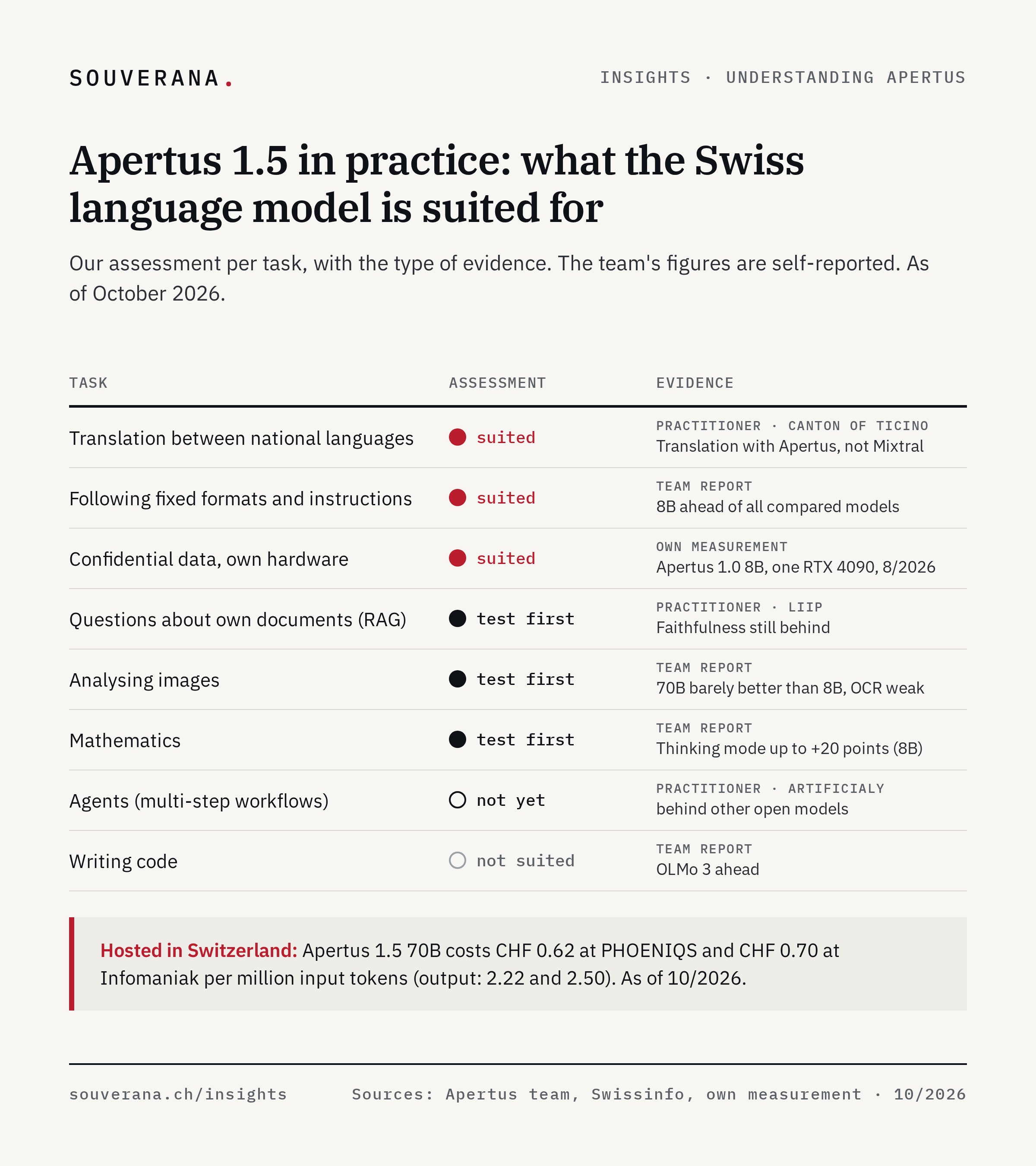
The table summarises what we would use Apertus 1.5 for today. The last column states what the assessment is based on.
| Task | Assessment | Evidence |
|---|---|---|
| Translation in the national languages | suited | Users: Artificialy, canton of Ticino |
| Keeping to fixed formats and requirements | suited | Team’s report |
| Confidential data on your own hardware | suited, 8B on one card | Own measurement (version 1.0) |
| Questions about your own documents (RAG) | with your own test | Users: Liip; own measurement |
| Analysing images | with your own test, 8B suffices, scans with an OCR model | Team’s report |
| Mathematics | only with thinking mode and your own test | Team’s report |
| Agents | not yet | Users: Artificialy |
| Code | no | Team’s report |
If the model answers your customers directly, also check whether its published charter of values matches your own policies.
How to deploy Apertus
To get started, we recommend three steps.
- 01
Choose a task
Take a limited task in several national languages where the origin of the training data matters, such as translating internal documents or answering questions from a manual.
- 02
Compare against a strong open model
Have Apertus and a strong open-weight model solve the same ten test cases from your daily work, with your own documents and in your own languages. Rate the search and the answer separately and note the tokens per language.
- 03
Plan for the switch
Build the application so that the model sits behind a standard interface. Then you can later move to Apertus 2.0 or to another model by changing a setting.
Sources
Frequently asked questions
- What is Apertus suited for in business?
- Apertus 1.5 is suited for translation in the national languages and for tasks where it must be documented what the model was trained on. According to the team's report, the 8B model follows instructions better than all the models compared. Answers drawn from your own documents require your own test. For agents, code and mathematics, other open models lead.
- Where can Apertus be used as an API in Switzerland, and what does it cost?
- According to the Apertus team, Swisscom, Infomaniak, PHOENIQS and Safe Swiss Cloud, among others, offer the 70B model in Switzerland (as of September 2026). For Apertus 1.5 70B, Infomaniak charges CHF 0.70 per million input tokens and CHF 2.50 per million output tokens, PHOENIQS CHF 0.6195 and CHF 2.2201 (as of October 2026). Swisscom does not publish a price.
- Is Apertus suited for agents and programming tasks?
- Not today. According to the Apertus 1.5 report, the open model OLMo 3 leads in mathematics and code. Damiano Binaghi of the Ticino firm Artificialy, which uses Apertus for translation, sees the model as not yet on the level of other open models for agentic tasks (Swissinfo, September 2026).
- Does Apertus need more tokens in German than in English?
- Yes. In a Souverana measurement on the Swiss Federal Constitution (October 2026), Apertus needed 17 per cent more tokens for the German text than for the English one, 21 per cent more for French and 28 per cent more for Italian. As a result, about 15 per cent less of the German text fits into the context window than of the English one. What a token costs is set by the provider.
- Can Apertus be run on your own hardware?
- Yes. The 8B model of version 1.0 ran on a single graphics card in a Souverana measurement (August 2026), an RTX 4090 with the server software vLLM. With eight users and 8,000 tokens of shared context, prefix caching reduced the wait for the first character from 17.9 to 0.9 seconds.
- Who already uses Apertus?
- The canton of Ticino is moving its translation tool for administrative documents to a fine-tuned Apertus-8B in the cantonal data centre; in a first phase, about 100 employees are testing it. EPFL uses Apertus as the basis of its medical pipeline MeditronFO, and AI Singapore uses it in research. Before the launch of version 1.5, 15 organisations reviewed the weights, including the Federal Supreme Court and Swisscom.
Share this article
Ready-formatted graphics and a suggested post for your LinkedIn feed: download, copy, post.
Suggested post
Are you currently assessing whether the Swiss language model Apertus suits your business?

According to Swissinfo, the canton of Ticino has decided to translate administrative documents with Apertus in future. The tool runs on a fine-tuned Apertus-8B in the data centre of the cantonal IT department; in a first phase, about 100 employees are testing it. Swiss hosts offer version 1.5 with 70 billion parameters, Infomaniak for example at CHF 0.70 per million input tokens (as of October 2026).

We have sorted the team's report, the experience of Liip and Artificialy and our own measurements by task. For translation in the national languages, Artificialy often prefers Apertus to other models, especially for sensitive documents. For agents, the same firm judges it to be still behind other open models, and for mathematics and code the team's report places it behind OLMo 3.

Our conclusion: today Apertus is worthwhile for individual tasks in the national languages where you must be able to document what the model was trained on.

The article covers the Swiss hosts with their prices, what a German text costs in tokens compared with an English one, our measurement of Apertus-8B on a single graphics card, and a worksheet with ten test cases for comparing on your own data. Link in the comments.

#Apertus #AI #Switzerland #DataSovereignty #OpenSource