AI strategy for SMEs: the questions to answer first
Most AI strategies are tool lists. Nine questions for senior management set how much control a Swiss SME keeps over its AI. No ready-made framework.
Strategy · Published 15 Jul 2026 · Updated 1 Oct 2026 · Joel Barmettler
Where an AI strategy really begins
Whoever starts by choosing a tool has already decided their AI strategy without noticing. An AI strategy sets out what you use AI for, on which foundation, and what that costs over the years. For a Swiss SME, it comes down to a handful of decisions for senior management: where AI creates value, how tightly you bind yourself to a provider, which data is sensitive, and who takes over the operation.
In brief
- Sort your data by confidentiality first, then the tools. Every data class needs its own degree of sovereignty, that is, of control over model, operation and data, from public text to case files.
- For data covered by professional secrecy, the Financial Market Supervisory Authority FINMA or official secrecy, rules prescribe some of these decisions. The weighing falls away, and you implement the requirement.
- The article poses nine questions for senior management, for example on value, on the most sensitive data and on cost over ten years. Half a day is enough for the answers, and you do not need a ready-made framework.
- The nine answers together form a profile of your company. That profile shows where a convenient standard service is enough and where the effort of sovereign operation pays off.
Most papers called an “AI strategy” are tool lists: Microsoft Copilot here, a chatbot there. That order is backwards, because then the tool dictates the strategy. In our foundational article on sovereign AI, we described sovereignty as a mixing desk. Each dial stands for an area in which you can keep control: model, operation and data. You set the dials according to how confidential your data is. Where those dials should sit follows from a few questions about your business.
This is the second part of our series on sovereign AI. The first named the dials, this one shows how you determine their position for your company.
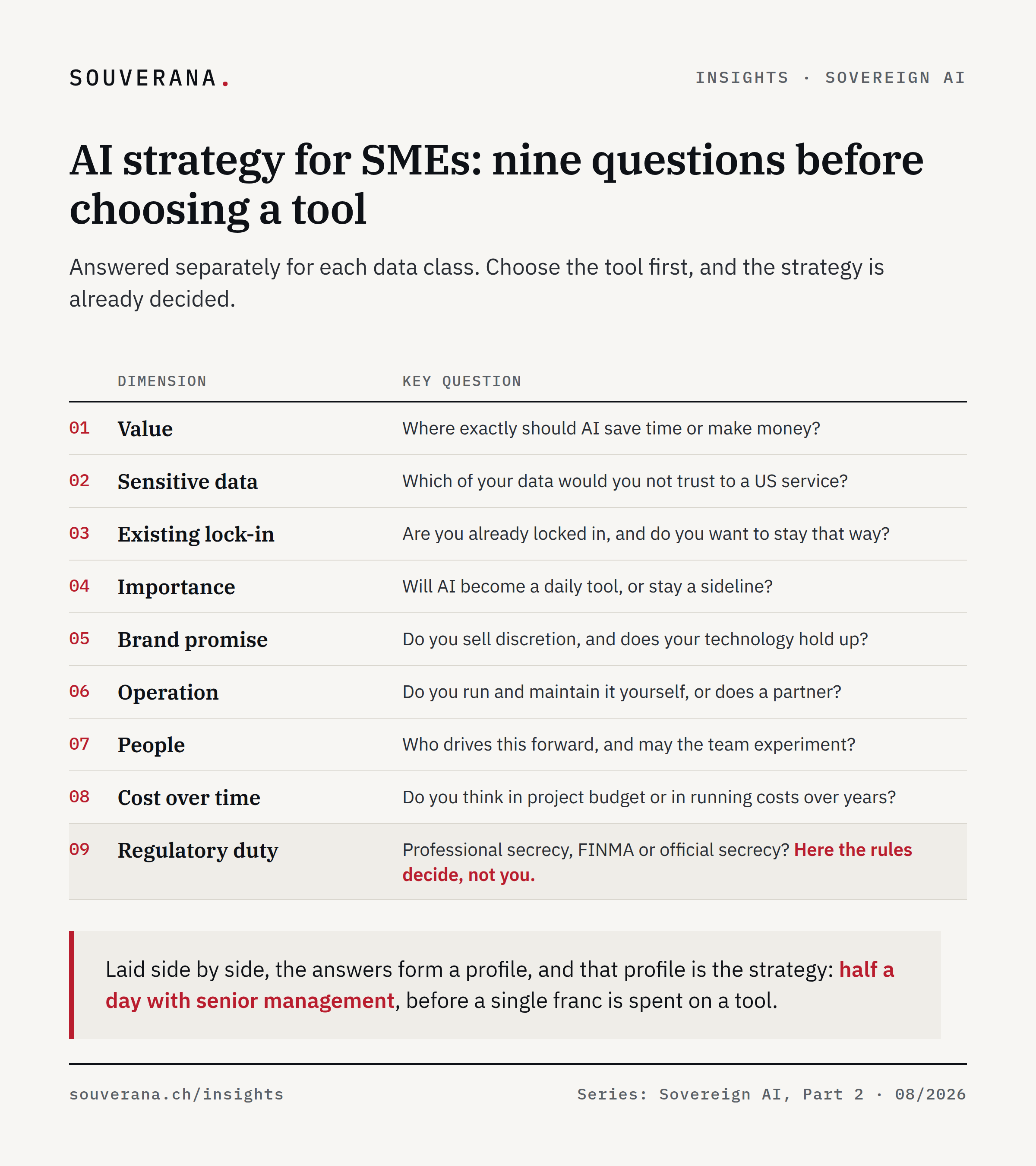
Nine questions for senior management
Take an hour with senior management and work through the following questions in order. Together they set where your dials sit.
01 Value and use case
Where exactly should AI save you time or bring in money?
Without a concrete project, every further question stays theoretical. Start with the work that takes too long today or does not get done, for example writing quotes, answering support requests or searching through old documents. Only once it is clear what AI should work on can you say which data it touches and how sovereign it needs to run.
02 Most sensitive data
Which of your data would you not trust to a US service?
Work through the question concretely, data type by data type. For most companies, the answer turns out smaller than expected. Product copy, website content and internal notes are uncritical. Sensitive data includes HR files, client data, contracts, and health or case data. Sovereign operation pays off for this small part, and only for it. The large remainder may run comfortably and cheaply on a standard service.
03 Existing lock-in
Are you already committed to a large provider, and do you want to stay that way?
This question often takes the pressure off. If mail, documents and identity have long sat with Microsoft and are meant to stay there, there is little reason not to set up AI there too. Breaking out of your own ecosystem for a single use case rarely justifies the effort. The real question then becomes what this path costs over ten years, and how easily you could leave it again later.
04 Importance in the core business
Will AI become a tool you rely on daily, or will it stay a sideline?
As long as AI helps draft an email faster, an outage is harmless. If it sits inside a core process your operation depends on, it becomes expensive. A provider that discontinues a model, doubles the price, or quietly swaps it for a weaker one then leaves you in a difficult position. Open weights, that is, freely available model files, and open software end that dependence. The model keeps running on your infrastructure even if the provider retires it or raises the price.
05 Brand promise
Do you sell your clients discretion, and does your technology keep that promise?
For a trust office, a law firm or a medical practice, confidentiality is the product. If the same client data ends up with a US corporation via an AI service, the story no longer holds together, and a client who asks notices immediately.
06 Operation
Do you want to carry operation and maintenance yourself, or should a partner take it on?
You remain sovereign with a partner too. What matters is that the contract records who operates which part, and that you could switch if it came to that. A small SME without its own IT sensibly hands the model, hosting and maintenance to a Swiss partner. A company with a strong team of its own runs more of it itself.
07 People and competence
Who inside the company drives this forward, and may the team experiment?
Name one person who is responsible. Without one, even a good pilot project comes to a standstill after the first few weeks. Employees also need a protected test space where a failed prompt, that is, an instruction to the AI, has no consequences. The EU AI Act requires adequate AI competence in the team anyway. The right training also helps AI deliver real benefit.
08 Cost over time
Do you think in a one-off project budget, or in running costs over years?
An AI system costs more to run than to acquire. Over the years, what counts are the price per token (the unit of text that providers bill by), the utilisation of the system, and the cost of leaving a provider again. Our article on LLM cost works through how misleading the raw model price can be.
09 Regulatory duty
Is your data subject to professional secrecy, FINMA, or an official secrecy obligation?
For some data, the answer is not a matter of weighing options. Whoever is bound by lawyer, doctor or banking secrecy or falls under FINMA requirements already has some dials set by the rules. These cases belong at the start of the strategy: whoever discovers them only after choosing a tool has to plan the architecture again.
What your answers add up to
Lay the answers side by side, and a profile emerges. A trade business lands on the left for most dials (convenient standard service), and that is enough for it. A law firm with case data lands on the right (sovereign operation). Most SMEs sit in between, and at a different point depending on the data class: the newsletter on the left, the HR file on the right. This profile is your strategy. It tells you where you may stay convenient and where the effort pays off, before you spend a single franc on a tool.
The three following articles in this series then cover, one by one, the layers on which you implement these dials: the infrastructure with model and operation, the platform for daily use, and the integration into your line-of-business applications.
What this means for your company
The questions above can be discussed in a single session; the answers need a sober look at your own data and processes. That is exactly what the AI positioning assessment is for: a structured meeting where we work through the questions with you and turn the answers into a prioritised path. At the end you hold a self-contained result you can keep working with, even without us.
Frequently asked questions
- What belongs in an AI strategy?
- An AI strategy sets out what you use AI for, on which foundation, and what that costs over the years. Technology plays a small part in it. For an SME, it comes down to a handful of decisions: where AI creates value, how tightly you bind yourself to a provider, which data is sensitive, who takes over the operation, and who drives the adoption.
- How does an SME develop an AI strategy?
- With a few honest questions to senior management, before choosing a tool: the concrete value, the most sensitive data, the existing lock-in to a provider, the importance of AI in the core business, the discretion promise to clients, the operation, the people and competence in the company, the cost over time, and the regulatory duties. These answers make up the strategy.
- Should we build our AI strategy on Microsoft?
- If mail, documents and identity already sit with Microsoft and are meant to stay there, there is little reason not to set up AI with Microsoft too. What then matters most is what this decision costs over ten years and how easily you could leave Microsoft again later.
- What is a sovereign AI strategy?
- A sovereign AI strategy sets out, for each data class, how much control you want to keep over the model, the operation and the data. Often only the sensitive data needs sovereign operation, and that is usually a small part. All other data may stay on a convenient, cheap standard service.
- Does a small company even need an AI strategy?
- Yes, but a lean one. A handful of conscious decisions is enough to stop you from tying yourself to a provider for years, without noticing, through the choice of a tool. One page suffices, with the answers to nine questions that senior management notes down in half a day.
Share this article
Ready-formatted graphics and a suggested post for your LinkedIn feed: download, copy, post.
Suggested post
How does AI adoption start at your company: with a tool list or with questions?

Most papers called an AI strategy are tool lists. Microsoft Copilot here, a chatbot there. That order is backwards, because whoever starts with the tool has already decided the strategy without noticing, often for years.

Nine questions belong before that: value, most sensitive data, existing lock-in, importance in the core business, brand promise, operation, people, cost over time, regulatory duty. You decide eight of these. The ninth is decided by the rules, if you are bound by professional secrecy, the Financial Market Supervisory Authority FINMA or an official secrecy obligation.

Our conclusion: laid side by side, the answers form a profile, and that profile is the strategy. It tells you where you may stay convenient and where the effort pays off. Half a day with senior management is enough for that.

The article spells out all nine questions, three worked profiles from a trade business to a law firm, and a worksheet for the strategy session. Link in the comments.

#AIStrategy #SME #Switzerland #DataSovereignty