Sovereign AI infrastructure: why the model is the easy part
The language model is the easiest part of your AI to swap. What ties you to one provider are the models that read your documents and make them searchable (OCR and embeddings). Which Swiss hosters offer every component.
Guide · Published 14 Jul 2026 · Updated 1 Oct 2026 · Joel Barmettler
What infrastructure actually means for AI
When AI is meant to answer questions from your own documents, it needs more than a language model. That includes services that prepare your data: OCR (text recognition) reads scans as text, transcription writes out audio, an embedding model translates text into series of numbers for search. You can swap the language model in an afternoon. Switch the embedding model, and you have to re-ingest all your documents.
In brief
- Compare providers by how much of the data preparation they take on for you: ingesting documents, converting them into vectors and storing them. The more the provider takes on, the harder a later switch becomes. That is why the most convenient offer binds you the tightest.
- For the embedding model and for OCR, use open models that you can also operate yourself. Only then can you switch provider later.
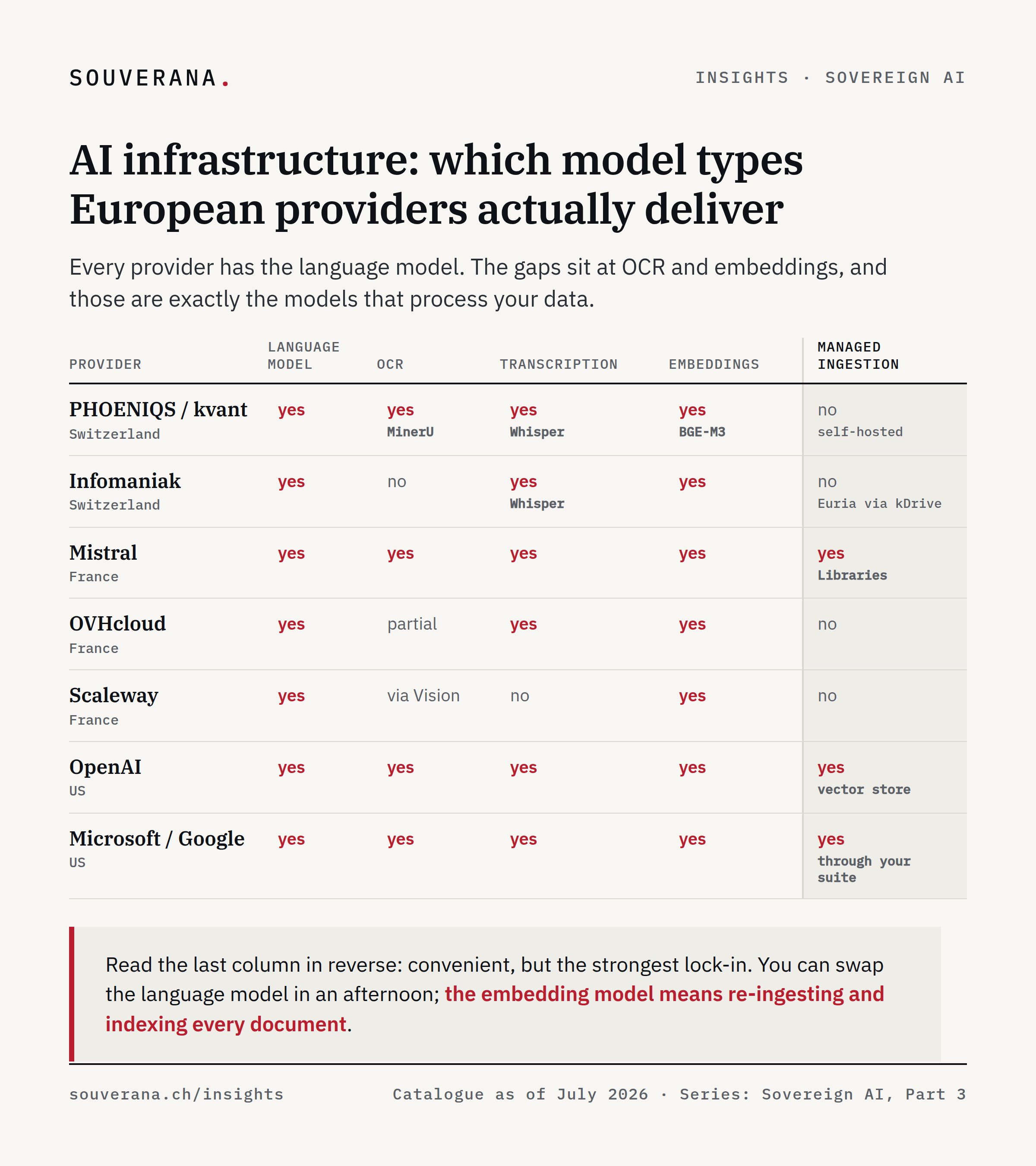
- Choose a hoster that runs all the data-preparation models in Europe. If a hoster offers only language models, you have to fall back on a US API for embeddings and OCR. As of July 2026, only PHOENIQS/kvant, a hoster for open AI models, offers the complete set in Switzerland.
- For the language model, performance and running costs are enough to go on, because that is the easiest decision to correct.
Public debate revolves almost entirely around language models, meaning AI like ChatGPT that understands and writes text. For a company, though, the language model is only the final step in a longer chain.
This is the third part of our series on sovereign AI. It covers the lowest of three layers, where your data is prepared.
The model does not know your documents
A language model is trained on the public internet. It knows nothing about your company: it has never seen your contracts, your quotes or your meeting minutes either. Yet anyone using AI in a business wants exactly that: answers from their own documents.
Those documents exist as PDFs, as office files, as scanned contracts, as recordings of meetings. Before a language model can use them, they first have to be turned into searchable text. The rest of the infrastructure handles that: an OCR model makes documents and scans readable, transcription writes out audio, an embedding model makes the text searchable, a vector database stores it, and only at the end does the language model compose an answer from the matching passages.
This interplay is called RAG, Retrieval-Augmented Generation, and it runs in two phases. Once, you ingest your documents and store them in searchable form. After that, every question runs through the second phase, from the search through the matching passages to the evidenced answer.
Each of these stations is its own decision, with its own providers and its own consequences for sovereignty. Anyone who only looks at the language model overlooks most of it. So we start with the question of how a company obtains AI in the first place.
How companies obtain AI
How sovereign a solution becomes depends above all on how much work the provider takes off your hands. Where the provider works for you, it also keeps control afterwards. Four paths, from the greatest convenience to the greatest control:
| Path | Provider | What you get | Data preparation |
|---|---|---|---|
| Suite with AI over your data | Microsoft, Google, Infomaniak | ready-made apps plus AI on top | the provider, in its own storage |
| AI platform with ingestion | OpenAI, Mistral | components plus managed storage | the provider, in its cloud |
| Cloud with model APIs | OVHcloud | models as a service, you build the pipeline | you |
| Open models, self-operated | Scaleway, PHOENIQS, on-premise | open models, full control | you |
The most convenient are the suites. Microsoft and Google dominate enterprise AI because your documents and mail already sit with them. Copilot searches SharePoint and OneDrive, Gemini searches Google Drive; the AI reads the data you already keep there anyway. Infomaniak belongs in the same category, with Swiss infrastructure: Euria searches the files in your kDrive and runs on open models in Switzerland. It is a hosting provider with built-in AI, not a company specialised in AI.
The next category is the AI platforms, whose real product is the AI. OpenAI, and Mistral as the European answer, give you the components through an interface and offer to upload, ingest and make your documents searchable. Mistral covers the full width of this: its own assistant (Le Chat), a platform (AI Studio), OCR, transcription, embeddings and on-premise operation. So a sovereign provider can keep up with the US corporations, from the assistant to the interface.
Next come the cloud providers such as OVHcloud, whose core business is infrastructure and who offer AI models as an additional service. The furthest step is to run only open models: at Scaleway, at a Swiss provider such as PHOENIQS, or on your own hardware. The more self-contained the operation, the more you set up yourself, and the less a provider can later take away from you.
Where the lock-in actually sits
The language model is the most easily replaceable component. The instruction to the model, the prompt, stays the same, and the same open model runs at a dozen providers.
The dependency forms at the models that process your data. For search and RAG, you convert your entire knowledge base into vectors with one specific embedding model, that is, into series of numbers that represent the meaning of a passage of text. Documents and search queries must use the same model, or the vectors will not match. The embedding model therefore determines how your entire data set is built. Switch it, and you have to re-ingest and re-index every document, because one model’s vectors are meaningless to another.
Accordingly, OpenAI, Google and Mistral are happy to ingest and store your documents for you. At OpenAI, the resulting knowledge base then sits in their vector database, billed per gigabyte and day. At Google, the RAG engine handles ingestion, chunking and embedding. It is convenient, and this is exactly where the strongest dependency forms: the ingested, embedded and stored data set sits in one provider’s vector space and storage, and switching means rebuilding it in full.
The second demanding component is the preparation itself. Extracting clean, structured data from real documents (Swiss PDFs, scans, tables and three national languages) is the real engineering work. The pipeline behind it is tailored to one specific OCR service’s output format and is just as hard to replace afterwards.
At this layer, sovereignty therefore mainly means keeping the models that process your data, that is embeddings and OCR, open and, if necessary, able to be run by you yourself.
Choosing the model
That leaves the question most people ask first: which language model? It matters, but the decision is the easiest to correct. Two reference points are enough to start. For performance, the independent Intelligence Index from Artificial Analysis ranks models by capability on standardised tests, open and closed models together. For cost, what we calculated in our article on LLM cost applies: the cheapest model on the price list is rarely the cheapest one in operation, because token consumption per task varies from model to model.
What matters for sovereignty is that the model has open weights, meaning its trained parameters are published. Then you can run it at several hosters, compare their prices and switch whenever you want.
Choosing the hoster
Anyone who wants to become sovereign chooses a hoster that runs open models. It is worth asking who offers all the models that process your data on European or Swiss soil. If a hoster only runs language models and you have to fall back on a US API for embeddings or OCR, sovereignty is lost again at exactly the point that matters most.
Key figure
six model classesSource: PHOENIQS Model-as-a-Service, catalogue as of July 2026
European providers cover these model types to differing degrees. OVHcloud lists over forty open models including transcription, embeddings and image models. Scaleway operates language models, vision and embeddings on sovereign infrastructure in Paris. Infomaniak offers the same models through an OpenAI-compatible API from Switzerland, so existing software can easily be switched over. And PHOENIQS shows that a Swiss provider can run all the models for data preparation openly, OCR and embeddings included.
The greatest control comes from running open models yourself on your own or a rented GPU (graphics processor). That is a topic of its own, which we cover in a dedicated article: the setup is demanding, but ongoing operation afterwards requires little effort.
Do not decide in isolation
One more note on order: the models depend on the platform, that is, the software in which your team works with the AI. It requires a particular interface and often a matching embedding model, and so dictates part of the infrastructure. That is why we stay with the model and data preparation here, and cover the platform in the next article of this series.
What this means for your company
Sovereign infrastructure delivers AI that is just as good. You assemble the individual components yourself and do not rent a finished, closed solution. The language model is the easy part of it. The effort belongs in the models that process your data, and with the question of whether you can take your data and models to another provider if it comes to that.
Above infrastructure sits the layer your team works with every day. That is what the next part of the series covers, before the last one turns to the integration layer.
Frequently asked questions
- What belongs to AI infrastructure?
- More than a language model. AI infrastructure also includes the models and services that prepare your data: OCR (text recognition) for documents, transcription for audio, embeddings (numerical vectors for search), and a layer for cost control and access. The language model is the most easily replaceable component of the set.
- Which AI model should a company choose?
- The model that solves the task at the best price. The Intelligence Index from Artificial Analysis, an independent comparison service, ranks models by capability. Running costs depend on token consumption (the amount of text you are billed for). An open model with freely available weights can be run at several hosters, and you can switch hoster at any time.
- Where can I host LLMs in Switzerland or Europe?
- As an API (programming interface) at European providers such as OVHcloud, Scaleway or Infomaniak. Or on a Swiss platform that offers models as a service, such as PHOENIQS/kvant, with open models including OCR and embeddings. Maximum control comes from running the models yourself, on your own or rented hardware.
- What is the difference between an AI platform and an integration?
- An integration is AI built into a product you already use (Microsoft Copilot, Google Gemini, Infomaniak Euria). The provider chooses the infrastructure behind it. A platform gives you the components through an interface, so you can build your own solution and switch provider.
- Why are embeddings a lock-in risk?
- An embedding model translates your texts into vectors, series of numbers that represent meaning, and your entire knowledge base is stored in that form. Documents and search queries must use the same model. Switching means re-ingesting and re-indexing every document. With an open, self-operated model, you decide when that rebuild happens.
Share this article
Ready-formatted graphics and a suggested post for your LinkedIn feed: download, copy, post.
Suggested post
Most companies compare the language model when buying AI. Do you know which model reads your documents and translates them into vectors (series of numbers for search)?

The dependency forms at the embeddings, and for embeddings and OCR the European offering is thin: anyone who needs embeddings or OCR quickly falls back on a US API and loses sovereignty at the point where their own data is actually processed.

A look at the catalogues (as of July 2026) shows the pattern: every provider has a language model. Beyond that, coverage gets patchy. Infomaniak offers no OCR, Scaleway no transcription, OVHcloud only partial OCR. A complete set across six model classes is delivered in Switzerland today only by the hoster PHOENIQS/kvant, with open models such as Apertus 70B (language), MinerU (OCR), BGE-M3 (embeddings) and Whisper (transcription).

Our conclusion: you can swap the language model in an afternoon. Put the effort into the embedding model. Switching it means re-ingesting and re-indexing every document, because one model's vectors are meaningless to another.

The article has the seven-row provider matrix, the chain from document search to answer (RAG) step by step, and seven questions for your AI hoster. Link in the comments.

#AI #DataSovereignty #RAG #Switzerland