Sovereign AI platform: why it binds more than the model
The model is easy to swap. The platform, the software your team uses for AI every day, holds your chats, files and knowledge, and that is what binds you longest. How to choose it sovereignly.
Platform · Published 13 Jul 2026 · Updated 1 Oct 2026 · Joel Barmettler
What the platform is in AI
The AI platform is the software your team uses for AI every day: the chat interface, the connection to your documents and user management. It is the AI decision that stays longest, because chats, prompts and the knowledge base built up over months live there. The language model underneath is easier to swap. The platform choice therefore weighs more heavily.
In brief
- The knowledge base, meaning your processed documents from which the AI answers, lives in the platform. The more you build there, the more expensive a switch becomes.
- Choose a model from OpenAI, Microsoft or Google, and you usually get their platform along with it: ChatGPT, Copilot or Gemini. A free choice of platform remains mainly with open models.
- Platform (the software), host (the infrastructure it runs on) and operations (updates, monitoring, security) can be assigned individually. You do not have to operate everything yourself.
- Choose a platform with an open ecosystem. Most specialised functions come from there, and only there can you inspect them and take them with you.
The public debate revolves around models. In practice, the platform decides more.
This is the fourth part of our series on sovereign AI. After infrastructure, it is time for the layer where your team works every day and where your data lives.
Why the platform decides more than the model
In our article on infrastructure, we showed that the language model is the most easily replaceable component. With the platform, it is the other way around. It holds the chat history, the uploaded files, the prompts, the memory and, above all, the curated knowledge base your answers are drawn from. All of this builds up over months and grows with every day of use.
That is why two open platforms pointed at the exact same model are still very different decisions. They differ in how they store your data, how they manage rights and users, which ecosystem they bring, and how easily you can get out again. Checking these points pays off most before you choose a platform.
Three roles: platform, host, operations
A clean decision separates three roles that are often bundled into one offer, but remain independently assignable. The platform is the software. The host is the infrastructure on which the model and platform run. Operations is the responsibility for updates, monitoring and security day to day.
These three roles combine freely. You can keep all three yourself, hand all three to a single provider, or mix them, for instance running an open platform through a Swiss partner on Swiss infrastructure. Choosing the software therefore does not yet decide where your data lives and who has access.
Self-operated
Full control, full effort
Managed Open Source
You choose, a Swiss partner operates
Turnkey
One provider, everything from a single source
For sovereignty, the middle is often the right choice: an open platform, hosted in Switzerland and run by a Swiss operator under Swiss law. That keeps control over the data intact, without your team having to operate the entire technology stack itself. What matters then is whom you entrust with hosting and operations, since that partner has technical access to the running system.
Platform given or chosen
Whether you can choose the platform at all depends on an earlier decision, the choice of model.
Whoever commits to a model from OpenAI, Microsoft or Google usually gets the platform delivered along with it: ChatGPT, Microsoft 365 Copilot or Gemini, complete with features for building your own agents (GPTs, Copilot agents, Gems). That is convenient, but it is a closed environment. Your chats, your own agents and your files live inside it, and the provider sets the rules. That the provider decides on interfaces and formats is something OpenAI itself demonstrates: the older Assistants interface is being shut down in August 2026 and replaced with a new one, and organisations’ own GPTs are being moved to a new format. What you build inside a closed platform is never permanently yours.
Mistral is the European exception here: Le Chat and the Studio platform come with agents, connectors and a knowledge base, and can be run in your own data centre on request. The distinction matters: many Mistral models are open, the platform itself is not. Open model weights do not automatically mean an open platform.
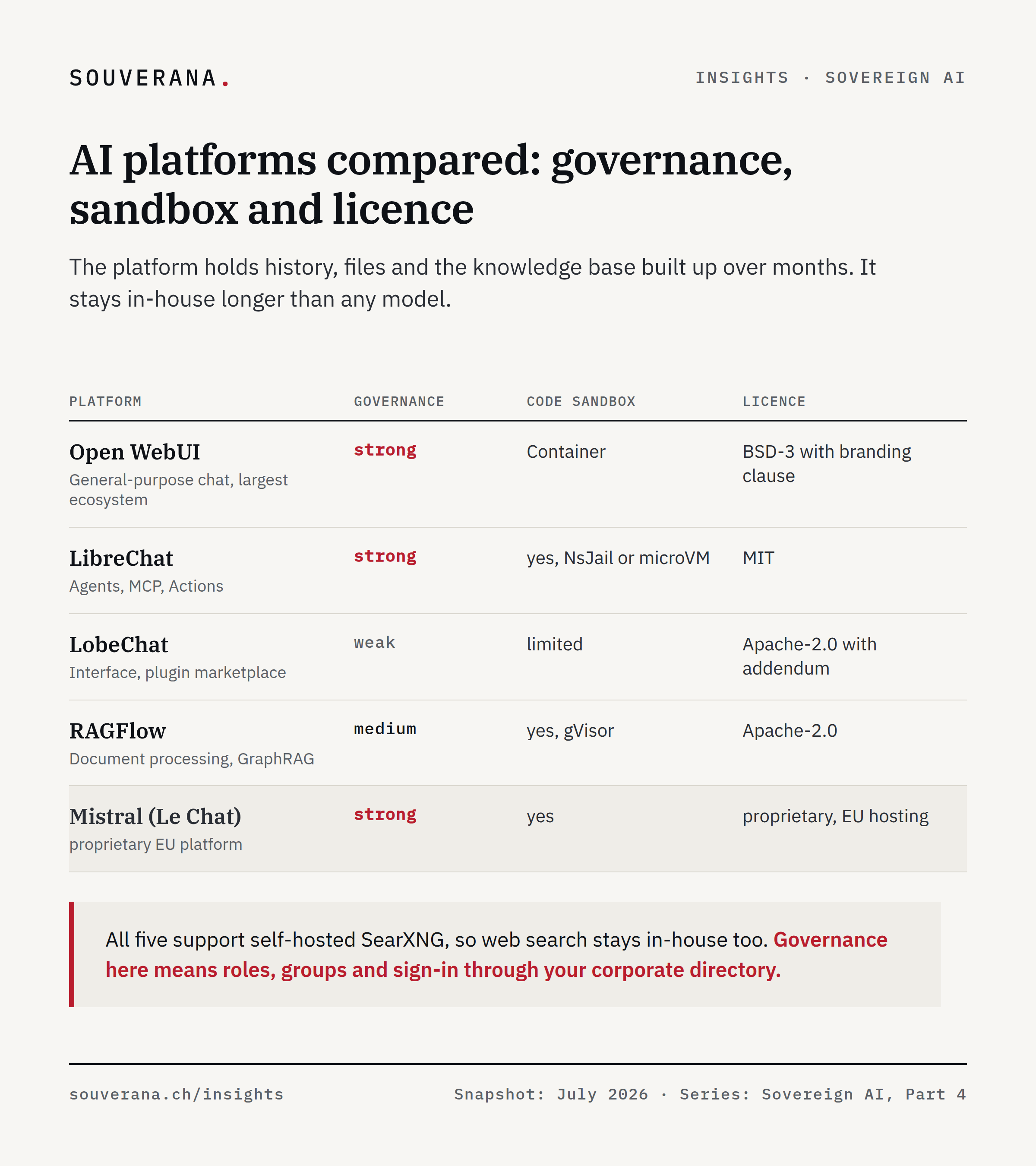
Whoever stays independent on models by choosing open weights can choose the platform freely. For general use, several mature, open-source interfaces are available: Open WebUI (the most feature-rich, with genuine user management and the largest ecosystem), LibreChat (agent-centred, with MCP and an open licence), LobeChat (a strong interface, but weaker administration) and RAGFlow (specialised in the high-quality processing of difficult documents). For more specialised tasks there are also standalone platforms, such as coding agents like OpenCode or Cline, which bring models, tools and context together. These open platforms often bring more functionality than the closed ones, but demand setup and operations in return.
The lock-in sits in the data
The reason the platform choice weighs more heavily than the model choice is the volume and value of the data that accumulates inside it. A plain chat history is still easy to migrate. A knowledge base curated over months, in which your documents have been ingested, chunked, embedded and assigned rights, is not.
That data also sits in the platform’s own structure, not in a neutral format. So check the exit before you choose: does the platform store data in open, exportable formats? Can you take chats, knowledge bases and configuration with you in full? With open-source platforms, the data sits in standard databases and can be extracted; with closed services, the exit depends on the provider. Sovereignty here has two parts: where the data lives today, and whether you can bring it home if it ever comes to that.
The ecosystem decides the niches
A platform’s basic functions converge quickly. The difference in daily use comes from the specialised functions. They mostly come from the ecosystem, meaning the extensions and catalogues around the platform, and hardly from the core. OpenAI has its GPT Store for this, Open WebUI has server-side functions and tools plus a community catalogue, others rely on extensions and the open MCP standard, through which any internal system can be connected.
For sovereignty, what matters is the nature of the catalogue. An open ecosystem can be inspected, adapted and self-hosted. A closed extension you have to take as it comes. For a narrow, regulated, Switzerland-specific requirement, a tool you can read and host yourself is often worth more than the larger but locked catalogue. How far a platform can be opened up for your own applications already belongs to the next layer, integration.
What the platform delivers that the model does not
Some capabilities are not delivered by the model; they come from the platform. Each of them calls for its own check, because each can create its own path for data to leave.
User management is the biggest difference between platforms: roles, groups, sign-in through your corporate directory and fine-grained permissions distinguish a serious enterprise platform from a plain interface. Open WebUI and LibreChat are strong here, others weaker, such as LobeChat.
Web search is more delicate than it looks: for the AI to search the web, the platform sends the search query to an external search service. That query can be sensitive, and it leaves your environment even when the model itself runs locally. A self-hosted metasearch tool such as SearXNG softens this, because the query goes out depersonalised and bundled. The leak cannot be avoided entirely as long as the open web is to be searched.
Code execution, which the AI uses to analyse data for instance, requires a clear decision. Run locally, the data stays sovereign, but you are executing code generated by the model and need genuine isolation (a container or microVM). If you buy execution in as a ready-made cloud service, the provider takes over the isolation, but code and data then run at a third party. For sensitive data, the sovereign answer is to execute locally and in isolation.
General-purpose or industry platform
Most companies are well served by a general-purpose platform. For individual industries, though, there are platforms tailored to their documents, workflows and regulations, and they hold a genuine edge there. In law, tools such as Zurich’s DeepJudge or the European Noxtua search and understand legal holdings, complete with citations and matter logic. In finance, Zurich’s Unique covers typical workflows from research through to compliance. In medicine, services such as Lausanne’s DOCumenter write reports directly from the consultation, with processing exclusively in Switzerland.
The advantage of such platforms is depth in one domain: fitting document understanding, built-in citations and review steps, ready-made specialist workflows. The price for that is twofold. First, they are mostly closed products with their own lock-in and higher licence costs. Second, and this is often overlooked: an industry platform is not automatically sovereign. Several well-known providers run on US cloud infrastructure, even where the data sits in Europe. Whether a specialised platform is the better choice depends on your core business. You have to check its sovereignty case by case, regardless of the marketing claims.
The path to a sovereign platform
A fully-fledged sovereign platform is more than an installed copy of Open WebUI. It takes user management and sign-in, a clean knowledge base, observability (monitoring and traceability of operations), the protection of sensitive data, and reliable operations with updates. There are three options for the path there, from the greatest control to the greatest convenience.
The first is self-operation. You host and run the open platform entirely yourself, with maximum control and maximum effort. The second is managed operation through a Swiss partner. Providers such as Begasoft, Swisscom, Infomaniak, AlpineAI or kvant run a platform on Swiss infrastructure for you. Sovereignty is preserved provided jurisdiction and access are right, since the partner has access to the system. The third is preconfigured bundles, which bring the entire sovereign build as one package.
Key figure
6 cantons, over 100 municipalitiesSource: Begasoft, SSGI mandate 2026
One example of such a bundle is the Swiss AI Hub, an open-source project that brings a whole sovereign platform (chat, model access, knowledge base, sign-in, observability) together as one combined package of components, and can be run in your own data centre or a Swiss one. A project like this takes a lot of the build-out off your hands, but is itself demanding to operate and keep current.
Disclosure: I helped shape the Swiss AI Hub as an architect. This is not a recommendation, and the AI Hub is not the right solution for every case. For many companies, a single Open WebUI instance or a turnkey managed service is the lighter, better-suited path.
What this means for your company
Choose the platform by four criteria: the features, the ecosystem behind your specialised functions, the exit path, and the question of who hosts and operates it. And do not let the model choice quietly predetermine the platform for you.
What remains is the top layer, where AI starts acting inside your systems. The final part of the series belongs to it.
Frequently asked questions
- What is an AI platform?
- The software your team uses for AI day to day: the interface for chat and agents, the connection to your documents (RAG, answers drawn from your own documents), user management and administration. The platform sits above the model and the infrastructure, and is the layer where your chats, files, prompts and knowledge live.
- Which AI platform is right for a business?
- It depends on the need. For most companies, a general-purpose platform, meaning one chat interface for all tasks, such as Open WebUI, LibreChat or a turnkey Swiss service, is enough. Individual industries with particular documents and regulations have specialised platforms. Beyond the features, what matters is the ecosystem, the operations model and the exit path.
- Why does the platform bind you more than the model?
- Because the model is interchangeable, but the platform holds your data: chat history, uploaded files, prompts, the memory (what the AI remembers about users) and, above all, the curated knowledge base. The more you invest in that knowledge base, the more expensive a switch becomes. That is why platforms differ from each other far more than the models underneath them.
- Can an AI platform be operated sovereignly in Switzerland?
- Yes. You can run an open platform such as Open WebUI, a widely used chat interface for AI, yourself on your own hardware, or choose a Swiss provider that hosts and operates it on Swiss infrastructure. Platform, host and operations are three separable roles here: you can take on all three yourself, hand them to a provider, or mix them.
- Open WebUI or an industry platform?
- General-purpose platforms such as Open WebUI suit most companies and can be operated sovereignly. An industry platform, for law, finance or medicine, say, pays off when your core business depends on domain-specific documents, citation requirements and regulation. An industry platform is not automatically sovereign, however; its hosting has to be checked case by case.
Share this article
Ready-formatted graphics and a suggested post for your LinkedIn feed: download, copy, post.
Suggested post
Which AI platform does your team use, and who chose it?

In many companies, the honest answer is nobody. It came bundled with the model. Choose OpenAI and you get ChatGPT; choose Microsoft and you get Copilot; choose Google and you get Gemini. Yet the platform is the decision that stays longest, because it holds your history, files, prompts and the knowledge base built up over months.

OpenAI itself shows how quickly this becomes real: the older Assistants interface will be shut down in August 2026 and replaced with a new one. On the other side stand five platforms, four of them open, that differ in user management, code execution and licence, from Open WebUI, with the largest ecosystem, to RAGFlow, built for document processing.

Our conclusion: choose the platform for its ecosystem and exit path, and decide it separately from the model. That this works at scale is shown by the provider Begasoft, with a sovereign platform for six cantons and over a hundred municipalities.

The article covers the five-way comparison, the division of roles between platform, host and operations, and eight evaluation questions. Link in the comments.

#AI #DataSovereignty #OpenWebUI #Switzerland