revFADP and AI: what the law actually requires
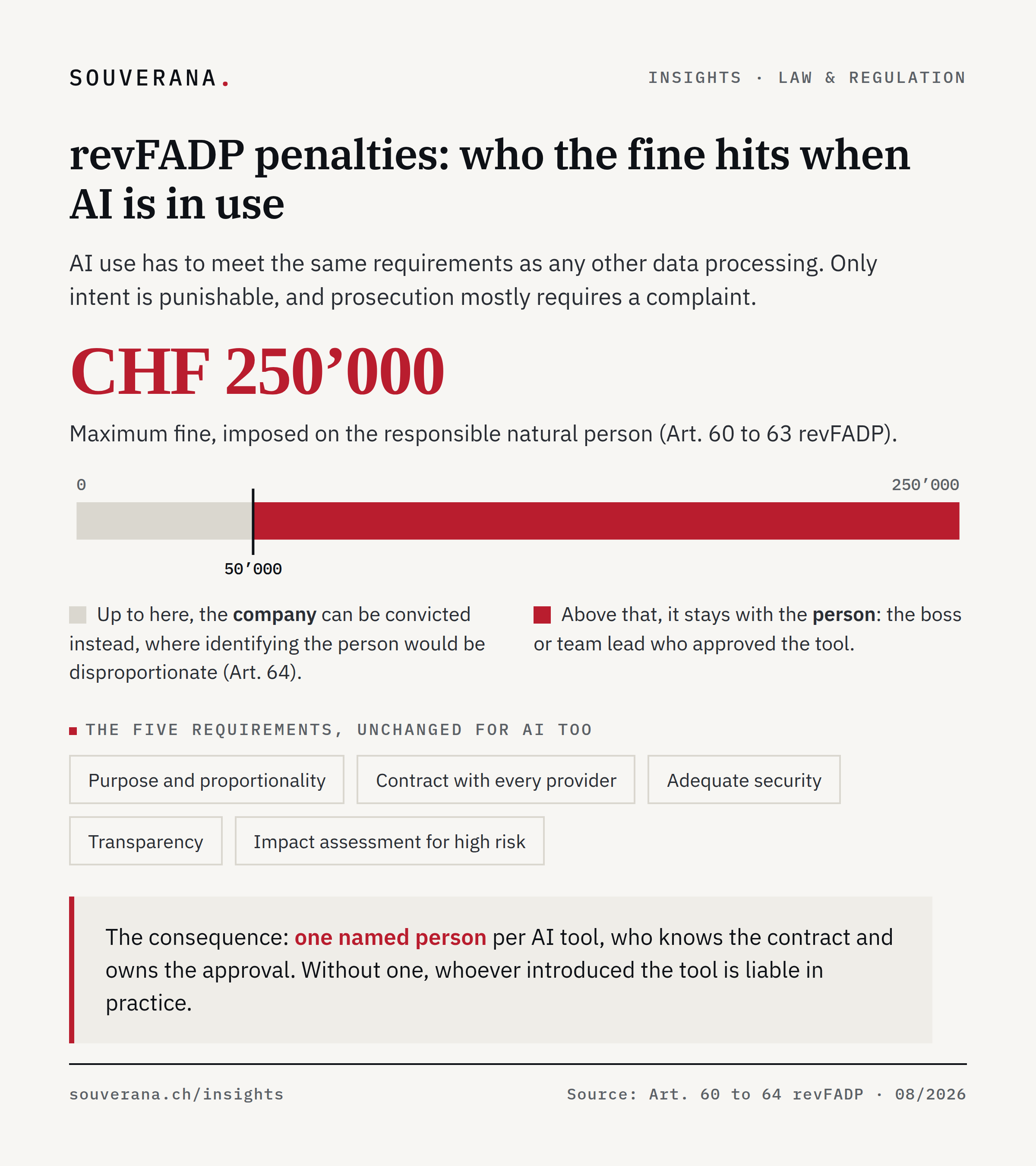
The fine of up to CHF 250’000 falls on the person who approved the tool, and only exceptionally on the company. That makes the approval a matter for management.
Guide · Published 4 Aug 2026 · Updated 1 Oct 2026 · Joel Barmettler
What does the revFADP require for AI use?
The revised Federal Act on Data Protection (revFADP) has applied since 2023. It does not mention AI, but because it is technology-neutral it governs AI like any other data processing. It requires a purpose, a contract with every service provider, adequate security, transparency and, where the risk is high, an impact assessment. Fines of up to CHF 250’000 fall on the person within the company who approves an AI tool.
In brief
- Companies have probably already met four of the five requirements without thinking of AI. The check is still worthwhile, because the fine falls on you personally if you approve a tool.
- Whoever holds oversight in the company can also be liable for what subordinates do: if they intentionally or negligently fail to prevent a breach. It is not enough that they did not give any instructions themselves.
- Check the subscription tier before you approve a tool. The provider’s assurances on confidentiality and on training with your data are missing from consumer subscriptions, even at the same providers.
- A chat tool for drafting text does not need an impact assessment. That only becomes necessary with high-risk profiling (automated evaluation of individuals) or the large-scale processing of especially sensitive data, such as health data.
- Record who approved which tool. Without a name, it is hard to establish in an emergency who directed the process.
Few people who decide on AI tools know one quirk of Swiss data protection law: the fines under Articles 60 to 63 are directed at the person who acted within the company, not at the business itself. That makes the question of who approves a tool, and on what contractual basis, a matter for management.
Most offences are prosecuted only on complaint. The cantonal prosecution authorities have jurisdiction, and the Federal Data Protection and Information Commissioner (FDPIC) can file a criminal complaint. Prosecution becomes time-barred after five years.
This article expands on a section of our overview of Swiss AI rules, the regulatory map. Souverana is not a law firm. In sensitive cases, you should involve legal counsel.
This is the second part of our series on law and regulation. The revFADP is the law against which almost every Swiss AI initiative is measured.
Five requirements, and none of them is new
You have probably already handled four of the five. If you revised your privacy policy in 2023, set up a register of processing activities and signed a data processing agreement with your cloud provider, AI only adds one more tool to these records. The only new thing is the pace at which these tools enter the company, often bypassing procurement altogether.
A purpose, and proportionality. Under Art. 6, you process personal data lawfully, in good faith and proportionately. In practice, this means you can state what the AI needs the data for, and you give it no more than that. Whoever uses a language model to summarise text usually meets this point already.
A contract with every service provider. Art. 9 ties the handover to a processor (a service provider that processes data on your behalf) to two conditions and makes intentionally disregarding them a criminal offence. The next section covers this point in detail.
Adequate security. Art. 8 obliges controllers and processors jointly to take suitable technical and organisational measures. For AI tools, this means above all: controlled access and a provider that can evidence its security.
Transparency. Under Art. 19, you inform the people affected adequately as soon as you collect their data. What this means for your privacy policy follows further down.
An impact assessment where the risk is high. Art. 22 requires a data protection impact assessment in advance wherever a processing may carry a high risk to personality or fundamental rights.
The real work sits in the contract
Art. 9 ties the handover to two conditions. First, the provider may only process the data in ways you yourself would be permitted to. Second, no statutory or contractual duty of confidentiality may stand in the way. On top of that comes your duty to satisfy yourself of the provider’s data security.
Whoever intentionally hands over the processing without meeting these conditions is liable to prosecution under Art. 61. Prosecution requires a complaint. The law requires the conditions to be met and prescribes no contract content. The contract meets the conditions and evidences them. Without one, you have no proof from the very first prompt.
For the second condition, law firms, medical practices and hospitals must clarify professional secrecy before signing the contract, and banks must clarify banking client confidentiality under the Banking Act. For everyone else, we check four points for every AI tool, and they belong in the provider contract:
- A data processing agreement that covers every function in use. Providers keep extending their products: what applies to the chat does not automatically apply to web search or the coding agent sitting alongside it.
- A duty of confidentiality that binds the provider itself. It must include sub-processors and continue to apply after the contract ends. Technical measures do not cover this.
- The assurance that your content is not used for the provider’s own purposes, in particular not for its training.
- Free use of the results, without an additional licence and without a restriction that does not fit your business.
Under Art. 9(3), a sub-processing arrangement also needs the prior authorisation of the controller. In practice, this almost always becomes a general authorisation with a duty to notify, and providers design it very differently. The comparison of OpenAI’s contracts shows how much.
Why the fine falls on you personally
Key figure
CHF 250’000Source: Art. 60 to 63 revFADP, in force since 1 September 2023
An exception applies only to small amounts. Where the fine would not exceed CHF 50’000 and identifying who acted within the company would be disproportionate for that amount, the authority can convict the business itself instead (Art. 64). Above that threshold, it stays with the person.
In practice, ownership therefore counts. Because the penalty falls on a person, every AI tool is worth assigning a named person responsible, who knows the contract and decides the approved data classes. Without that role, it is hard to establish in an emergency who directed the process: often a team lead who never saw the contract.
Transparency: three additions to your privacy policy
Everyday AI tool use rarely needs its own disclosure. Art. 19 is tied to the collection of the data. Which tools sit along the processing chain is not decisive in itself. What matters is whether the purpose changes. An assistant that shortens an existing text does not change the purpose. A system that turns a job application into an assessment does.
Three additions are still worthwhile in almost every privacy policy:
- Mandatory: where personal data goes abroad, Art. 19(4) requires you to name the country and the safeguard you rely on. You also name the categories of recipients (Art. 19(2)(c)).
- Name the purposes for which AI works with personal data, as soon as something new happens with it.
- Record that personal data can also be generated using AI, for instance when a system turns a job application into an assessment.
The rules are stricter as soon as a machine alone makes a decision that has a legal effect or materially affects the person concerned. Art. 21 then applies: you must inform the person affected, and they can demand that a natural person review the decision. The law itself names two exceptions: where the decision grants a contractual request, and where the person has expressly consented. Today, only decisions made exclusively by automated means are covered. It is exactly this threshold that upcoming Swiss regulation is likely to lower.
How to get started
These four steps put your AI use in order:
- 01
Define data classes
Which data may go into which tool? Three levels are enough: public, internal, especially sensitive.
- 02
Review contracts
The four points above, per tool, and for every function your employees actually use.
- 03
Name a person responsible
One responsible person per tool, who knows the contract and sets the approved data classes.
- 04
Update the register
Wherever AI works with personal data, it belongs in the register of processing activities. This is only mandatory from 250 employees, or where especially sensitive data is processed on a large scale, or with high-risk profiling (Art. 12(5) revFADP, Art. 24 of the Data Protection Ordinance (DSV)). It is still worthwhile voluntarily: it takes care of part of the future requirements at the same time.
The revFADP does not prohibit AI use anywhere, and the four steps above contain no ban either. The law requires that someone makes the decisions and can evidence them. A blanket ban within the company achieves the opposite: the work migrates to private accounts, and those you no longer see.
Where the revFADP leaves off, the other parts of the series begin: professional secrecy for especially protected data, AI governance for the organisation, and the EU AI Act for the view towards Europe.
Frequently asked questions
- Does the revFADP apply to the use of AI?
- Yes, without limitation. The law is written to be technology-neutral and does not mention artificial intelligence anywhere. As soon as an AI application processes personal data, the same requirements apply as for any other processing: a defined purpose, a contract with the service provider, data security, transparency, and, where the risk is high, an impact assessment.
- How high are the fines under the revFADP?
- Up to CHF 250’000. The fines are directed at the person who acted within the company. Where the fine would not exceed CHF 50’000 and identifying that person would be disproportionate, the company can be convicted in their place. The offences require intent, and most are prosecuted only on complaint.
- Do I need a data processing agreement for an AI tool?
- In practice, yes. Art. 9 of the revFADP ties the handover of data to a service provider to conditions: the provider processes the data only in ways you yourself would be permitted to, no duty of confidentiality stands in the way, and you satisfy yourself of the provider's data security. Whoever intentionally disregards these conditions is liable to prosecution under Art. 61. The contract evidences that they are met.
- When does an AI project need a data protection impact assessment?
- When the processing carries a high risk to the personality or fundamental rights of the people affected, for instance with extensive profiling (automated evaluation of individuals) or especially sensitive data. Art. 22 of the revFADP requires one in advance. In practice, this is a structured conversation, not a project.
- May holders of professional secrecy engage AI providers?
- Only with additional review. A processor is the service provider that processes data on your behalf. Art. 9 of the revFADP expressly permits a handover to it only where no statutory or contractual duty of confidentiality stands in the way. Law firms, medical practices and hospitals must therefore clarify professional secrecy before signing the contract; banks must clarify banking client confidentiality.
Share this article
Ready-formatted graphics and a suggested post for your LinkedIn feed: download, copy, post.
Suggested post
Who in your company actually approved the team's use of AI tools? At many SMEs, the honest answer is nobody, not formally.

Under the revised Federal Act on Data Protection (revFADP), this carries a consequence few people know: the penalty provisions (Art. 60 to 63) are directed at the person who acted within the company, not at the company itself. Up to CHF 250’000, the offences require intent, and prosecution mostly requires a complaint. Only up to CHF 50’000 can the company be convicted instead, and only where identifying the person would be disproportionate.

What the law requires for AI use is nothing new: a purpose, a contract with every service provider, adequate security, transparency, and, where the risk is high, an impact assessment. A company that tidied up properly in 2023 has long since met four of the five.

Our conclusion from consulting practice: the hurdle is usually the missing ownership. Every tool needs a named person who knows the contract and sets the approved data classes. Without one, it is hard to establish in an emergency who directed the process, often a team lead who never saw the contract.

The article covers the five requirements in detail, the four points that belong in every provider contract, and the three additions your privacy policy needs. Link in the comments.

#revFADP #DataProtection #AI #Switzerland