Self-hosting an LLM: the real cost and the break-even
Whether your own machine pays off against a Swiss provider's prices comes down to one figure: utilisation, meaning the share of possible requests that the machine processes. The full calculation to check for yourself, from the parts list to the break-even (the point from which the purchase pays off), with measured power.
Analysis · Published 14 Aug 2026 · Updated 1 Oct 2026 · Joel Barmettler
What does a self-hosted LLM cost?
Your own machine for AI costs more than a Swiss provider, unless it runs close to full load around the clock. Our CHF 8’450 workstation undercuts the price of Infomaniak, a Swiss host, for a 30-billion-parameter model (12 August 2026) only from 57 percent utilisation over two years. At 10 percent, it costs CHF 310 more per month. In return, the data stays in your own operation.
In brief
- Compare against a Swiss provider. Infomaniak, a Swiss host with data held in Geneva and Zurich, charges 90 centimes per thousand requests for our reference request on a model with 30 billion parameters. The request comprises 10,000 input tokens and 2,000 output tokens, and a token is a text fragment of a few letters.
- Power barely registers. It costs just over 6 centimes per million tokens generated (graphics cards measured, Zurich peak tariff). The purchase of the hardware makes up the main part of the cost.
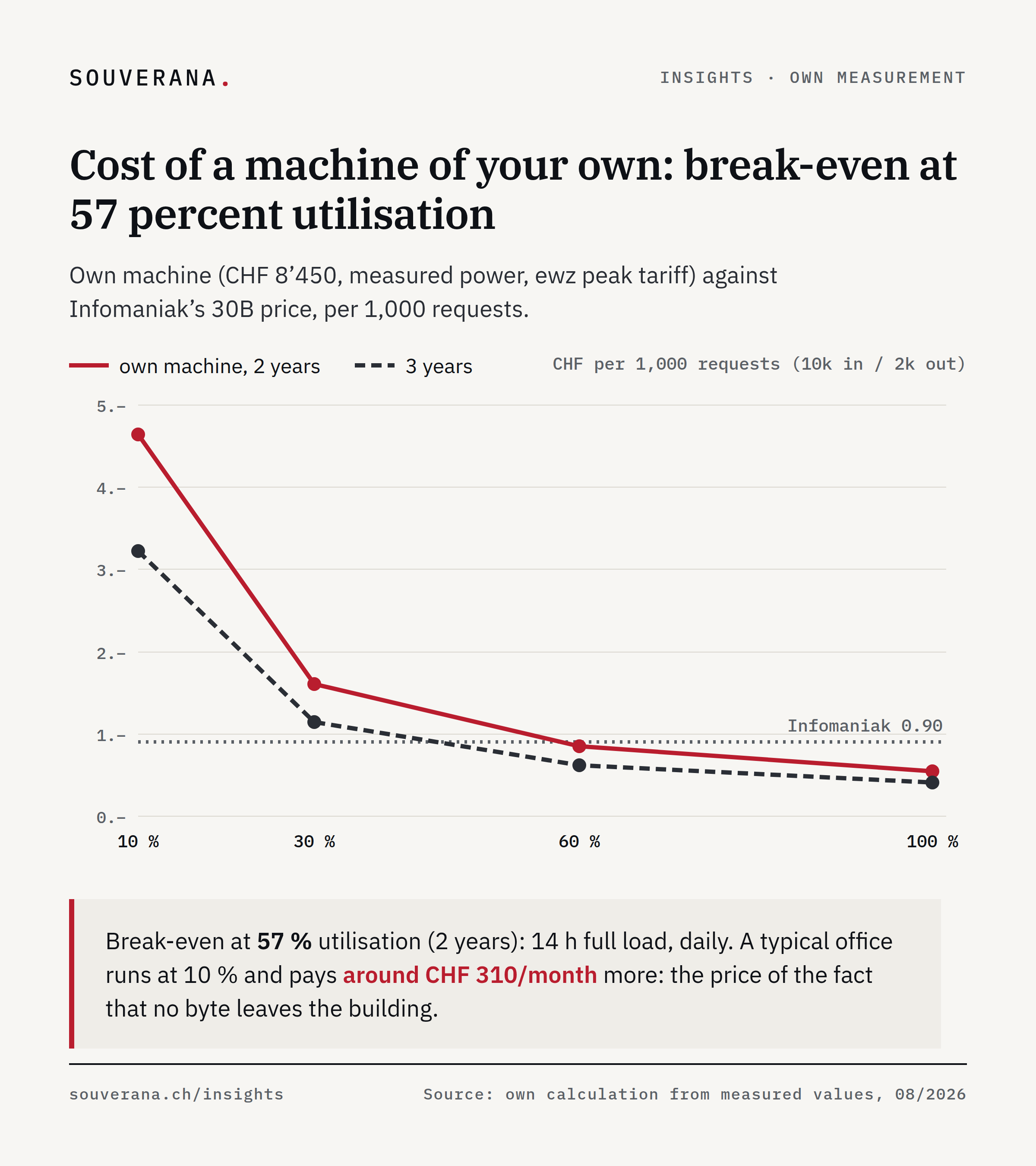
- Think in utilisation. It is the share of requests that the machine actually processes, measured against what it could manage around the clock. This figure alone decides: over two years, the same machine costs 0.6 times the provider price per request at 100 percent utilisation and 5 times at 10 percent.
- Raise utilisation with overnight work. Batch processing overnight, meaning many jobs one after another without intervention, is the most effective way to reach the break-even, the point from which your own machine is cheaper than the provider.
- Budget for the person who runs the machine. Operation, updates and getting things running again after failures appear on no parts list, and this calculation deliberately does not include them.
This article is the fifth and final part of our series on local inference, meaning the operation of AI models on hardware of your own. The first part described a machine with two graphics cards. This part answers whether it pays off against buying per token. The calculation is set out in full and ready to check, with measured power and the Zurich tariff.
The price you have to beat
The benchmark for this calculation is the cheapest sovereign provider. Infomaniak hosts a model of the same size class and design as ours (30 billion parameters, Mixture of Experts design, or MoE for short: a model that uses only a small part of its parameters per token) in Geneva and Zurich, without the US CLOUD Act, for 5 centimes per million input tokens and 20 centimes per million output tokens. We did not measure whether its quality matches ours; for the price comparison, it is the closest match on the market.
For a typical request from our measurement series (10,000 input tokens, 2,000 output), that means: 90 centimes for a thousand requests. That is the comparison price. Anyone self-hosting is up against an offer in which a single request costs a tenth of a centime and Swiss data hosting is already included.
What your own machine costs
You know the purchase cost from the first part: around CHF 8’450 for two RTX 4090s, a processor, 128 GB of system memory and the rest of the parts list.
We measured the power draw. Under full load, both cards together drew 405.7 watts, 28 watts at idle. With the estimated surcharge for the processor and board, we calculate 520 watts under load and 130 watts at idle. At the Zurich peak tariff of 27.65 centimes per kilowatt-hour (excl. VAT), power costs just over 6 centimes per million tokens generated.
Power is therefore a minor item. A full-load day costs CHF 3.45 in power, while the purchase cost, spread over two years, comes to CHF 11.58 per day. The largest share of the cost is depreciation, and it runs whether or not anyone makes a request.
The calculation everything hinges on
The table uses the MoE model, because it reaches the highest throughput in the measurement series: at full utilisation, the machine delivers 633 tokens per second with it, which is just over 27,000 requests per day. It reaches index 32.1 (between GPT-5 mini and GPT-5). The model at GPT-5.1 level from the first part manages only 240 tokens per second, and with it there is no break-even at all: even continuous full load would remain more expensive than the provider. The daily cost (the purchase cost’s daily share plus power) is spread across however many requests are actually made. The table shows how strongly utilisation changes the price per request:
| Utilisation | CHF per 1,000 requests (2 years) | (3 years) | vs. Infomaniak (0.90) |
|---|---|---|---|
| 10 % | 4.64 | 3.23 | 5.2x and 3.6x more expensive |
| 30 % | 1.61 | 1.14 | 1.8x and 1.3x more expensive |
| 60 % | 0.85 | 0.62 | cheaper |
| 100 % | 0.55 | 0.41 | clearly cheaper |
The break-even sits at 57 percent utilisation over two years, at 39 over three. In hours: the cards would have to run at full load for 14 and 9 hours a day respectively, every day, weekends included.
What utilisation really means in an office
What this means for an office can be worked out. A business with twenty to thirty employees uses the machine during 40 of the 168 hours in a week, and during those hours perhaps half its capacity is occupied on average. That works out to 12 percent; we round down to 10 percent utilisation. At night and over the weekend, the depreciation costs keep running, without any requests coming in.
At 10 percent, your own machine costs five times as much as the provider. In francs: around CHF 310 more per month than the same requests would cost at Infomaniak.
This calculation deliberately leaves out the largest item. The person who operates the machine, keeps it updated and gets it running again on a Friday evening appears on no parts list. Every hour they need shifts the comparison further in the provider’s favour.
How the break-even can be shifted
The calculation is not a law of nature; two levers can move it.
Overnight work raises utilisation. The machine’s most expensive property is its unused hours. Anyone who has jobs worked through in overnight batches, such as checking contracts, indexing files or preparing reports, puts idle time to use for requests. The extreme case from part one fits exactly here: the 284-billion model is too slow for the screen and ideal for the night. A machine that answers the team during the day and works through the case archive at night reaches a higher utilisation and therefore sits closer to the break-even. Since our calculation applies the peak tariff throughout, night-time electricity also costs less than calculated.
A longer depreciation horizon lowers the daily cost. Over three years instead of two, the break-even falls from 57 to 39 percent. The counter-argument: three years is a long time in this technology. The RTX 4090 on our list was replaced after just over two years by a successor with a third more memory, and model quality within each size class keeps rising. Anyone depreciating over a longer period is betting that today’s machine will still be enough the day after tomorrow.
When your own machine is still the right call
After all the figures, reasons remain that no cost calculation captures, and in practice people buy because of them:
- Some data must not leave your own operation, whatever a contract promises.
- With professional secrecy, even reviewing provider contracts already means effort and residual risk.
- Your own machine makes you independent of price increases, model retirements and contract changes, as the provider series documents.
- The machine will still do tomorrow exactly what it does today.
Anyone who buys for these reasons is making the right purchase, and now knows what it costs. Anyone who just wants to save money is better served by the Swiss provider.
How to calculate your own case
With these four steps, you set up the calculation for your business:
- 01
Count your requests
How many AI requests does your business make per day today, and how long are they? Anyone not yet using AI starts with a month of API usage and reads the figure off the bill instead of estimating it.
- 02
Derive the utilisation from it
Divide the daily requests by the daily capacity of the machine you want (requests per day at full load). If the result sits below a third, the purchase does not pay off at today's Swiss provider prices.
- 03
Look for night-time load before you buy
Is there batch work that goes undone today? Case archives, records, recurring reports? It raises utilisation the most.
- 04
Budget the operation in full
Who keeps the machine running, and what does that time cost? Only with this line item is the comparison against the provider price complete.
This closes the series. Parts one through four provide the foundations of this calculation: the machine, the memory sizing, the quantisation and the engines, each with all its measured values.
Frequently asked questions
- What does it cost to self-host an LLM?
- Our workstation with two graphics cards cost around CHF 8'450, plus about CHF 3.45 in power per day under full load. Over two years, that comes to CHF 0.55 per thousand requests at full utilisation, and CHF 4.64 at a realistic 10 percent. Utilisation is the share of possible requests that the machine processes. Staff costs come on top.
- Is a self-hosted LLM cheaper than an API?
- Only from high utilisation onward. Against the price of the Swiss host Infomaniak for a 30-billion-parameter model (90 centimes per thousand requests with 10,000 input tokens and 2,000 output), our machine pays off over two years from 57 percent utilisation, over three years from 39 percent. That equals 14 and 9 hours of full load per day, respectively, every day.
- How much power does a local LLM use?
- Measured, our two graphics cards (RTX 4090) together drew 406 watts under full load; with the processor and board, we estimate around 520. Per million tokens generated, that is 0.23 kilowatt-hours, or just over 6 centimes at the Zurich peak tariff of the utility ewz. Power barely registers; the purchase cost makes up the largest share of the cost.
- Why self-host if it costs more?
- For control: the data never leaves your own operation, no contract to check, no provider switch to fear. At a realistic 10 percent utilisation, this control costs around CHF 310 more per month in our calculation over two years than the price of the Swiss provider Infomaniak.
Share this article
Ready-formatted graphics and a suggested post for your LinkedIn feed: download, copy, post.
Suggested post
Ever thought about buying your own machine for AI? All data in your own operation, nobody reading along, and money saved on top?

We worked out what that means financially, against a sovereign Swiss provider, not a US cloud. At Infomaniak, a Swiss host, a thousand requests to a 30-billion-parameter model (10,000 input tokens, 2,000 output) cost 90 centimes, with data held in Geneva and Zurich.

Your own machine, by contrast: CHF 8'450 in hardware, 520 watts under full load (the graphics cards measured, the rest estimated), Zurich peak tariff of the utility ewz. From 57 percent utilisation (the share of possible requests that the machine processes), meaning 14 hours of full load per day, your own machine becomes cheaper than the provider over two years (break-even). A normal office runs at around 10 percent and therefore pays about CHF 310 more per month. Power barely registers here (just over 6 centimes per million tokens); the purchase cost dominates.

So nothing is saved. Your own machine is a quantifiable premium for keeping every byte inside your own operation, and for most businesses it comes out smaller than expected.

The article carries the full calculation to check for yourself: both depreciation horizons, the utilisation curves, and what is deliberately left out, namely the person who runs the operation. Link in the comments.

#AI #DataSovereignty #Costs #Switzerland