What is Apertus? The open Swiss language model explained
With Apertus, ETH Zurich and EPFL have released a language model that companies can download and run themselves. Many ask whether Apertus is an alternative to ChatGPT. The article explains what Apertus is, what the model is good for today and where other models lead.
Analysis · Published 14 Oct 2026 · Updated 5 Nov 2026 · Joel Barmettler
What is Apertus?
Apertus is a language model from Switzerland that you can run on your own servers, so your texts stay in-house. ETH Zurich, EPFL and the computing centre CSCS developed it, and the training data and code are public. It is a building block for your own applications: it is strong at translation, while other open models lead on agents and code.
In March 2026, the Apertus team announced that the canton of Ticino is switching its translation tool for the public administration from Mixtral by the French provider Mistral AI to Apertus.[1] The Ticino firm Artificialy built an adapted version of a smaller Apertus model for this. That version runs on graphics cards in the data centre of the cantonal IT centre and translates between Italian, German and French, among other pairs. In a first phase, about 100 employees are testing the tool.
In an in-house comparison test by Artificialy, the adapted small version reached 94 per cent. The same variant without adaptation scored 90 per cent, the largest model of the family without adaptation 92, and Meta’s model Llama Scout 91.4.[1] The adapted small version therefore beat all three. The announcement does not say which measure the test uses.
This article opens our series “Understanding Apertus”. It explains what Apertus is, what it is good for today and what its openness means.
What you get with Apertus
ChatGPT is a product, whereas Apertus is only the model. You receive it as a file, known as the weights. Under the Apache 2.0 licence, you can use it, modify it and deploy it commercially.
- Part of the offering
- comes from you or a service provider
ChatGPT
a finished product
- Language model OpenAI
- User interface OpenAI
- Hosting OpenAI
Apertus
only the model
- Language model ETH Zurich, EPFL, CSCS
- Hosting your own servers or a Swiss provider
- User interface build or buy
- Search across your documents build or buy
- Integration with your systems build or buy
You can run the model on your own hardware or with a Swiss provider. In a measurement by Souverana in August 2026, the smaller 8B model of version 1.0 ran on a single graphics card. Swiss providers include Swisscom and Infomaniak.[2] In October 2026, Infomaniak charged CHF 0.70 per million input tokens and CHF 2.50 per million output tokens for the larger 70B model.[3]
Apertus was released on 2 September 2025 in two sizes, with 8 and with 70 billion parameters, 8B and 70B for short.[4] Parameters are the values a model learns during training. More parameters generally mean more capability and more hardware. The small models of the Apertus Mini family, with 0.5, 1.5 and 4 billion parameters, followed in May and June 2026. The Mini models are derived from the 8B model and are also available in compressed form for use on devices.[5]
Version 1.5 of 24 July 2026 continues the training of the first version and additionally reads images. Answers are still text only.[6] According to the team’s roadmap, version 2.0 is to be about ten times larger and to appear in the first quarter of 2027. That is a target and may slip.
Where Apertus performs well and where other models lead
On instruction following, the 8B model of Apertus 1.5 beats all compared models in the Apertus team’s report. That helps when an answer has to keep to a fixed format, tone or length. The team measured all values in the report itself. Independent comparisons exist so far only as user experience reports, most concretely on translation.[7, 8]
On mathematics and code, Apertus trails OLMo 3 in the Apertus team’s report, a fully open model from the American institute Ai2. On agents, meaning workflows in which the model completes several steps on its own, it trails other open models according to Artificialy’s experience.
Apertus has been able to read images since version 1.5. In the report, the 70B model analyses images hardly better than the 8B, although it is about nine times larger. Apertus is weakest at text recognition in scans, OCR for short. For scans, you are better off putting a dedicated OCR model in front of the language model.
The press was initially unkind to Apertus. Two days after the release, the blog clickomania ran the German headline “This will not work out as a Swiss ChatGPT killer”.[9] The NZZ wrote in March 2026, in German: “Nice, but not fit for practice”.[10]
Who built Apertus and who pays for it
Apertus comes from the Swiss AI Initiative, which ETH Zurich and EPFL launched in December 2023.[11] Training took place on Alps, the supercomputer of CSCS in Lugano, using chips from the US manufacturer Nvidia. According to the NZZ, pretraining cost about CHF 7 million.[12]
The ETH Board granted the initiative a total of CHF 20 million for the years 2025 to 2028. No commitment for the period after that is public.[13] According to SRF, the first version was worked on by “only two people full time, supported by a few dozen researchers”.[14] What the funding and the values the model is meant to follow mean politically is examined in the third part of the series.
Open training data costs performance
For language models, “open” stands for two different things. Open weights means: you may download and run the finished model. Open source additionally means that how the model came about can be traced. Why this difference matters for the sovereignty of a company is covered in our series on sovereign AI.
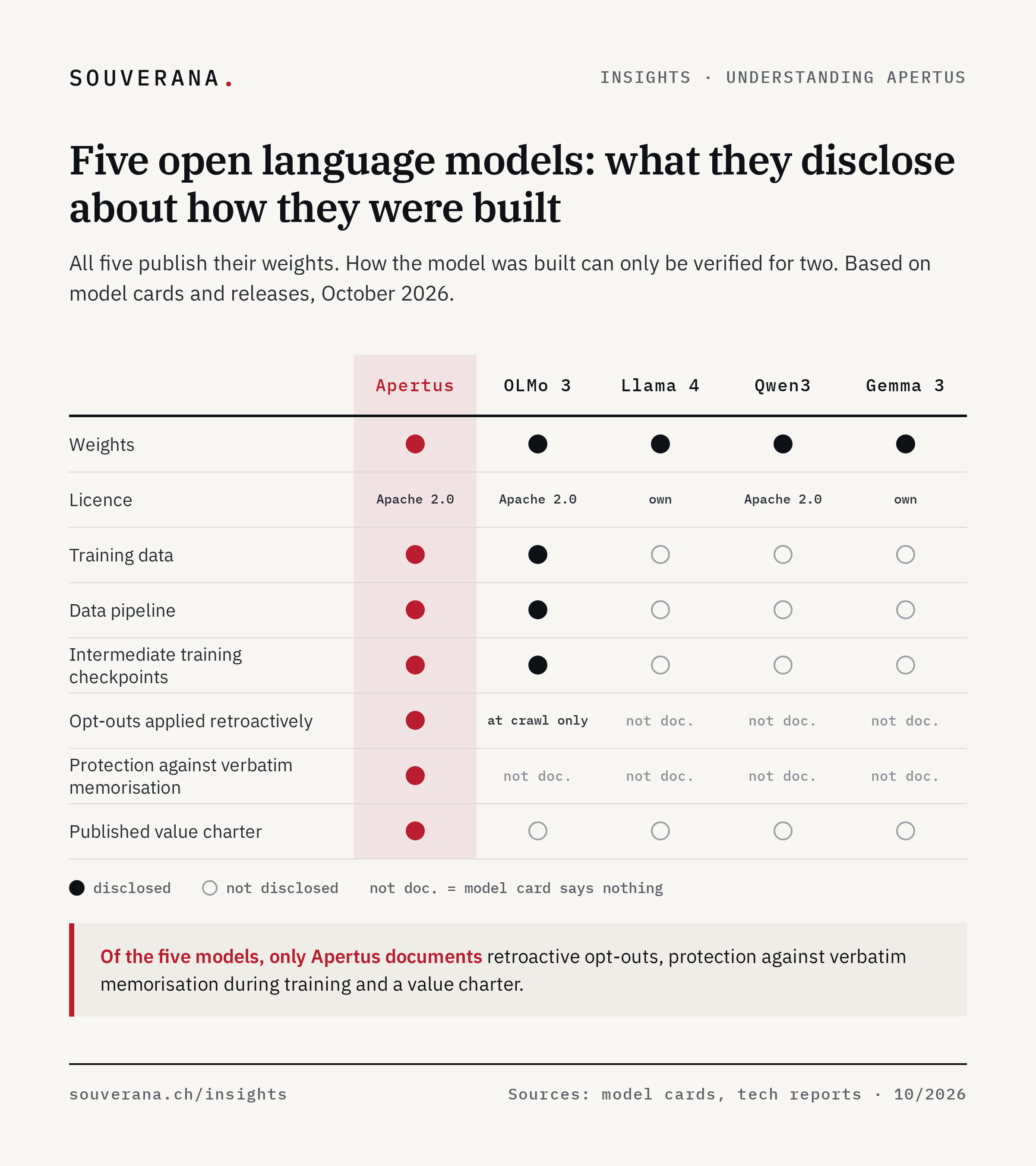
Llama 4, Qwen3 and Gemma 3 disclose only the finished model. You have to take the manufacturer’s word for what data went into training. Meta describes it in the Llama 4 model card as “publicly available, licensed data and information from Meta’s products and services”.[15] For Apertus and OLMo 3, training data, pipeline and intermediate training checkpoints are public, so the origin of the data can be checked.[4, 16]
- public
- not public
| Modell | Finished model | Training data | Data pipeline | Intermediate checkpoints |
|---|---|---|---|---|
| Apertus | ||||
| OLMo 3 | ||||
| Llama 4 | ||||
| Qwen3 | ||||
| Gemma 3 |
The team measured the price of this openness itself. Websites now block the crawlers of AI firms, such as OpenAI’s GPTBot. Datasets for training usually respect such blocks only at the moment of the crawl. The Apertus team also removed the content of blocked websites retroactively from all crawls from 2013 to 2024. That cost about 8 per cent of the English and 4 per cent of the multilingual web data.[17]
In fine-tuning, in which a model learns to follow instructions, the team left out data with a non-commercial or unclear licence. In an experiment with the 8B model, the average over 13 tests fell by 5.8 per cent. The average hides how unevenly this is distributed: on a knowledge test with a worked solution the score halved, while on a test of truthfulness it rose.
Apertus 8B in the fine-tuning experiment
- Without licence filter
- With licence filter
- Average over 13 tests−5.8%0.4430.417
- Knowledge test with worked solution MMLU-CoT−51%0.5130.253
- Knowledge about Switzerland SwitzerlandQA−1.9%0.5900.579
- Truthfulness of answers TruthfulQA MC2+6.6%0.4860.518
The team writes that it accepts this trade-off, “as necessary for responsible open-source model development”.[4]
This changes how model comparisons should be read. A model that scores better in tests may have learned from material that Apertus declines to use. With a model whose training data is closed, there is no way to check how much of its lead comes from that.
What Apertus covers on personal data and the law, and what it does not
The team filters personal data only roughly: before training, a pattern search replaces email addresses, IP addresses and IBAN numbers with placeholders. The report itself calls this “best-effort”. The filter does not search for names or home addresses. According to the model card, the model also has no filter for its outputs. If the model nevertheless reproduces a name or a phone number, your own application has to catch that. To stop a model reproducing training texts word for word, known as memorisation, the team trained with the Goldfish loss: during learning, 2 per cent of the tokens are hidden, so that the model cannot reproduce long passages without gaps.[4] The team accepts deletion requests from data subjects at llm-privacy-requests@swiss-ai.org.
The data rules follow an opt-out approach: an objection to the use of content is respected. If there is no robots.txt, the team uses the data. The Zurich law firm VISCHER described the legal basis for this in an analysis of training on third-party content under Swiss law. The report lists the authors of the analysis as advisers to the project.[18] The robots.txt was queried only for the domains with the most text. A small website that blocks AI crawlers may therefore still have ended up in training. This section is not legal advice.
The EU AI Act requires in Article 53 that providers of general-purpose models publish a summary of their training data. In March 2026, researchers at Trinity College Dublin and the Mozilla Foundation reviewed five published summaries. Apertus received the top grade on every criterion. None was available from OpenAI, Google or xAI at the time.[19]
How to get started
Begin with a limited task in several national languages, such as translating internal documents. Have Apertus and a strong open model solve the same ten cases from your daily work, using your own documents. Decide beforehand how many answers you would accept without rework.
The Apertus team’s reports are a useful yardstick even if you use a different model. For a first conversation with a model provider, four questions are enough:
- Is there a published summary of the training data under the EU AI Act, and where can it be found?
- Were website blocks respected, including retroactively for older crawls?
- What prevents the model from reproducing training texts verbatim?
- Which personal data was removed before training, and does anyone filter the outputs?
Apertus answers all four publicly. Get the provider’s answers in writing. Ten questions, with the answers from Apertus as a comparison, are included as a worksheet in the PDF.
Sources
Frequently asked questions
- What is Apertus?
- Apertus is a language model from Switzerland that you can download and run on your own servers. ETH Zurich, EPFL and the computing centre CSCS developed it. Version 1.0 was released on 2 September 2025 and version 1.5 on 24 July 2026, each with 8 and 70 billion parameters. The finished model, known as the weights, is under the Apache 2.0 licence, and the data pipeline, the training code and the intermediate training checkpoints are public.
- Is Apertus open source?
- Yes, in the strict sense. Llama 4, Qwen3 and Gemma 3 publish only the finished model. With Apertus, the data pipeline, the training code, the intermediate training checkpoints and a charter of values are public as well. Of the open models compared, as of October 2026 the same applies only to OLMo 3 from the Allen Institute for AI.
- What data was Apertus trained on?
- Apertus 1.0 learned from 15 trillion tokens, mainly from public web datasets such as FineWeb and FineWeb-2, as well as from code and mathematics. Content from websites that block AI crawlers was removed, including from older crawls. In fine-tuning, the post-training on instructions, only data with a clear, commercially usable licence was permitted.
- What does leaving out sensitive training data cost in performance?
- Retroactively leaving out content from websites that block AI crawlers removed about 8 per cent of the English and 4 per cent of the multilingual web data. In an experiment with the 8B model, the average over 13 tests fell from 0.443 to 0.417 when data with a non-commercial or unclear licence was missing from fine-tuning. On a knowledge test with a worked solution, the score halved from 0.513 to 0.253, while on a test of truthfulness it rose from 0.486 to 0.518.
- Does Apertus meet the transparency obligation of the EU AI Act?
- In March 2026, researchers at Trinity College Dublin and the Mozilla Foundation compared five published summaries of training data, which Art. 53 of the EU AI Act requires. The summary for Apertus received the top grade on every criterion. None was available from OpenAI, Google or xAI at the time.
- Is Apertus a Swiss ChatGPT?
- No. ChatGPT is a service with a user interface, whereas Apertus is only the model on which companies and public authorities build their own applications. It is strong at translation and at following instructions, but according to the Apertus team's report it trails OLMo 3 on mathematics and code.
Share this article
Ready-formatted graphics and a suggested post for your LinkedIn feed: download, copy, post.
Suggested post
Do you know what the language model your company uses was trained on?

The canton of Ticino is moving its translation tool for the public administration to the Swiss model Apertus. With Apertus, you can check what it was trained on. Of five open models compared, that is otherwise possible only with OLMo 3. With Llama 4, Qwen3 and Gemma 3, only the finished model is open, according to the model cards of October 2026.

The price is in the Apertus team's report. The team removed websites that block AI crawlers from the training data retroactively, about 8 per cent of the English web data. In an experiment with the 8B model, the average over 13 tests fell from 0.443 to 0.417, because data without a clear licence was missing from fine-tuning.

Our conclusion: part of other models' lead may come from material that Apertus declines to use. Compare models with that in mind.

In the article: what Apertus can do and where other models lead, the model family up to the planned version 2.0, the legal basis from the Zurich law firm VISCHER, the review under the EU AI Act, and a worksheet with ten questions for every model provider. Link in the comments.

#Apertus #AI #Copyright #Switzerland #DataSovereignty