Apertus in business: what it is good for today
To many companies, a Swiss language model on their own hardware sounds like a solution for sensitive data. Whether Apertus is enough for sensitive data today depends on the use case. The article covers what Apertus is good for, which Swiss hosts offer the model, what it costs and how to test it on your own data.
Guide · Published 14 Oct 2026 · Updated 5 Nov 2026 · Joel Barmettler
Is Apertus suited to your business?
For translation in the national languages, you can use Apertus today, even with confidential documents, because you can run the model on your own hardware. For program code and for workflows in which the model works through several steps on its own, other open models are better suited. Only a test with your data will show whether Apertus is good enough for questions about your own documents.
The agency Liip tested Apertus in ZüriCityGPT, an AI search that answers residents’ questions about the city of Zurich. Asked about the population, the system gave a wrong figure. The search had not found the most recent source.
An application like this works in two steps. First it searches your own documents for the matching passages, then the model formulates the answer from them. The technical term is RAG. An error can arise in the first step or in the second.
-
Question
How many inhabitants does Zurich have?
-
Search
Finds the matching passages in the city's documents.
In the Liip test
The search had not chosen the most recent source.
-
Model
Formulates the answer from the passages found.
Faithfulness
Every statement must be supported by the passages found. Here Apertus 1.5 trails, according to Liip.
-
Answer
In the test, the population figure given was wrong.
Liip is positive about much of version 1.5: the answers are more useful, the model follows instructions better and is more likely to decline to answer when information is missing. On faithfulness, the criterion Liip considers most important, Apertus trails. Faithfulness means that every statement in an answer can be supported by the sources found. In September 2026, Liip told Swissinfo: “So far, we haven’t used Apertus in client projects. We felt it wasn’t ready yet.”[1]
This article is the second part of the series “Understanding Apertus”. The first explains what Apertus is. This one is about use in business.
What Apertus is suited for and what it is not
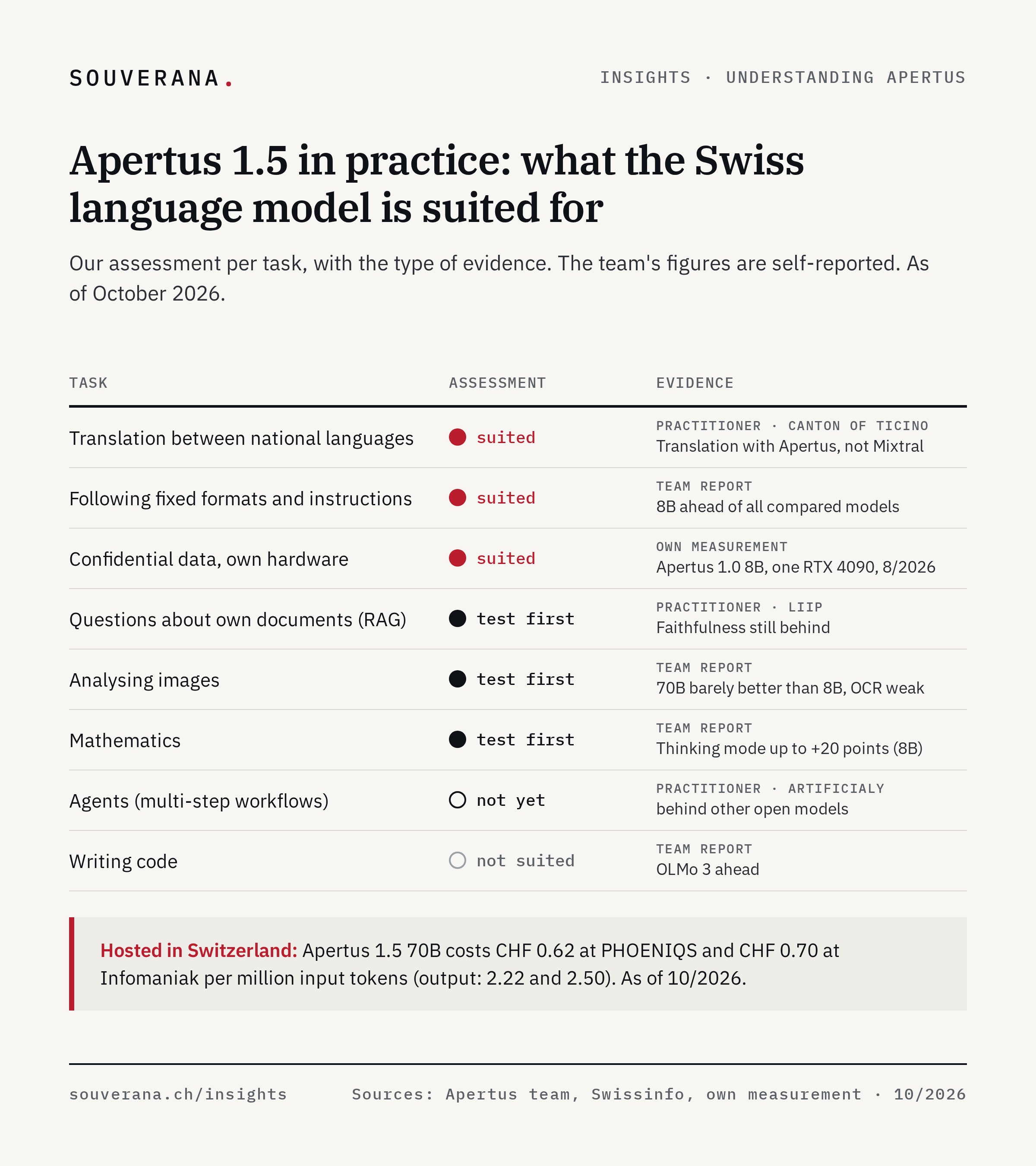
Apertus comes in two sizes: a small 8B model with 8 billion parameters and a large 70B model with 70 billion. The table shows what we would use Apertus 1.5 for today and what each assessment rests on.
| Task | Assessment | Evidence |
|---|---|---|
| Translation in the national languages | suited | Adopter: Artificialy |
| Keeping to fixed formats and requirements | suited | Apertus team’s report |
| Confidential data on your own hardware | possible, the 8B model runs on one graphics card | Own measurement, version 1.0 |
| Questions about your own documents | with your own test | Adopter: Liip, our measurement |
| Analysing images | with your own test, 8B suffices, scans with an OCR model | Apertus team’s report |
| Mathematics | with your own test, also in thinking mode, in which the model reasons first | Apertus team’s report |
| Agents | not yet | Adopter: Artificialy |
| Code | no | Apertus team’s report |
In the Apertus team’s report on version 1.5, the 8B model follows instructions better than all the models compared. In mathematics and code, OLMo 3 leads, a fully open model from the research institute Ai2. For images, the large model is hardly better than the small one. Apertus is weakest at text recognition in scans.[2]
The Ticino firm Artificialy uses Apertus for translation. In September 2026, the firm told Swissinfo: “We’re not doing charity. We don’t use Apertus because we have to, but because it’s a good model.” For agents, meaning workflows that the model completes on its own in several steps, the firm said Apertus is, despite considerable progress, not yet on the level of other open models.[1]
If the model talks directly to your customers, the public charter of Apertus matters: it sets out the values by which the model answers.[3]
Where Apertus runs and what it costs
On its list of September 2026, the Apertus team names seven Swiss providers.[4] Most of them offer the model through an API, a programming interface for your own application. Billing is by tokens, small pieces of text.
The prices apply to version 1.5, in Swiss francs per 1 million tokens.
| Provider | Offer | Input | Output |
|---|---|---|---|
| PHOENIQS (kvant) | 70B via API | 0.6195 | 2.2201[5] |
| Infomaniak | 70B via API | 0.70 | 2.50[6] |
| Swisscom | 70B on platform | – | – |
| Safe Swiss Cloud | 70B via API | – | – |
| stepping stone | 8B hosted | – | – |
| OnPrem.ai | 70B at the customer’s site | – | – |
| Exoscale | 8B, 70B self-operated | – | – |
As of October 2026, public price lists of PHOENIQS and Infomaniak. A dash means: we have not confirmed a price from a primary source. At Exoscale, you run the model yourself following a guide, so there is no token price.
The price does not reveal how heavily the model is compressed. Heavily compressed versions may answer less well. Ask the provider which version it runs.
On your own hardware, the 8B model of version 1.0 ran on a single graphics card in our measurement of August 2026, an RTX 4090 with 24 GB. Eight users asked questions about the same documents at the same time. With prefix caching, which processes the shared beginning of all requests only once, they waited 0.9 instead of 17.9 seconds for the start of the answer.[7] The whole series of measurements is in our comparison of server software.
What the same text costs in five languages
The team has not published how many tokens a text needs in each national language. We therefore counted ourselves, on a text with the same content in all the national languages: the Swiss Federal Constitution in the Fedlex version of 3 March 2024 and its English translation by the Federal Chancellery.[8] We counted the 231 articles available in all five languages on 14 October 2026 with six tokenizers, including those of Apertus, OpenAI’s gpt-oss and Llama 3.3.[9]
More tokens than for the English text, in per cent
- Apertus
- Qwen 3.5, Gemma 4, gpt-oss, DeepSeek V3.2, Llama 3.3
- German 1712 bis 44 %
- French 2121 bis 49 %
- Italian 2816 bis 47 %
- Romansh 6047 bis 72 %
| German | Apertus +17 %; Qwen 3.5 +12 %; gpt-oss +14 %; Gemma 4 +16 %; DeepSeek V3.2 +36 %; Llama 3.3 +44 % |
|---|---|
| French | Apertus +21 %; gpt-oss +22 %; Qwen 3.5 +24 %; Gemma 4 +25 %; DeepSeek V3.2 +44 %; Llama 3.3 +49 % |
| Italian | Apertus +28 %; Qwen 3.5 +16 %; Gemma 4 +23 %; gpt-oss +30 %; DeepSeek V3.2 +41 %; Llama 3.3 +47 % |
| Romansh | Apertus +60 %; gpt-oss +47 %; Qwen 3.5 +58 %; Gemma 4 +58 %; DeepSeek V3.2 +72 %; Llama 3.3 +72 % |
Romansh is the most expensive language with every tokenizer: the same content needs 47 to 72 per cent more tokens than in English, and 60 per cent more with Apertus. In German, the surcharge is between 12 and 44 per cent, and 17 per cent with Apertus.[9] At the same price per token, a German text costs 17 per cent more with Apertus than the same text in English. A budget calculated with English test texts comes out too low. Less text also fits into the context window with the Apertus tokenizer: about 15 per cent less German constitutional text fits than English.
Apertus is in the middle of the field. In absolute tokens, gpt-oss needs the fewest in German, French and Romansh, and Qwen 3.5 in Italian. The gap is mostly small: in German, Apertus needs 6 per cent more tokens than the most economical tokenizer. Llama 3.3 and DeepSeek V3.2 need more than Apertus in all four national languages. The measurement rests on a single text in legal language. E-mails or chats may give different ratios.
Each provider sets its own price per token. Depending on the model, the same task needs different numbers of tokens. How these factors interact is shown in our article on the cost per token. Count the tokens of your own texts before you calculate with the provider’s price.
How to proceed
- 01
Choose a task
Take a narrowly scoped task in several national languages where the origin of the training data matters, such as translating internal documents or answering questions from a manual.
- 02
Compare against a strong open model
Have Apertus and a strong open model solve the same ten test cases from your daily work, with your own documents and in your own languages. Rate the search and the answer separately and count the tokens per language. A template is in the PDF. Only then decide whether Apertus is good enough for your task.
- 03
Keep the model replaceable
Build the application so that the model can be swapped. Then you can later move to Apertus 2.0, which according to the team's roadmap is due in the first quarter of 2027, a date that may slip. A move to another model then needs no rebuild either.
Sources
Frequently asked questions
- What is Apertus suited for in business?
- Apertus 1.5 is suited for translation in the national languages and for tasks where it must be documented what the model was trained on. According to the Apertus team's report, the 8B model follows instructions better than all the models compared. Answers drawn from your own documents require your own test. For agents, code and mathematics, other open models lead.
- Where can Apertus be used as an API in Switzerland, and what does it cost?
- According to the Apertus team's list of September 2026, Swisscom, Infomaniak, PHOENIQS and Safe Swiss Cloud, among others, offer the 70B model in Switzerland. In October 2026, Infomaniak charged CHF 0.70 per million input tokens and CHF 2.50 per million output tokens for Apertus 1.5 70B, PHOENIQS CHF 0.6195 and CHF 2.2201. We found no public price for Swisscom.
- Is Apertus suited for agents and programming tasks?
- Not today. According to the Apertus 1.5 report, the open model OLMo 3 leads in mathematics and code. The Ticino firm Artificialy, which uses Apertus for translation, told Swissinfo in September 2026 that Apertus is not yet on the level of other open models for agentic tasks.
- Does Apertus need more tokens in German than in English?
- Yes. In a Souverana measurement on the Swiss Federal Constitution of October 2026, Apertus needed 17 per cent more tokens for the German text than for the English one, 21 per cent more for French and 28 per cent more for Italian. As a result, about 15 per cent less German text fits into the context window than English text. What a token costs is set by the provider.
- Can Apertus be run on your own hardware?
- Yes. In a Souverana measurement of August 2026, the 8B model of version 1.0 ran on a single graphics card, an RTX 4090 with the server software vLLM. With eight users and 8,000 tokens of shared context, prefix caching cut the users' wait for the start of the answer from 17.9 to 0.9 seconds.
- Who already uses Apertus?
- The canton of Ticino is moving its translation tool for administrative documents to a fine-tuned Apertus-8B in the cantonal data centre; in a first phase, about 100 employees are testing it. EPFL uses Apertus as the basis of its medical pipeline MeditronFO, and AI Singapore uses it in research. Before the launch of version 1.5, 15 organisations reviewed the weights, including the Federal Supreme Court and Swisscom.
Share this article
Ready-formatted graphics and a suggested post for your LinkedIn feed: download, copy, post.
Suggested post
Should Apertus answer questions about your own documents in your business?

The agency Liip tested Apertus in an AI search for the city of Zurich. The question about the population got a wrong answer, partly because the search had not found the most recent source. On faithfulness to the sources, Apertus 1.5 trails, according to Liip. That is the criterion Liip considers most important.

For translation in the national languages, the Ticino firm Artificialy often prefers Apertus to other models, especially for sensitive documents. For agents, in the same firm's judgement, it trails other open models, and for mathematics and code the Apertus team's report places it behind OLMo 3.

Our conclusion: if you use Apertus for questions about your own documents, rate the search and the answer separately.

The article covers the Swiss hosts with their prices, what a German text costs in tokens compared with an English one, our measurement of the 8B model on a single graphics card and a worksheet with ten test cases. Link in the comments.

#Apertus #AI #Switzerland #DataSovereignty #OpenSource